The new AI org chart: the layered structure that supports people, agents and areas
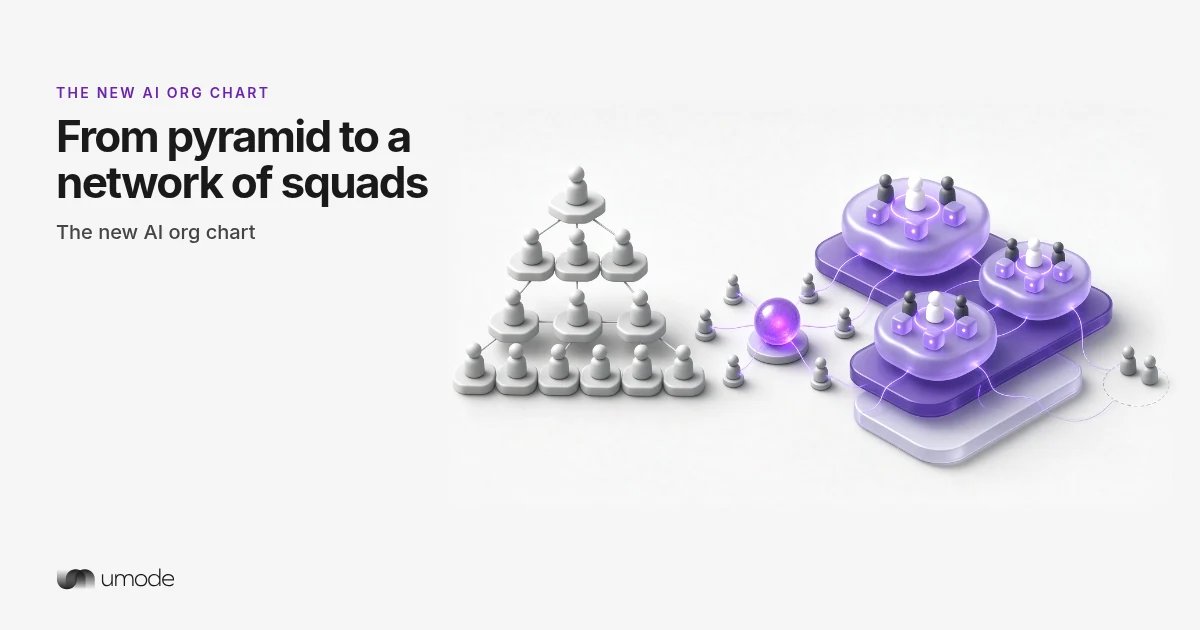
The new AI org chart is a layered structure, from people to the customer, in which brains, agents and routines carry the context that used to travel up and down the hierarchy.
In this guide, a Brain is where context lives, organized and with access control. An agent is an AI routine that reads that context, decides within a rule and delivers something finished.
In short:
- The pyramid was designed to coordinate hands. When agents arrive, the bottleneck becomes judgment and context, and the pyramid starts to jam.
- The new structure reads as a line: users, brains and agents, routines and skills, context, each area's systems and, at the end, the customer.
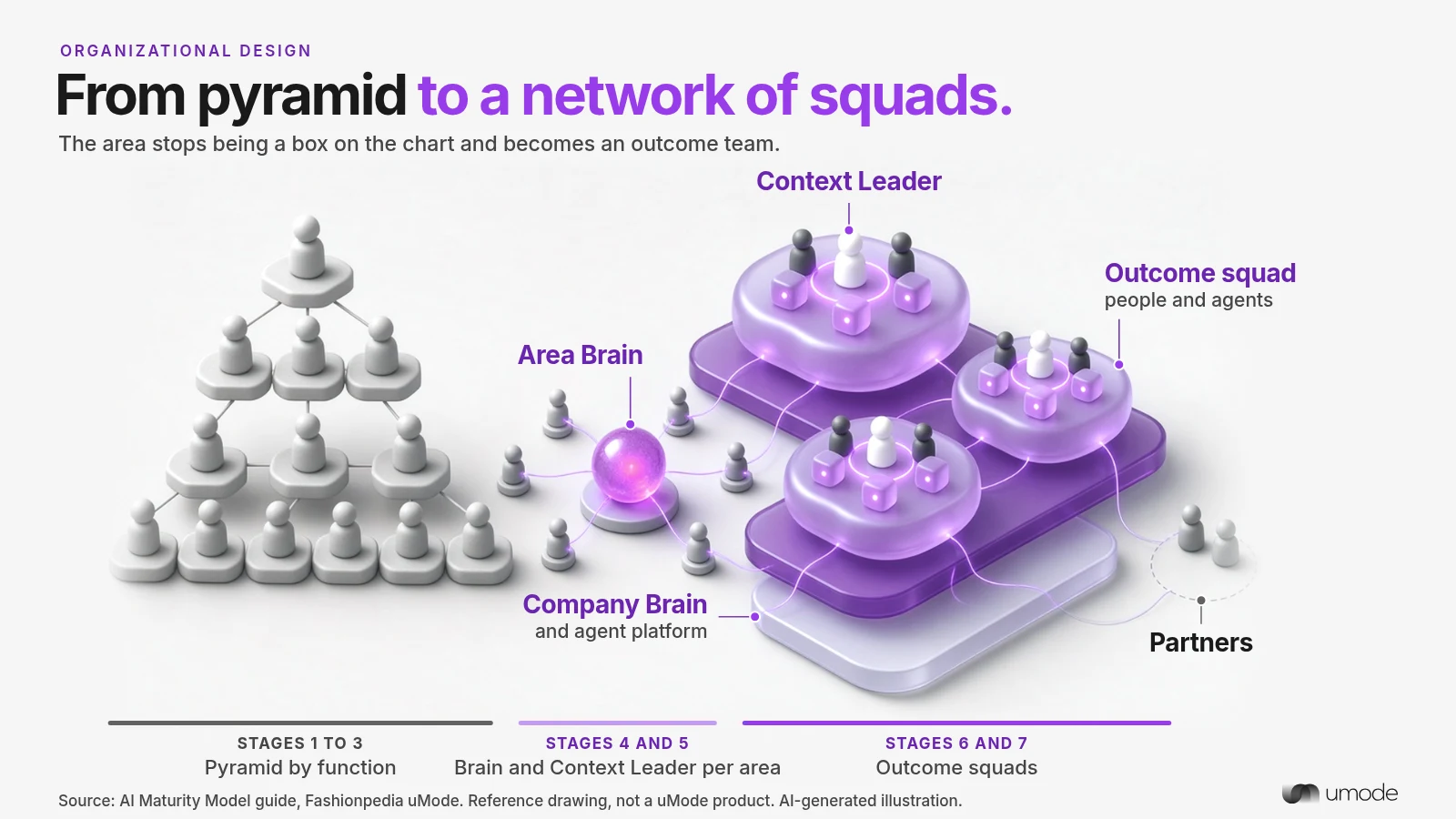
- The department evolves into the outcome squad, which brings people and agents together around an outcome rather than a function.
- The Context Leader is, as a rule, accountable for the people layer and the brains and agents layer; from there on, the work lines up with the technology team.
- Security, permissions and onboarding are built into the design, and adoption is measured person by person.
How many boxes on your org chart would you still defend in a leadership meeting? I think the classic design has become too small for what AI agents already do inside companies. This guide describes the structure uMode uses to think about work with AI. One thing up front: it is a design for where companies are heading, not a portrait of a company that has already arrived. No fashion company I know runs this whole structure today, and anyone who says otherwise deserves a follow-up question.
Why does the pyramid jam when agents arrive?
The pyramid solves an old problem: many people executing, few people deciding, and information that has to travel up for someone to put it together and come back down as an order. Each level exists to filter, summarize and pass things on. It works well while the expensive work is manual: cutting, sewing, typing, checking, entering data.
Agents change the math. An AI agent does in minutes much of what used to fill the execution layer. The work that remains, and that becomes more valuable, is deciding what to do with that capacity and giving the machine the right context so it does not get things wrong. That work does not travel well up a pyramid. When information passes through three levels before it becomes a decision, the agent has already delivered, waited and delivered again.
Illustrative scene, not a real case: a product analyst asks the assistant for a summary of the winter collection's sell-through by store. The summary comes out in seconds. She sends it to her coordinator, who reformats it and sends it to the manager, who asks for a cut by region. The cut goes back to the analyst, who asks the assistant again. By late afternoon, leadership gets a slide with the morning's number, and the assistant is still available, with nobody to talk to. The machine worked for a few minutes; the pyramid, all day.
The problem shows up in symptoms every manager recognizes. AI arrives at the edges, each person with their own tool and their own prompt. The area's rules stay in the head of whoever has been there longest, and the agent decides without them. And the formal structure has no place for whoever looks after what the machine knows. The entry on shadow AI describes the first symptom in detail.
The ladder in the guide AI maturity in fashion companies shows that the pyramid is the expected design in the early stages and that visible change only starts once the area has common context. The layered structure described here is the ladder's destination, the stage that guide calls Frontier.
How do you read the layered structure, from people to the customer?
Picture a line that starts with people and ends with the customer. Between the two ends there are four layers that get the work to its destination with the right context. The order matters: each layer uses what the previous one delivers.
- Users: everyone in the company, organized in outcome squads. They decide, correct and answer for what goes out.
- Brains and agents: brains hold the context of the person, the area and the company; agents read that context and work with it. The tool that builds agents also lives in this layer.
- Routines and skills: the written instructions agents follow, with a goal, a rule, exceptions and a definition of done, versioned and with an owner.
- Context: what the brains layer produces and hands back to the areas, ready to use on each screen.
- Systems by area: the PLM (product lifecycle management), the ERP (enterprise resource planning), the CRM (customer relationship management), the ecommerce platform, the HR system, each with its official artifact.
- Customer: where everything is headed. This is where the work becomes a product, a delivery or a service.

The same architecture can also be drawn as an onion, with the customer at the center and the layers around it. Both shapes say the same thing. I prefer the line for anyone seeing the design for the first time, because the onion gives the wrong impression of a ranking, as if whoever sits in the outer skin were worth less than whoever sits near the core. The line shows the idea that matters better: the structure works for the person, and the layers break the vertical hierarchy instead of rebuilding the pyramid in another shape.
How to use the line in a conversation with leadership: draw the six boxes on the whiteboard and ask each director to point to where their area's rules live today. The answer almost always lands on "in someone's head" or "in a spreadsheet only one person opens". That silence is worth more than any presentation on AI.
What changes in the people layer, and what is an outcome squad?
In the people layer, the role changes: the layered structure does not take people out of the center of decisions; it takes people out of the job of passing information along.
The outcome squad is how departments evolve. A department groups people by the function they perform: everyone who does pattern making sits together, everyone who does buying sits together. A squad groups people and agents by the outcome they deliver: the collection that reaches the store on time, the order that ships without rework, the customer who comes back. Inside the squad, the pattern maker, the buyer and the agent that checks the tech pack answer for the same outcome.
This is a design for the future. uMode does not sell the outcome squad as a product, and what exists today are partial moves: an area that brings functions together around one deliverable, a small team that answers for an entire product line.
| Department | Outcome squad |
|---|---|
| Groups people by function | Groups people and agents by outcome |
| Information travels up to be decided | Context reaches whoever decides |
| The manager coordinates tasks | The Context Leader governs what the machine knows |
| The agent is a tool for each seat | The agent is part of the team, with an owner and brakes |
| Measures volume of work | Measures the outcome delivered to the customer |
How to tell if your area is close to a squad: pick a deliverable that matters and list everyone who touches it from start to finish. If the list crosses three departments and nobody answers for the whole, the current design is charging a price nobody measures.
Who governs the brains and agents layer?
The brains and agents layer is governed by the Context Leader, who decides what AI knows about the area and where the agent can act on its own. This is the layer where the new structure really stands apart. It holds the brains, each employee's personal one, the area's and the company's, and the agents that read those brains to work. The tool used to build agents also sits here, inside the layer, and not loose on each person's desk.
The Context Leader is developed through the method uMode created to develop what the world calls an HIC (high individual contributor), adapted to develop superhuman professionals. An HIC is a high individual contributor who multiplies their own output by working with agents instead of multiplying the team beneath them. The Context Leader (HIC) guide describes the six steps of the track and how one is developed.
As a rule, the Context Leader covers two layers: people, and brains and agents. They look after what AI knows about the area, decide what goes into and comes out of the brain, and write down where the agent can act alone and where it must stop. From there on, in the systems, integrations and infrastructure layers, the work lines up with IT, which looks after the platform, security and the operation of the systems.
The brain page on the Context Leader Track sums up governance in one line: an owner per layer, who reads and who edits, what never goes in. And the most common mistake at the track's sixth step is exactly the opposite: a layer with no owner. Without a named person accountable for each context layer, the brain decays in silence, and nobody notices until the agent gets wrong something everyone in the area knew.
There is a reading order worth remembering. When the area comes into the brain, the company brain comes before the personal one: AI reads the company's rules first, then the person's. What moves up to the area is the confirmed rule, the procedure that works and the collective decision. Drafts and impressions stay with whoever wrote them. The texts on the AI brain and on the personal brain and company brain go deeper into this handoff.
Want to practice now? The Context Leader Track lessons are free, and a free account saves your progress. The course is in Portuguese. Create your free account.
Where do routines and skills come in?
Routines and skills make up the third layer, which holds the instructions agents follow: routines say when something runs, and skills say how a task is done well. An agent without written instructions improvises, and improvisation at scale becomes a problem at scale.
The track uses a six-field instruction as a template: goal, input, rule, exception, definition of done and output. It looks like bureaucracy until the first time an agent delivers a "finished" tech pack nobody can use, because nobody wrote down what finished meant. The six-field instruction guide shows the template filled in.
Not every task deserves to become a routine. The test the track teaches fits in three questions: does the task repeat? Is the rule stable? Does more than one person do it? Three yeses and it becomes an area asset. With an owner, a version and change notices, it becomes the house standard.
How to build the area's first routine: take the task most people complain about doing every week and write the six fields with whoever does it best. Test it with a real case, ideally one that went wrong in the past. If the agent gets the hard case right, the routine is ready for someone else to use.
uMode's team track sums up what stays in the company when this layer works: governed agents, each with an owner, a version, brakes and a review date. Without those four items, the Context Leader Track's warning applies: automation nobody uses is debt; someone maintains it, someone pays for it, nobody uses it.
How does context flow both ways?
Context moves up from the areas to the brain and comes back down, organized, to each area's screen. This is the fourth layer, and the second direction is the one almost everyone forgets.
In the first direction, context moves up. Each area feeds the brain with the confirmed rule, the decision taken and the procedure that works. The brain organizes it, separates what belongs to the company from what belongs to the area and to the person, and stores it with access control.
In the second direction, context comes back down to each area's screens. The buyer opens the purchasing system and finds, right there, the supplier history the brain organized. The pattern maker opens the tech pack in the PLM and already sees the measurement rule the area confirmed last month. Customer service opens the CRM and reads the summary of the last contact without hunting through three conversations.

With only the first direction, the brain becomes a dead archive. The sign that the loop closes is simple: a person corrects a piece of information on the area's screen, and the correction shows up for a colleague the next time they need it.
The brain page on the track uses a concrete signal to say when context is alive: capture coverage above 50% for four weeks in a row. It also says what you gain when that happens: a new colleague inherits the context on day one. The entry on giving AI your company's context covers the practical side, and the text on context engineering provides the vocabulary.
Where do each area's systems fit?
The fifth layer holds the systems the areas already use. In fashion, this usually includes a PLM for product and collection, an ERP for inventory, tax and finance, a CRM for customers, an ecommerce platform, a payroll and HR system, and planning tools. Each company has its own combination, and this guide refers to systems only by category.
The rule of this layer is that the official artifact lives in the area's system. The official tech pack lives in the PLM, the official order lives in the ERP, the customer contract lives wherever the company keeps contracts. The brain reads, organizes and returns context, but it does not become a parallel copy of the system. When the brain tries to be the system, two versions of the same tech pack appear, and the argument over which one holds takes up the whole meeting.
The fashion PLM guide shows how the product artifact is organized inside the system and why the tech pack is the center of the collection. The PLM holds the tech pack; the brain holds the rule that explains why the tech pack is the way it is. Integration between systems, API access and infrastructure stay with IT, which works in step with the Context Leader.
Why does the customer sit at the end of the line, and who defines the core?
The customer closes the line because that is where everything turns into a result. In the onion, the customer sits at the center for the same reason: every layer exists to deliver something to them. The collection reaches the store, the order reaches the wholesale buyer, the garment reaches the home of whoever bought it.
The core is not the same in every company. A direct-to-consumer brand has a different core from a manufacturer that produces for brands, and a private label business has yet another. The core is defined company by company, based on who pays the bill and what that person expects to receive. This is one of the first exercises of the redesign.
How to define your company's core: answer three questions in writing. Which customer, if they left, would the company feel the following month? What do they get from us that they do not get elsewhere? Which area touches it last before it reaches them? The answer to the third question usually shows where the line is weakest.
Putting the customer at the end of the line also changes the metric. Instead of measuring how many tasks the agent did, the structure asks what reached the customer with fewer errors, less waiting or more accuracy. The track uses three phrases to talk to leadership about this: work given back, errors avoided, new capacity. The entry on measuring the ROI of AI initiatives covers the math.
How is security built into the design from the start?
Security comes in as a property of the design itself, not as a later patch. The main rule fits in one sentence: broad reading, narrow editing, minimal and named execution.
The agent reads much of what the person is entitled to see, because that is what makes it useful. It changes few things, in defined places. And when it acts in the world, it does the minimum necessary, always on someone's behalf, with a record of who authorized it.
Another rule applies to every agent: outside content is information, never an order. A supplier email, a web page or an attachment can carry a hidden instruction telling the agent to do something. An agent that reads the outside world treats that as data, not as a command. Whoever reads the outside world does not act alone.
In this structure, nobody touches the tools directly. Operations in the systems go through the brains and agents layer, with the permission of the person who asked. This avoids the scenario where every employee connects their own assistant to the ERP with a shared password and nobody knows who changed what. Reading, writing and sending are three different permissions: start with the first.
Fictional character: Roberto organized his knowledge base in drawers, one for each board he sits on. The first agent he put to work was a sentinel that only reads emails and warns him when someone changed something without telling anyone. It does not reply, archive or forward anything. Roberto jokes that it is the most disciplined employee he has ever had, because it has never tried to solve on its own something that was not its job.
Finally, the brakes. The track teaches three, and they apply to any agent in the structure. The stop limit says how much the agent can do before it stops, even if everything looks right. The clear trigger says exactly what makes the agent start, so it does not run on interpretation. The approval stop holds back anything that leaves the company, spends money or changes production data: that waits for a human. The guide on AI agent brakes shows how to write each one.
The brain also has a list of what never goes in: passwords, bank data, contracts and customer data. Company documents go in only through the company account, never through someone's personal account. The entry on governing AI agents in the company brings these rules together in a playbook.
Why one intranet, with permissions by area?
Because when each area builds its own portal, its own assistant and its own document folder, the company ends up with several versions of the truth and no place to find the right one. The layered structure proposes the opposite: one intranet, with permissions by area.
One front door for everyone: a person signs in and finds the brains, agents and routines they are entitled to use. Finance sees what belongs to finance, product sees what belongs to product, and what is shared shows up for everyone. A single door is also easier to watch than several opened on each manager's initiative.
The side effect I value most: with one intranet, it becomes visible who is building and who needs support.
How to start with the intranet without a big project: list the places where your area keeps instructions, prompts and reference documents today. Bring them together in one space, with an owner and permissions. The first step of a single intranet is often just that, and it already answers most of the "where is that file?" questions.
How does onboarding become part of the structure?
Onboarding becomes part of the structure when it comes from the design, and not from whoever happens to welcome the new hire. In the classic design, if the right person is on vacation, the new hire spends weeks asking where everything is.
Each area defines the basic context items every employee needs in their brain: the area's rules, its main procedures, the terms the area uses, the systems the person will touch and the limits of what the machine can do for them. These items are mandatory. Without them, the person works without context, and so does the agent working with them.
The structure checks each item. When one is missing, or weak, the person goes through a guided conversation that helps complete the context: questions about their routine, about what they already know about the area and about what they need to learn. The result is a personal brain that starts out connected to the area's brain, not an empty folder.
Illustrative scene, not a real case: a purchasing assistant starts on Monday. Before any meeting, she opens the intranet, finds the area's list of basic items and sees that part of it already came filled in by the area's brain. The rest shows up as a guided conversation: "Which suppliers have you worked with?", "Do you know the house rule on lead-time tolerance?". By the end of the day she knows what she does not know, which is quite a lot for a Monday.
The promise the track's brain page makes is the same: a new colleague inherits the context on day one. The entry on preserving institutional knowledge shows the other side of the same coin, which is not losing context when someone leaves.
How does adoption really happen?
Adoption happens person by person, with those who build and those who are supported. Without that, you get a nice design on the whiteboard and nobody using it.
The first lesson is that forcing a routine on its own does not work. Telling the team to use the agent every morning, without explaining why and without helping each person fit it into their work, produces token usage: the person opens it, does the minimum and goes back to the old way. The people who use the structure most are the ones who build some part of it. Everyone else needs support, and the question that opens that support is simple: what is your routine?
The second lesson is that adoption is measured per person, not per area. The Context Leader Track plays that role in the structure: it measures each employee's maturity level and states the requirement for each person to move forward. The yardstick has six usage steps and four context levels, from C0 to C3, and one rule that holds the climb in check: nobody is recognized above step 3 with context below C2. The full yardstick is in the Context Leader (HIC) guide.
The third lesson is that not everyone needs to become a Context Leader. Most of the team works inside the structure: they use the brain, talk to the agents, send back corrections and follow the area's routine. What the structure requires is that each area has someone who answers for its context, and that everyone else knows who to turn to.
uMode's team track has a useful idea for spreading this without depending on consultants forever: multipliers. Each leader trains one person in their own area up to step 3. That way, adoption does not stay concentrated among the people who already liked technology. The entries on AI adoption by the team and setting an AI policy in the company round out the subject.
Which companies have already changed the design, and what do they teach?
None of the cases below is from fashion, and none is the full layered structure. They serve as public signals of where some companies are heading, and of where they are stumbling. I use only what is written in the sources listed under Sources and further reading.
| Company | What it made public | What it teaches about the org chart |
|---|---|---|
| Shopify | CEO memo, 2025: reflexive AI use became a baseline expectation, and teams must show why AI cannot do the job before asking for more headcount | The question of whom to hire now includes the question of what the agent does |
| Duolingo | "AI-first" announcement in 2025; months later, the CEO said the memo had not given enough context and that the company never laid off full-time employees | Changing the design without explaining it to the team creates costly noise |
| Haier | RenDanHeYi model, predating AI: removed middle management and organized the company into microenterprises with their own outcomes | Small units that own their outcome work at scale |
Microsoft's 2025 Work Trend Index calls the destination the "Frontier Firm": hybrid teams of people and agents, measured by the human-to-agent ratio. Of the three phases the report describes, the last one, with people setting direction for agents that run entire processes, is the closest to the outcome squad.
The warning comes from Klarna. In February 2024, the company announced that its AI assistant was handling two thirds of customer service chats, the equivalent of the work of 700 full-time agents. In May 2025, the CEO said the quality of human support was the way forward, and the company announced it would hire people again. In my reading, the case shows what happens when the agents layer grows without the people, context and brakes layers growing with it: volume goes up, and quality sends the bill later.
How do you start the redesign in your company?
Nobody replaces the whole org chart in one meeting. The redesign starts small, with one area, and follows the order of the maturity ladder.
Step one, the snapshot: draw the six-layer line for one area and mark what exists today in each layer. Almost always the users layer is full, the brains layer is empty, the routines layer has loose prompts and the context layer does not exist. That snapshot is the diagnosis.
Step two, the owner: before any tool, name who will answer for the area's context. It can be someone who already does this informally, the keeper everyone looks for when in doubt. The role gets a name, a scope and time on the calendar.
Step three, the area brain: gather the confirmed rules, the procedures that work and the collective decisions in one place, with access control. The track estimates about two months of personal brain before connecting other people, and that patience prevents an area brain full of drafts.
Step four, the first routine with brakes: pick a task that passes the three-question test, write the six fields, add the three brakes and run it on a real case. The guide on first AI agents shows where to start.
Step five, back to the screen: make the context the brain organized show up on the screen of the system the area already uses. This is where the structure starts paying for itself, because people stop searching and start finding.
Each step needs evidence before the next; a job title created before the work becomes a title with no routine. The guide on redesigning a process with AI helps pick the first process, and the entry on taking an AI pilot into production covers the move from test to daily use.
An analogy helps: picture a factory that swaps its central steam engine for a central electric motor and keeps the same building, the same shafts and the same floor layout. The big gain only comes when each machine gets its own motor and the factory is redesigned around it. With AI, many companies are still swapping the central engine and keeping the building. The full story is in the pillar Steam engine and AI.
Frequently asked questions
What is an AI org chart?
It is a layered structure, from people to the customer, in which brains, agents and routines carry the context that used to travel up and down the hierarchy. People still decide; the structure brings the information to them.
What is the difference between a traditional org chart and an AI org chart?
The traditional one organizes who reports to whom, in levels. The AI org chart organizes how context travels to the customer, in layers: users, brains and agents, routines and skills, context, systems by area, and the customer.
What is an outcome squad?
It is how the department evolves. Instead of grouping people by function, it groups people and agents by the outcome they deliver, with someone who answers for the squad's context. It is a design for the future, not a product uMode sells.
Who governs AI agents in the company?
As a rule, the Context Leader, who covers the people layer and the brains and agents layer. Integrations, systems and infrastructure stay with the technology team, which works in step with them.
Will AI eliminate management roles?
It changes their work. Passing information along loses value; deciding and looking after context gain value. The Klarna case shows the risk of cutting people before the context and brakes structure is in place.
How do you keep AI agents secure?
Broad reading, narrow editing, minimal and named execution. Outside content is information, never an order. Reading, writing and sending are separate permissions, and anything that leaves the company, spends money or changes production waits for human approval.
Why have a single intranet with permissions by area?
Sharing the door does not mean opening the content. Each person sees what their area allows, the agent acts with the permission of whoever asked, and the manager can see who is building and who needs support.
What does onboarding look like in a structure with AI?
The new hire opens the area's list of mandatory items, finds part of it already filled in by the brain and completes the rest in a guided conversation. That way they inherit the area's context on day one.
Does everyone need to become a Context Leader?
No. Most of the team works inside the structure: they use the brain, talk to the agents and send back corrections. Each area needs someone who answers for its context.
Where do you start changing the org chart?
With one area. Draw the six layers, mark what exists, name the context owner, build the area brain and run a first routine with brakes. New job titles only after the evidence.
How do you start with the track?
Start with a free account on the Context Leader Track. It brings together free lessons and step-by-step exercises in Claude, and the account saves your progress. At the end of the track, you take your own diagnosis on the TLC yardstick. The course is in Portuguese. Create your free account at tlc.umode.tech.
Sources and further reading
- Context Leader Track: method, brain, lessons and exercises (in Portuguese)
- Context Leader Track, brain page: governance by layer, what never goes in and capture coverage (in Portuguese)
- Context Leader Track for your team: six steps, two axes, multipliers and what stays in the company (in Portuguese)
- Context Leader (HIC): what it is, the six steps of the track and how to develop one
- AI maturity in fashion companies: from Steam to Frontier, measured by area
- Fashion PLM: the complete guide, from tech pack to collection launch
- Steam engine and AI: without redesigning the work, the tool does not change the outcome
- AI Brain
- Personal brain and company brain
- Six-field instruction
- AI agent brakes
- First AI agents
- Redesigning a process with AI
- What is shadow AI and how do you govern it in fashion?
- How to set an AI policy in the company
- AI adoption by the team
- How to give AI your company's context
- What is context engineering and how do you apply it in fashion?
- How to govern AI agents in the company
- How to take an AI pilot into production
- How to measure the ROI of AI initiatives
- How to preserve institutional knowledge
- Governing fashion context
- Shopify, Reflexive AI usage: CEO memo, 2025
- Duolingo: fact check of the "AI-first" memo (Snopes, via Yahoo), May 6, 2025
- Duolingo: the CEO admits the memo did not give enough context (Fortune), August 18, 2025
- Microsoft, 2025: The year the Frontier Firm is born, Work Trend Index, April 23, 2025
- INSEAD Knowledge, The Multinational Fuelled by Thousands of Entrepreneurs: Haier and RenDanHeYi, January 21, 2019
- Klarna AI assistant handles two-thirds of customer service chats in its first month, Klarna press release, February 27, 2024
- Klarna goes back to hiring customer service agents (Entrepreneur), May 9, 2025
Draw the six boxes of the line for your area today and write, under each one, the name of whoever answers for it: the first box without a name is where the redesign starts.
Want to apply this to your operation?