Personal Brain and company Brain: what goes up and what stays
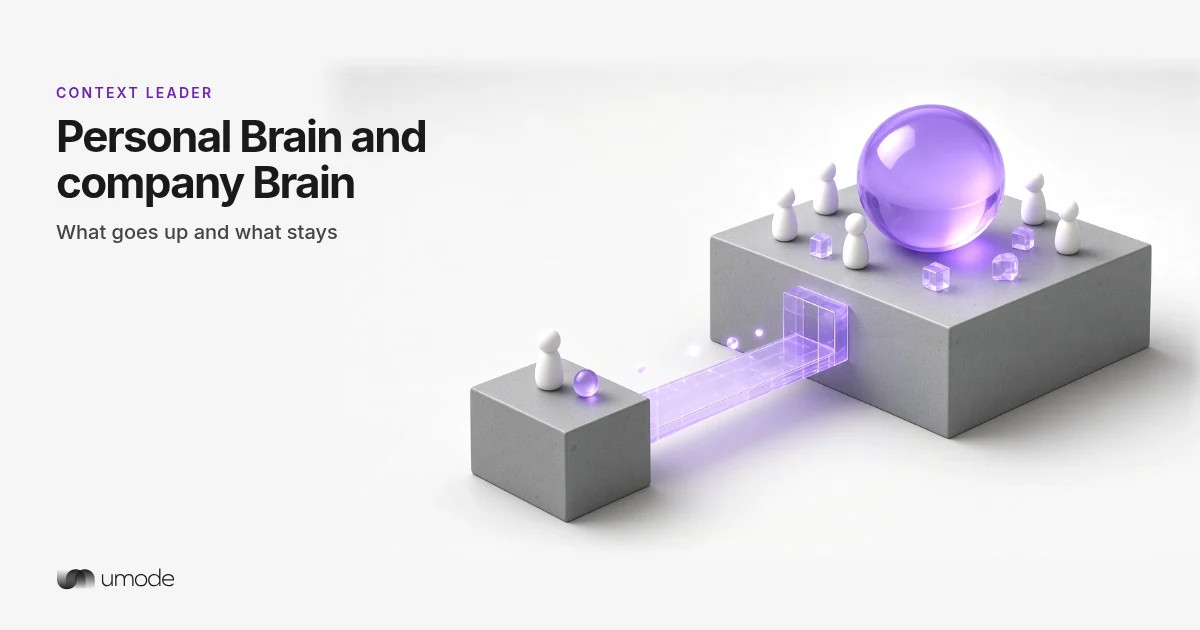
A personal Brain is your own context folder; a company Brain is the area's folder. The AI reads the company one first, then yours, and combines the two.
In short:
- The Brain starts personal. The track estimates about two months there before connecting other people.
- When reading, the company Brain comes before yours. The house rules apply first.
- What goes up is the confirmed rule, the procedure that works and the collective decision. Drafts and impressions stay with you.
- A company document goes in only through the company account, and access is tested before opening the Brain to the team.
I think the move from personal to company is the point where the Brain stops being individual productivity and becomes an asset. While the context lives only in your folder, it leaves with you the day you change area. When the right part goes up, it stays.
This text is part of the guide Context Leader: what it is, the six steps of the track and how to develop one.
That move is part of the Context Leader (HIC), the method uMode created to develop what the world calls an HIC, adapted to develop superhuman professionals.
Why start with the personal Brain?
Because it is where mistakes are cheap. Before touching other people's context, you learn to give the AI feedback, discover which rule was missing and tighten your own governance.
The track speaks of about two months in the personal Brain before connecting other people, as an estimate given in the lesson. The number serves as a reference, and the proof that you are ready comes from the yardstick: the guide on context levels shows what has to be standing at C2 and C3.
The common mistake is opening the Brain to the area before it works for you. Each structural flaw starts repeating in every folder, and whoever arrives later inherits the mess along with the context. If you have not built your folder yet, the guide what a Brain is and how to build yours brings the minimal structure.
In what order does the AI read the two Brains?
The company's first, then yours. The track lesson describes it this way: personal Brains use the company Brain and combine the context of the two.
In practice, the AI starts with the house rules, such as exchange policy, collection calendar and sample approval criteria. Then it reads what is only yours: your way of writing, your projects, your people. The answer comes out of the two layers together.
When your note contradicts the company's, I treat the contradiction as a signal. Either the house rule changed in practice and has not been written yet, and then it is worth proposing the change upward; or your note aged, and then it goes to the archive. Letting both coexist produces a different answer for different people.
What goes up to the company Brain and what stays with you?
Three types of content go up: confirmed rules, procedures that work and collective decisions. Drafts and impressions stay with you.
| Goes up to the area | Stays personal |
|---|---|
| Confirmed rule: the current exchange policy, with the exception written right below | Draft: the policy proposal still under discussion |
| Procedure that works: the step-by-step of reviewing a tech pack | Impression: your reading of a supplier after a meeting |
| Collective decision: what the area decided, who decided and from when it applies | Your writing style and the corrections that only apply to you |
To separate them, I use one question: does this hold for someone who was not in the conversation? If it does, it goes up. If it depends on who wrote it or may still change tomorrow, it stays.
Want to practice now? The Context Leader Track lessons are free, and a free account saves your progress. The course is in Portuguese. Create your free account.
Why is copying the note into the area Brain not enough?
Because the copy does not follow the source. The track shows this in an exercise: the file enters the project as a copy, and when the source changes, the copy stays old. A rule that changes every week lives at the source.
The same holds between Brains. If the exchange policy is in the company folder, your Brain points to it with a link, and does not keep a second version. Two versions of the same rule in different places is the recipe for an old note that lies.
Which account should you use for each document?
A company document goes in only through the company account. The personal account stays for personal use. To train with the track's demo base, which is synthetic, any account will do.
Before opening the area Brain to the team, run the permission test: the same question, asked with an account that has no access to a document, cannot bring back its content. The track is clear about the limit of the tool: AI does not fix your access architecture. If the folder is open to whoever should not see it, the AI will answer whoever should not. Only after the test passes does the agent enter the team channel.
In João Risoléo's Mentoring Session, Vera's plan starts with that separation. Vera and Roberto are fictional characters, created to portray real mentees of João Risoléo's Mentoring Session. The mentees' identities do not appear, to protect them. In her plan, still in progress, what belongs to the company goes in one place, and only there. The plan's second rule protects the Brain from excess: nothing new comes in without closing or cutting something.
The general usage policy is better written by the company than decided person by person. The entry how to define an AI guideline in the company helps write that rule.
When does the personal Brain become the area Brain?
At step 5 of the track, when you start writing other people's method. One of the techniques of that step is exactly this move: the Brain goes up from personal to the area, and that is how the context stops leaving with whoever leaves the company.
I suggest an order for the move:
- Define the owner of the area layer and who edits.
- Move up the collective decisions first, which are the easiest to confirm.
- Then move up the procedures, one at a time, with whoever executes them checking.
- Last, move up the rules, each with the exception written right below.
- In your Brain, swap the content that went up for a link to the area note.
The problem this solves has a name in fashion: the brand whose memory lives in one person. The text your brand's memory lives in one person and the entry on dependence on key people cover the cost of not making the move.
How the track trains this: the Context Leader track puts the personal Brain in the context steps and the move to the area at step 5. In the exercises, the permission test with an account without access comes before the area agent enters the team channel.
Frequently asked questions
How long should you use the personal Brain before connecting the area?
The track estimates about two months, as a reference given in the lesson. It is the time to make cheap mistakes, learn to give the AI feedback and tighten the governance before involving other people.
Does the company Brain replace the personal one?
No. The AI reads the company's first and then yours, and combines the two. The house rules stay with the area; your style, your drafts and your projects stay with you.
What happens if my note contradicts the company's?
The answer becomes unstable. Either the house rule changed and needs to go up written, or your note aged and goes to the archive. Two versions of the same rule should not coexist.
Can I use my personal account for company documents?
No. A company document goes in only through the company account. The personal account stays for personal use, and the track's synthetic base can be used on any account.
How do you start with the track?
Start with the free account on the Context Leader Track. It brings together free lessons and step-by-step exercises in Claude, and the account saves your progress. At the end of the track, you take your own diagnosis on the TLC yardstick. The course is in Portuguese. Create your free account at tlc.umode.tech.
Want to apply this to your operation?