Context levels: from C0 to C3, with the proof of each
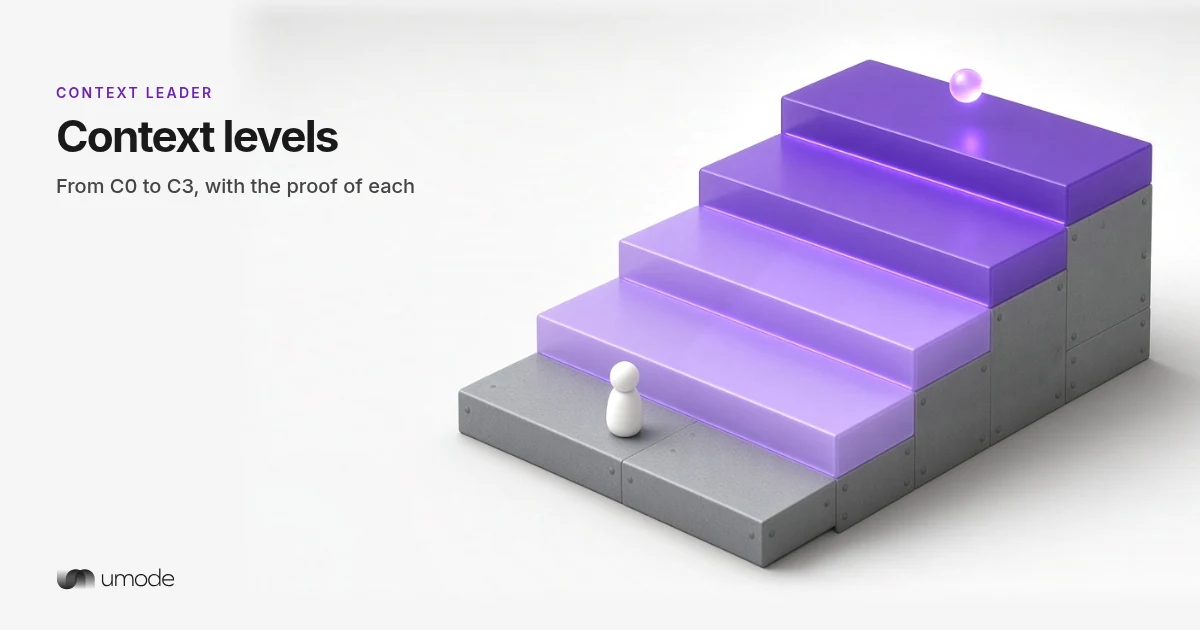
Context level measures how much the AI already knows about your work without you explaining again: from C0, nothing stored, to C3, a one-line request that comes out ready.
In short:
- C0 is pasting the same documents and repeating the house rule. C1 is one week of work: a profile, two texts of yours and the five documents of the area.
- C2 is ritual: the meeting becomes a decision note, the correction becomes a note and capture coverage is measured every week.
- C3 is proven with a week of one-line requests, half or more ready, and with the maintenance pass checked by you.
- Governed context has an owner per layer, a rule on who reads and who edits, and a list of what never goes in.
I see people evaluate their own AI by the tool and forget to evaluate what the tool knows. Two people with the same subscription reach opposite results because of the context stored. I prefer a yardstick with proof to an impression that the AI is getting better.
This text is part of the guide Context Leader: what it is, the six steps of the track and how to develop one.
That yardstick is one of the axes of the Context Leader (HIC), the method uMode created to develop what the world calls an HIC, adapted to develop superhuman professionals.
Why measure context in levels?
Because, without a yardstick, nobody knows whether the context improved or only seems to have improved. The level says how much the AI already knows about your area before the first question.
The general concept of giving the machine the right information is in the entry on context engineering.
| Level | Day-to-day symptom | What is missing to move up |
|---|---|---|
| C0 | You paste the same three documents and repeat the house rule | A fixed place where context lives |
| C1 | The AI knows you and the area, but forgets what changed during the week | The ritual of capturing decisions and corrections |
| C2 | Capture runs, and short requests start coming out right | Proof that "ready" became the rule |
| C3 | A one-line request comes out ready most of the week | An owner per layer and an access rule |
What do you seed first at C1?
You seed with what you open every week, and leave what seems noble for later.
The common mistake is starting with the corporate manual or the brand story. What unlocks the day's request is the working file: the standard tech pack, the collection calendar, the exchange policy, the color glossary, the list of active suppliers.
The C1 proof has three parts:
- Half-page profile: who you are, what you decide, who you work with.
- Two texts of yours: they serve as a style sample, so the AI writes the way you write.
- The five documents of the area: the ones you open most, already in the format the machine reads well.
For the profile, the track proposes a seed document with six sections: role and scope, what data I work with, who depends on me, house vocabulary, rules that exist only here and how I want the AI to speak.
Writing for the machine to read takes three cares. The rule comes with a number, and the exception comes right below it. There are never two versions of the same policy in the same place. And an old note lies: a rule that changed and stayed stored will produce a wrong answer with total confidence.
Want to practice now? The Context Leader Track lessons are free, and a free account saves your progress. The course is in Portuguese. Create your free account.
How does a meeting become a decision note?
You record what was decided, who decided, from when it applies and what changes, and leave the rest out. The track is direct: the meeting becomes a decision note, never minutes.
Illustrative scene: at Monday's meeting, the area decides that a pilot sample without a checked measurement does not go on to sample approval. The note keeps the rule, the exception (replenishment of an already approved model), who decided and the date. When someone asks whether the pilot can go, the answer comes from the note.
The correction follows the same path. When you fix an AI output, the fix is a rule that was not yet written down. If it dies in the conversation, you will fix the same thing the following week.
Capture has to fit in thirty seconds, or it does not happen. The track prefers thirty good notes to three hundred lukewarm ones: an overloaded Brain brings back the similar instead of the right.
Capture coverage is the count that keeps the ritual honest. Of the week's decisions and corrections, how many became notes? Done every Friday, that count opens the C2 proof.
How do you prove C2 and C3?
Each level has a proof you can check.
| Level | Proof |
|---|---|
| C2 | Capture coverage above 50% for four weeks; five style corrections recorded; one one-line request that comes out right |
| C3 | A week of one-line requests with half or more ready; the maintenance pass reviewed by you |
For a week, note each short request and mark whether it came out ready or asked for adjustment. The track sums up what to do with the adjustment: each adjustment that still remains is a note that is missing.
The maintenance pass is the request for the Brain to evaluate itself. It lists outdated notes, notes that contradict each other, notes with no links and stalled projects. It proposes what to do and never deletes. You review and decide.
One test fails any level: asking something that is not stored. If the AI makes it up, the context is not reliable. A good Brain knows how to say it does not know.
How the track trains this: the Brain exercises lead from the loose document to the linked note (C1), test the memory in a new conversation and with a question that has no stored answer, and end with the Brain evaluating itself.
Who owns each layer?
Each layer of context has a responsible name, and that name decides who reads, who edits and what never goes in.
| Layer | Who owns it | Who reads | Who edits |
|---|---|---|---|
| Personal | You | You | You |
| Area | The area leader | Whoever works in the area | The owner and whoever they designate |
| Company | Whoever leadership names | Everyone with permission | Only the layer owner |
The common mistake at step 6 of the track is the layer without an owner: rules change in practice and stay old in the note. When that happens, the decision architecture starts citing rules that no longer hold.
The list of what never goes in holds for all layers: passwords, bank data, contracts and customer data. The Context Leader track treats this list as a prerequisite, before any file goes up. The entry on context and information governance goes deeper into the access rule, and the guide personal Brain and company Brain shows what goes up from your layer to the area's.
The folder where these levels happen is in the guide what a Brain is and how to build yours.
Frequently asked questions
What is context for AI in a company?
It is the set of rules, decisions, documents and house vocabulary the AI consults before answering. Without it, each conversation starts from zero and the answer comes out generic.
How long does it take to reach C1?
The track speaks of one week of work: a half-page profile, two texts of yours as style samples and the five documents the area opens most, stored in a fixed place.
Why does the meeting become a decision note and not minutes?
Because minutes keep the conversation and the note keeps the rule. The AI needs to know what was decided, who decided and from when it applies. The rest takes up space and confuses the search.
How do I know I reached C3?
Note a week of one-line requests. If half or more came out ready and you reviewed the Brain's maintenance pass, C3 is proven. Each adjustment left over points to a missing note.
How do you start with the track?
Start with the free account on the Context Leader Track. It brings together free lessons and step-by-step exercises in Claude, and the account saves your progress. At the end of the track, you take your own diagnosis on the TLC yardstick. The course is in Portuguese. Create your free account at tlc.umode.tech.
Want to apply this to your operation?