AI maturity model for fashion companies: from Steam to Frontier, measured by area
AI maturity is how far a business area has redesigned its own work around AI and around the context AI reads, measured by signals you can observe.
In short:
- What it is: a seven-stage ladder, from Steam to Frontier, that describes how a company uses AI and where it keeps the context AI reads.
- How to measure it: area by area. The company sits at the stage most of its areas are in, and a few initiatives can sit above it.
- What separates one stage from the next: an observable signal, such as licenses with usage measured per person, apps reading from a common source, or decisions logged in the Brain on the same day.
- Where people come in: the Context Leader Track (course in Portuguese) measures each employee on six steps and four context levels. An area does not move up unless its people move up.
- What changes in the organization: stage by stage, the org chart built by function gives way to the outcome squad, which is how departments evolve.
- What does not change: the fashion company's problem. Revenue, margin and inventory turnover are still the numbers that matter.
I write this guide because the question I hear most from fashion brand owners and directors is "where are we with AI?", and the answer almost always comes as a count of licenses bought. Licenses measure purchasing. In my reading, maturity shows up when a task starts being done a different way, with the rule written in a place the machine can read and that survives when the person who wrote it leaves. The ladder in this guide is the yardstick uMode uses to look inside a company, area by area. It is a picture of the market: it describes where companies are, and each stage has its own pains and gains. Where software comes in, it appears in short boxes, as the "how" of each idea.
Why measure AI maturity, and why measure it by area?
Because without a measure the AI conversation turns into opinion, and leadership opinion tends to confuse enthusiasm with results. A measure gives everyone a common language, and leadership can see where people's time is worth investing.
Measuring by area fixes a common mistake: treating the company as one block. In the same brand, marketing can be producing campaigns with agents that know the house tone while bank reconciliation is still done by hand, line by line, at month end. A single score for the whole company hides both.
Measuring by area also shows who is pulling ahead: the one or two people who got there first show up by name and task, and the company can give them the right role.
The rule I use is simple. Maturity is measured by department, and the company's stage comes from how its areas add up: it sits at the stage of the majority, with initiatives that may be higher. A company at stage 3 with a stage 5 pilot in marketing is still at stage 3. The pilot shows the way; it does not change the math yet.
How to start measuring without setting up a project: list the company's areas in a spreadsheet, one per row. For each one, write down the task that eats the most hours per week. That is the task you will read the stage from, not the whole area at once.
What does an engine have to do with AI?
A lot, and the image helps explain why buying AI almost never changes results on its own. Picture a factory driven by one central engine, connected to every machine by shafts and belts. When a new, better motor comes along, the first thing almost every factory does is swap the central engine and keep the shafts and belts. The floor plan stays the same. The gain is small, because the design of the work is still tied to the old engine.
The big gain comes when each machine gets its own motor and the plant is redesigned around the work, not around the belt. With AI, most companies are in the first phase: they swapped the engine and kept the belts. They bought licenses, taught people to write prompts and left their processes exactly as they were.
The ladder in this guide follows that image: the first stages swap the engine, the middle stages create a common source of context and the last stages redesign the plant. The full story of that shift, with the electrification of factories, is in the pillar on the steam engine in this Fashionpedia.
What are the seven stages of AI maturity?
There are seven: Steam, Swapped Engine, App Shortcut, Seeded Brain, Connected Brain, One Motor per Machine and Frontier. Each one has an observable signal, which is how you know, without argument, whether an area is there. To keep the comparison concrete, every stage uses the same task: the finance team's bank reconciliation, which runs through the whole ladder.
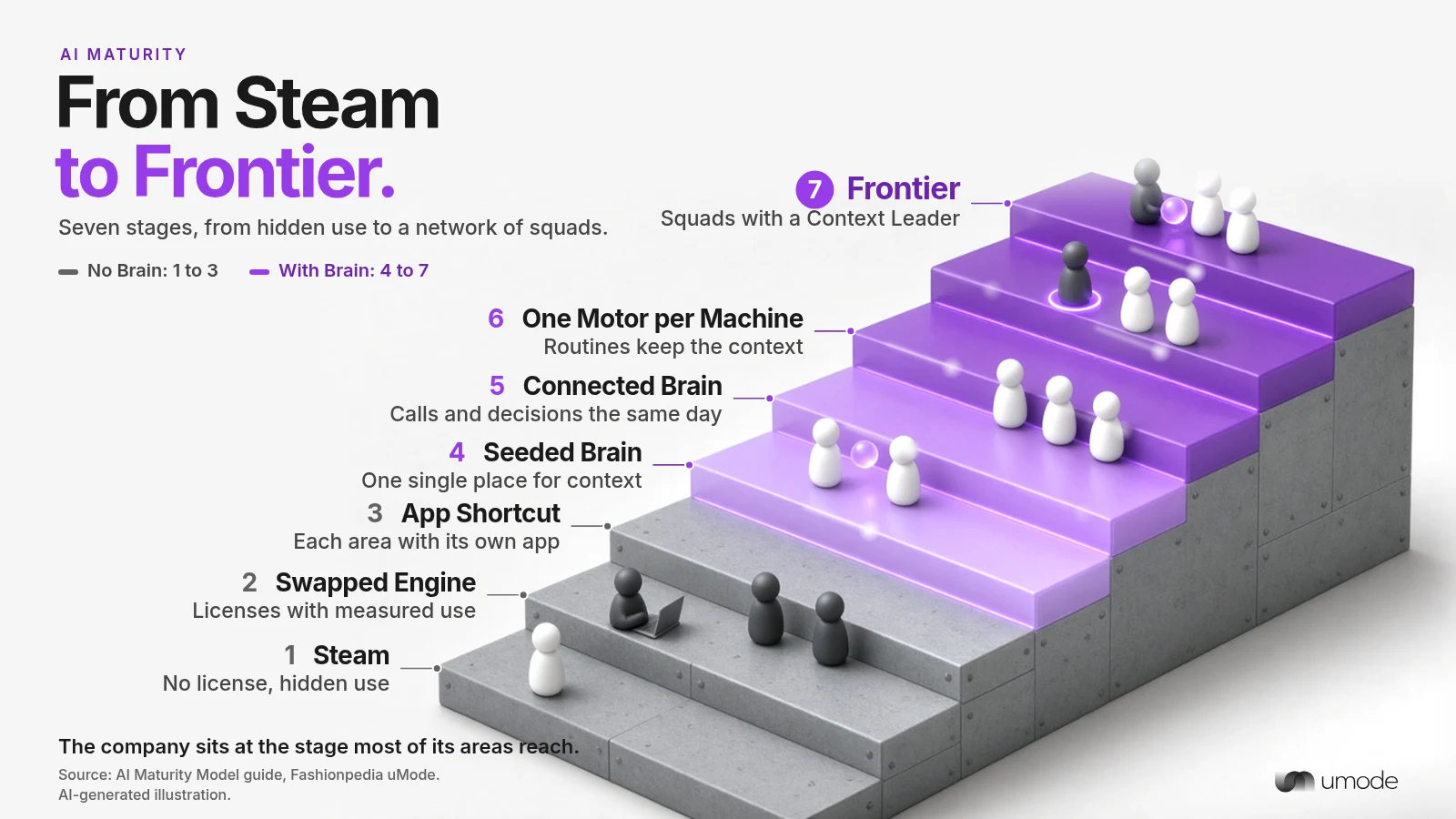
Stage 1, Steam: AI exists, but off the radar
The company does not use AI officially. The team uses it quietly, on personal accounts. The hierarchy is vertical and the org chart is a pyramid by function, with one seat per task and information moving up and down through managers.
The pains are familiar. Repetitive work eats the day: reconciliation, invoices, reports. Company data travels through personal accounts with no rules. Knowledge lives in people's heads. There are gains too: everyone knows what they do, there is no new software cost and there is an appearance of control, because nothing changes without the boss.
- Signal: no corporate license; AI use happens off the company's radar.
- Bank reconciliation: done by hand, line by line, at month end.
- To move up: bring usage into the open and own AI as a company tool. The entry on shadow AI explains how to govern that usage without banning it.
Stage 2, Swapped Engine: licenses for everyone, same process
The company bought AI for the team and ran prompt training. Processes stay the same, with AI on the side. The org chart is the same as in Steam: AI comes in as a tool for each seat, and no seat changes.
The main pain is the license bill going up while results do not show. Usage is uneven: some people fly, others never open it. And every person explains the company from scratch in every prompt, because the machine knows nothing about the business. The gain is real: usage comes into the open, data risk drops, individual gains appear in writing, email and summaries, and the company finds out who its enthusiasts are.
- Signal: corporate license and usage measured per person.
- Bank reconciliation: the analyst asks AI for help building the reconciliation spreadsheet. The work stays the same.
- To move up: pick one task and redesign it end to end.
Stage 3, App Shortcut: each area builds its own machine
The company starts building its own applications. Areas build apps without waiting for IT, spreadsheets turn into small systems and the enthusiasts become internal references. It is the path almost every company takes, which is why it deserves attention.
These are the first real gains: the first truly redesigned task, time given back on repetitive work and a team that discovers it can build. The pains follow right after. Each area has its own app and none of them talk to each other. What was learned disappears when the person leaves. IT and security find out later, and IT becomes the app fire brigade.
- Signal: how many apps are in use and how many read from a common source.
- Bank reconciliation: the analyst built a reconciliation app. The rule lives in her head.
- To move up: give the apps a common context. An app without a Brain ages fast.
Stage 4, Seeded Brain: the first single place for context
The company starts to have a Brain, the first single place for context: processes, customers, products, rules. One person feeds it by hand, almost always the owner or someone very close to them. Apps start reading from the same place, and the first agents that know who the company is appear.
The most visible gain is the end of rework spent explaining the company in every prompt, and areas start giving the same answer about the same subject. The pain is dependency: without a ritual, the Brain goes stale, and it depends on a single person. On the org chart, an informal context keeper emerges.
- Signal: a Brain with an owner, a last-updated date and a ritual on the calendar. Agents have mandatory facts, cite their source, refuse to make things up and say what is missing.
- Bank reconciliation: the reconciliation rules are written in the Brain. The app reads from there.
- To move up: context stops belonging to one keeper and is fed by everyone.
Stage 5, Connected Brain: context goes out and learning comes back
Each person has connected their own Brain to the company's, and context is fed by ritual. Calls, decisions and deliveries become context on the same day. Agents answer with the history of the customer, the product and the decision.
The gains change scale: shorter onboarding, decisions made with the history at hand and people taking on a bigger seat without dropping their current one. The pains are about discipline and trust. When someone skips the ritual, context goes stale. Versions conflict and someone has to decide which one holds. And a fear of exposure appears: what is mine and what belongs to the company. On the org chart, seats start to merge, with one person covering two functions with agents, and each area gets a context leader.
- Signal: calls and decisions logged in the Brain on the same day. On the individual yardstick, context level C2 has a public signal: capture coverage above 50% for four weeks.
- Bank reconciliation: reconciliation runs on the rules the team taught it. Exceptions arrive with the supplier's history.
- To move up: the ritual moves out of people's hands and becomes an automatic routine.
Stage 6, One Motor per Machine: context keeps itself current
Routines generate and update context, with an owner and a date. Whoever knows the pain builds the application. People lead context and agents, and monitoring agents warn leadership about an indicator drifting off course without anyone asking.
The gains are of a different kind: someone in a business area can create a new business unit, sales material comes out of agents with the company's context, and when someone leaves, the knowledge stays. The pains change too. Everything is possible, and the hard part is choosing. Governing context becomes work in itself: what goes in, what comes out, what is sensitive. And the human cadence of approving and deciding becomes the bottleneck. On the org chart, seats start to be designed around outcomes.
- Signal: context routines running with a daily log; an indicator drifting off course reaches leadership first through an agent.
- Bank reconciliation: the Brain reconciles and explains the exceptions. The finance person looks after cash and new initiatives.
- To stay here: decide what not to do and protect what is sensitive.
Stage 7, Frontier: a network of outcome squads
Frontier is the design uMode uses as the destination of the ladder. The company becomes a network of outcome squads. Each squad has a Context Leader and its agents, answers for one business outcome and reads from the same company Brain. Governance is continuous instead of a project with a start and an end. One agent platform serves every squad, and partners such as suppliers and sewing contractors work inside the same context, each with their own permissions.
Few companies are here, and the ones that say they are close to the Frontier are still putting the pieces together. The pain is the same as in stage 6, with more outsiders inside the context: choosing, governing and protecting. The gain is that the company grows in results without growing in layers of management at the same rate.
- Signal: squads with their own outcome, one Context Leader accountable for each, and partners reading from the same Brain under written access rules.
- Bank reconciliation: the cash squad answers for the company's cash outcome; reconciliation is one of the routines it governs, with the bank and suppliers in the same context.
- To stay here: the same question as stage 6, asked every week: what not to do and what to protect.
Want to practice now? The Context Leader Track lessons are free, and a free account saves your progress. The course is in Portuguese. Create your free account.
How does a person's maturity connect to the company's?
The company only moves up when its people move up, so the company ladder has a sister yardstick for each employee. That yardstick is the Context Leader Track, which measures each person's maturity level and what they need to prove to move forward. The Context Leader guide covers the track in detail; here we only cover how the two fit together.
The track has two axes. The usage axis has six steps: Executor, Assisted Operator, Redesigner, Amplified Operator, Outcome Architect and Context Leader. The context axis has four levels: C0 None, C1 Seeded, C2 Fed by ritual and C3 Alive. The rule that ties them together, published on the track's site, is that nobody is recognized above step 3 with context below C2. Moving from one step to the next requires proof taken from real work, and nobody moves up for time served.
Each company stage calls for a mix of people. The table below shows, for each stage, the team's typical step, who pulls the climb, the prevailing context level and the transition in focus.
| Area stage | Team's typical step | Who pulls | Context | Transition in focus |
|---|---|---|---|---|
| 1 Steam | Executor | Nobody, officially | C0 | Entry diagnosis |
| 2 Swapped Engine | Executor and Assisted Operator | The enthusiasts | C0 moving to C1 | Step 1 to 2 |
| 3 App Shortcut | Assisted Operator; enthusiasts at Redesigner | The enthusiasts | C1, scattered across apps | Step 2 to 3 |
| 4 Seeded Brain | Assisted Operator and Redesigner | The context keeper | C1 | Step 3 to 4 |
| 5 Connected Brain | Redesigner and Amplified Operator | Each area's context leaders | C2 | Step 4 to 5 |
| 6 One Motor per Machine | Amplified Operator and up | Unit and outcome owners | C3 | Step 5 to 6 |
| 7 Frontier | A Context Leader in each squad | The outcome squads | C3, shared with partners | Developing the next Context Leader |
Two readings of this table tend to surprise people. First: at stage 3, the person who built the app gets stuck at step 3, because the context lives scattered across apps and never reaches C2. Second: at stage 4, the context keeper only reaches step 4 if the Brain has a ritual. Without a ritual, the Brain stays at C1 and the keeper stays where they were.
The first sign that a person has started to climb is small and easy to see: they change the verb in their prompt. They stop asking the machine for explanations and start asking for deliverables. "Explain how I do the reconciliation" becomes "reconcile this statement with these rules and show me the mismatches". Maturity belongs to the person: it does not depend on age or title, and an intern can be two steps above the director of the same area.

How to read someone's step without a formal test: ask the person to redo, with AI, a real task from last week and watch three things. Did they explain the company from scratch, or did the machine already know it? Did they check the output before using it? Was the output actually used? The track's team program starts with an entry diagnosis in this format, scored on a four-point scale.
How do you measure AI maturity in each area?
With a short reading, done area by area, on the task that eats the most hours. The template below is empty on purpose: the values come from your company.
| Area | Anchor task | Stage read | Evidence of the signal | Team's typical step | Context | Who pulls |
|---|---|---|---|---|---|---|
| Sales | Proposal | |||||
| Marketing | Campaign | |||||
| Customer service and Operations | Order to delivery | |||||
| Technology | Request to deploy | |||||
| Product | Collection and tech pack | |||||
| People | Onboarding | |||||
| Finance | Reconciliation | |||||
| Leadership | Decision |
The anchor tasks are not random. Each one runs through the area end to end and shows up every week, which keeps the reading comparable over time. In product, for example, the tech pack shows the stage clearly: at Steam it is retyped from one spreadsheet into another; at Seeded Brain the product history and the collection decisions live in a place the agent reads; at One Motor per Machine the agent drafts the tech pack with required fields and formula-based costing, and a person approves it. The fashion PLM guide shows the tech pack from the inside.
The evidence column is the most important one and the one most often skipped. A stage without evidence is an opinion. For each area, the evidence is the stage signal itself: the measured license, the list of apps and where each one reads from, the date the Brain was last updated, decisions logged on the same day, the daily routine log.
After the reading, the company's stage comes from the count. If five of the eight areas are at stage 3, the company is at stage 3, even if marketing is at 5. A full reading shows three things no single score shows: where the majority is, who is ahead and who is behind with a pain that costs a lot.

Illustrative scene, not a real case: a womenswear brand runs the reading for the first time. Leadership expected to land at stage 4, because it had bought licenses for everyone and had two well-known internal apps. The reading showed five areas at stage 2, two at stage 3 and marketing at 4, with an area Brain fed by a single person. The two well-known apps did not read from a common source. The company was at stage 2. The leadership conversation shifted from "which tool should we buy" to "which task do we redesign first, and who looks after marketing's context when that person goes on vacation".
How to run the reading in one meeting: bring together each area lead with the empty table on screen. For each row, ask for the evidence before the stage. If the evidence does not exist, the stage is the previous one. Record the reading with a date, because its value is in repeating it and seeing what moved.
What changes in the organization's design at each stage?
The org chart follows the ladder, and changing the org chart before the stage calls for it usually creates nothing but confusion. At stages 1 and 2, the design is the pyramid by function. AI comes in as a tool for each seat and no seat changes. That is expected: there is no common context that would justify merging functions.
At stage 3, the official org chart stays the same, but the real one has already changed: informal builders work outside the design and IT becomes the app fire brigade. At stage 4 the context keeper appears, the first new role, almost never written down anywhere.
The visible change starts at stage 5. Seats start to merge: one person covers two functions with agents, and each area gets a context leader who looks after what AI knows about that area. The structure gets flatter, meetings shrink and agents flag outdated facts in the Brain.
At stage 6, seats start to be designed around outcomes. Unit owners govern queues of agents, one platform serves everyone and a person in a business area can build the application for their own pain and take it to market with agents and the Brain's context.
At stage 7, the department gives way to the outcome squad. The outcome squad is how departments evolve: instead of grouping people by the function they perform, it groups people and agents by the outcome they deliver. Each squad has a Context Leader. As a rule, the Context Leader covers two layers, people and brains with agents; from there, the work lines up with the technology team, which looks after the platform, security and infrastructure.
| Stage | Org chart | New role |
|---|---|---|
| 1 and 2 | Pyramid by function | None |
| 3 | Pyramid, with informal builders | IT as the app fire brigade |
| 4 | Pyramid, with an informal keeper | Context keeper |
| 5 | Flatter; seats merge | Context leader per area |
| 6 | Seats by outcome | Unit owner with a queue of agents |
| 7 | Network of outcome squads | Context Leader per squad |
The full design of this structure, with its layers and the roles in each one, is the subject of the pillar The new AI org chart.
How not to get the order wrong: do not create the job title before the evidence. First the area shows the stage signal; then the informal role that already exists gets a name, a scope and time on the calendar. A title created before the signal becomes a title with no work.
Which companies have declared themselves AI-first, and what do they show?
A few companies outside fashion have made public the decision to put AI at the center of their work. The cases below use only what is written in the open source listed under Sources and further reading, and they help show where on the ladder each move fits.
| Company | What it declared | What the move shows on the ladder |
|---|---|---|
| Shopify | CEO memo, 2025: reflexive AI use became a baseline expectation, and teams must show why AI cannot do the job before asking for more headcount | Leaving Swapped Engine, with AI usage entering each person's review |
| Duolingo | "AI-first" announcement in 2025, with AI use in performance reviews; months later, the CEO said he had not given enough context | The same climb, with a warning about communicating the change badly to the team |
| Haier | RenDanHeYi model, predating AI: removed the middle management layer and organized the company into microenterprises | Proof of shape for the Frontier: small units with their own outcome |
Microsoft's 2025 Work Trend Index gives that destination a name: the "Frontier Firm", organized in hybrid teams of people and agents, with a new metric, the human-to-agent ratio. The report describes three phases: AI as an assistant, agents as digital colleagues that do tasks under human direction and, finally, people setting direction for agents that run entire processes. That reading matches the ladder: the first phase is Swapped Engine, and the last sits between One Motor per Machine and Frontier.
The cautionary case is Klarna. In February 2024, the company announced that its AI assistant was handling two thirds of customer service chats, the equivalent of the work of 700 full-time agents. In May 2025, the CEO said that investing in the quality of human support was the way forward, and the company announced it would hire people for customer service again. In my reading, speed without context and without brakes looks like stage 6 in volume and falls back to stage 2 in quality. That is why the area reading asks for evidence of output quality alongside evidence of volume.
How do you run a self-assessment of your area?
With questions, not a numeric score. A score without evidence only gives the feeling of measurement, while a list of questions forces the area to show what it has. Answer each question with yes, no or "don't know", and keep the evidence for every yes. The first question answered with no usually shows the stage the area is in.
Usage and governance, the entry condition:
- Does the company have a corporate AI account, and does the team use that account for company documents?
- Is there a written policy on what can and cannot go into AI? The entry on an AI policy for the company gives a starting point.
- Can anyone say who uses it, how much and for what?
Redesigned task:
- Is there at least one task in the area that is now done differently, end to end, because of AI?
- Is the output of that task actually used, with no hidden rework?
- If the person who redesigned the task left tomorrow, could someone carry on?
Context:
- Does the area have a single place where rules, decisions and history are written down?
- Does that place have an owner, a last-updated date and a ritual on the calendar?
- Do the area's apps and agents read from that place, or does each keep its own?
- Do decisions and corrections go into that place every week, by ritual?
Agents:
- Do the area's agents have an owner, a version, a brake and a review date?
- Do they cite their source, refuse to make things up and say what is missing?
- Is there a written point where the agent stops and waits for a person? The entry on governing AI agents shows how to design that point.
Routine and outcome:
- Does any routine update context on its own, with a daily log?
- Does any indicator drift reach the leader through an agent before it reaches them through a person?
- Can the area say which business outcome changed because of AI, in revenue, margin or inventory?
People:
- How many people in the area have moved past the Executor step?
- Is anyone in the area training another person up to step 3?
The governance questions come first because data rules are the entry condition, before any stage.
How to use the list in practice: run the self-assessment in every area on the same day, with the area lead and one team member. Compare their answers. Where the lead says yes and the team says no, there is a conversation to have before any plan.
How do you plan the move from one stage to the next?
With one plan per area, in five steps, always built on the anchor task. The pace depends on how much the area can absorb; the path is the same for a small brand and a large one.
1. Close the entry condition. A corporate account, a written AI policy and sensitive data kept out of the machine. Without these, none of the following steps holds up.
2. Pick one task and redesign it end to end. The area's anchor task, with a beginning, a middle and an end. The redesign answers three questions: what the machine does, what the person checks and where the machine stops. The entry on taking an AI pilot into production covers the path from test to daily use.
3. Write the context in one place. The rules the task uses move out of people's heads and out of the apps into the area's Brain, with an owner and a date. The entry on giving AI your company's context shows what goes in first, and the one on context engineering explains the technique.
4. Put a ritual on the context. A short, fixed meeting where the week's decisions and corrections go into the Brain. Once the ritual sticks, the next step is to turn it into a routine that runs on its own and flags when something has gone stale.
5. Train people along the way. Each step above calls for people at a certain step. The area chooses who will look after the context, and that person climbs the track using real work as material. Without this, the plan depends on one enthusiast and stops when they leave.
To check whether it paid off, the entry on measuring the ROI of AI initiatives helps tie each step to a business outcome.
How to know the plan worked: repeat the area reading with the same table. If the next stage's signal showed up with evidence, the area moved up. If it did not, the problem is almost always in step 3 or step 5, and rarely in the tool.
Frequently asked questions
What is AI maturity?
It is how far an area has redesigned its own work around AI and the context AI reads. It is measured by observable signals, such as measured licenses, apps reading from a common source and decisions logged in the Brain.
What are the AI maturity levels of a company?
Seven stages: Steam, Swapped Engine, App Shortcut, Seeded Brain, Connected Brain, One Motor per Machine and Frontier. Each one has an observable signal and a clear step to move up.
How do I measure my company's AI maturity?
Area by area, on the task that eats the most hours. For each area, record the stage and the evidence of the signal. The company sits at the stage most of its areas are in.
Why not use a single score for the whole company?
Because an average hides the area that is ahead and the one that is behind. A single score says everything is more or less fine, and nobody knows where to act first.
What is the difference between company maturity and personal maturity?
The ladder measures the area; the Context Leader Track measures each person, on six steps and four context levels. An area only moves up when its people move up with context.
Does buying AI licenses for everyone change the company's stage?
It takes you from Steam to Swapped Engine: usage comes into the open and data risk drops. To go further, the area has to redesign one task end to end.
What is the company Brain?
The single place where rules, decisions and history are written down, with an owner and a date, so that people, apps and agents read from the same source. It appears at stage 4 of the ladder.
What is an outcome squad?
How departments evolve: instead of grouping people by function, it groups people and agents by the outcome they deliver. Each squad has a Context Leader and reads from the company Brain.
Where do you start moving up a stage?
With the entry condition: a corporate account, a written AI policy and sensitive data kept out of the machine. Then pick one task in the area and redesign it end to end.
How long does it take an area to move up a stage?
It depends on how much the area can absorb and how many people climb with it. The right signal is the evidence of the next stage showing up in the following reading.
How do you start with the track?
Start with a free account on the Context Leader Track. It brings together free lessons and step-by-step exercises in Claude, and the account saves your progress. At the end of the track, you take your own diagnosis on the TLC yardstick. The course is in Portuguese. Create your free account at tlc.umode.tech.
Sources and further reading
- Context Leader Track: method, brain, lessons and exercises (in Portuguese)
- Context Leader Track, brain page: context levels C0 to C3 and the C2 signal (in Portuguese)
- Context Leader Track for your team: six steps, two axes and the step 3 rule (in Portuguese)
- uMode services: AI maturity projects (in Portuguese)
- uMode education: the four starting questions about AI (in Portuguese)
- Context Leader: what it is, the six steps of the track and how to develop one
- Fashion PLM: the complete guide, from tech pack to collection launch
- The new AI org chart: the layered structure behind people, agents and areas
- Steam engine and AI: without redesigning the work, the tool does not change the outcome
- What is shadow AI and how do you govern it in fashion?
- How to set an AI policy in the company
- AI adoption by the team
- How to give AI your company's context
- What is context engineering and how do you apply it in fashion?
- How to govern AI agents in the company
- How to take an AI pilot into production
- How to measure the ROI of AI initiatives
- How to preserve institutional knowledge
- Governing fashion context
- Shopify, Reflexive AI usage: CEO memo, 2025
- Duolingo: fact check of the "AI-first" memo (Snopes, via Yahoo), May 6, 2025
- Duolingo: the CEO admits the memo did not give enough context (Fortune), August 18, 2025
- Microsoft, 2025: The year the Frontier Firm is born, Work Trend Index, April 23, 2025
- INSEAD Knowledge, The Multinational Fuelled by Thousands of Entrepreneurs: Haier and RenDanHeYi, January 21, 2019
- Klarna AI assistant handles two-thirds of customer service chats in its first month, Klarna press release, February 27, 2024
- Klarna goes back to hiring customer service agents (Entrepreneur), May 9, 2025
The area reading fits in an eight-row table, and the first row that asks for evidence and has none shows where the company starts.
Want to apply this to your operation?