Steam engine, electric motor and AI: without redesigning the work, the tool does not change the outcome
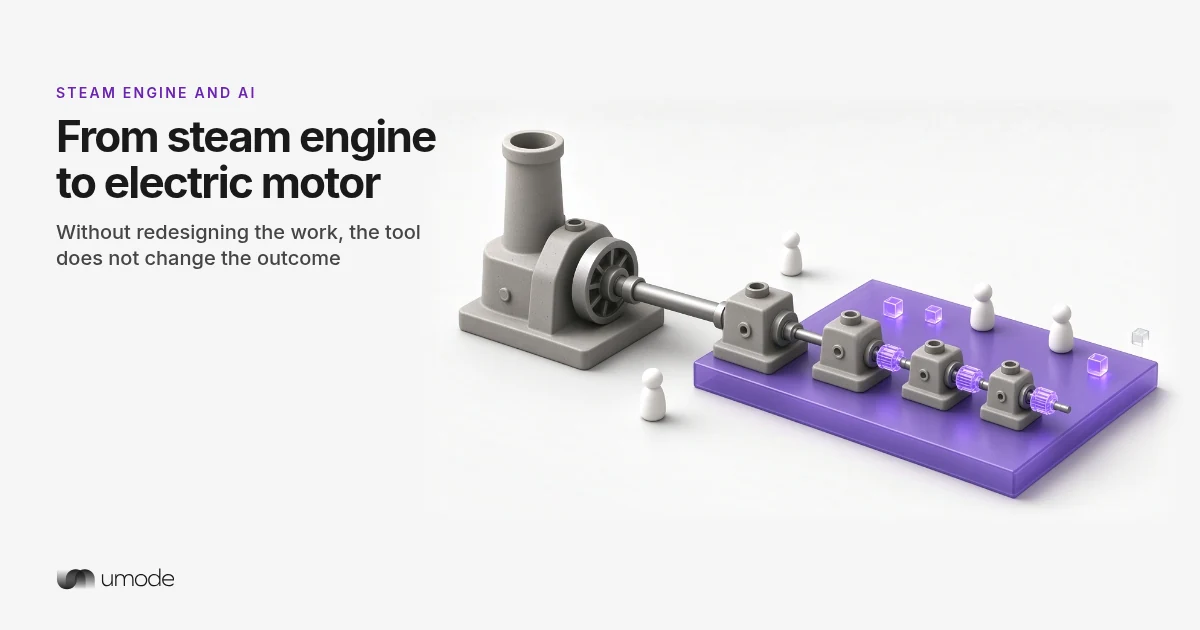
Swapping the steam engine for an electric motor, or an old process for AI, does not change the outcome unless the work is redesigned: that is the AI productivity paradox.
Two terms come up all the time. A Brain is where the company's context lives, organized and with control over who can access what. An agent is an AI routine that reads that context, decides within a rule and delivers something finished.
In short:
- In American factories, the electric motor first arrived to turn the same shafts the steam engine had turned. The building, the belts and the place of each machine stayed the same, and the gain was small.
- The leap came when each machine got its own motor and the factory was redesigned around the order of the work. Between the first central power station and the effect on productivity, about four decades went by.
- With AI, many companies are in that first phase: licenses for everyone and the same process as before. uMode's Context Leader Track (TLC) sums up the picture in one line: "Everybody uses it. Almost nobody moves up."
- Redesigning work starts with an honest map, separates coordination from execution and asks why each step exists before speeding any of them up.
- Companies usually get stuck at step 3, when the question changes from "how do I prompt better" to "why does this step exist", and the answer touches a process that no single person owns.
I like this story because it takes the blame off the tool and puts the conversation where it belongs. Every week someone says AI did not deliver what it promised, and almost always the company did what factories did around 1900: it hung the new motor on the old shaft and waited for the results to show up. The good news is that the script has been written once before, with a beginning, a middle and an end. The bad news is that the first time it took about four decades, and I do not know a leadership team willing to wait that long.
How did a steam-powered factory work?
According to historian Warren Devine (1983), the steam factory was built around a central engine, and everything inside it, from the building to the place of each machine, was designed to carry that engine's power to the end of the line. In most factories, a single prime mover, a waterwheel or a steam engine, turned iron or steel line shafts hung from the ceiling that ran the full length of each floor (Devine, 1983, p. 350).
Smaller countershafts branched off the main shafts, also hung from the ceiling, and from each countershaft a belt dropped down to each machine. That is why machines were arranged, out of necessity, in rows parallel to the shafts. Each machine's place obeyed the physics of power transmission; the order of the work came second, if it fit.
The design charged prices nobody saw on the coal bill. The whole network of shafts turned nonstop, no matter how many machines were in use, and if a shaft or the engine broke, production stopped in an entire room, sometimes in the entire factory. Every shaft bearing had a drip oiler that operators refilled every day. And economist Paul David (1990), of Stanford University, adds that power loss along very long shafts pushed companies toward multistory buildings, which cost more, just to shorten the distance between the engine and the machines.
Anyone who works at a fashion company recognizes the design, in other materials. Today's central shaft is the master spreadsheet everyone feeds, the weekly status meeting and the person who consolidates everything on Friday afternoon. The whole network turns whenever one area needs an answer, and if the person who consolidates goes on vacation, the room stops. Nobody fills drip oilers anymore, but plenty of people spend Monday checking whether the collection spreadsheet matches the one from sales.
What happened when the electric motor came into the factory?
According to Warren Devine (1983), almost nothing changed in the first swap: the electric motor took the place of the steam engine, and the only difference was the type of machine turning the shafts (Devine, 1983, p. 355). In this first arrangement, electric line shaft drive, all the countershafts, belts, pulleys and clutches stayed in place.
Fashion was at the front of the line. Mechanical drive was electrified first in industries such as apparel, textiles and printing, where cleanliness, constant power and speed, and ease of control were critical. An 1895 account of a weaving mill in Connecticut describes motors installed in the basement, next to the steam engines they replaced, belted to the usual shafts, with one of them driving 1,200 looms.
The article calls this the habitual superimposition of a new technology onto the structure of an old one, and it made sense: turning the shafts with a motor was an improvement that only required changing the end of the system. It is hard to read that sentence in 2026 without thinking of the companies that bought AI licenses for the whole team and changed nothing else.
The second phase was group drive: instead of one motor for the factory, one motor for each department or group of machines, turning shorter shafts. It helped. Each department could run on its own, which saved energy when only part of the factory worked overtime, and a broken shaft no longer stopped the whole plant. Even so, the direct gain was modest: the coal savings were real, but fuel was a small share of the total cost of making one unit. Saving a lot on a small item barely moves the total.
Adoption was slow too. Paul David, in a 1990 article in the American Economic Review, shows that in 1899 electric motors accounted for less than 5% of the mechanical drive power in American factories, and that electrification had no impact on manufacturing productivity before the early 1920s, four decades after the first central power station (David, 1990, p. 356-357).
One detail from that article applies to any company adopting AI. When a steam factory installed group drive, the new motors were added on top of the old equipment. The shafts, the belts and the steam engine itself stayed there, as spare capacity. The result was more capital for the same output, which held back measured productivity gains. David notes that the same thing was happening with computers in 1990: old paper procedures kept alongside electronic methods, sometimes hurting the performance of both.
Swap paper for a parallel spreadsheet and computers for AI, and the sentence still holds: the draft AI writes in seconds and someone retypes into the ERP. The company pays for both structures and measures the gain of only one. Hence the line David writes about 1900: observers at the time could have said that dynamos were everywhere except in the productivity statistics.
What changed when each machine got its own motor?
According to Warren Devine (1983), the design of the whole factory changed: with no shaft on the ceiling, a machine could go wherever the work required, and the big gain started coming from the production flow, with energy in the background. This is unit drive, one motor per machine, usually mounted on the machine itself.
The first consequence was flow. Machines could be arranged on the factory floor following the natural sequence of operations, reducing material handling. The United States Government Printing Office managed to install forty more presses without adding floor space, because the area taken up by shafting disappeared (Devine, 1983, p. 364).
The second was overhead space. With no shafts on the ceiling, overhead cranes could travel to any part of the plant. Portable tools started going to the workpiece, instead of the workpiece going to the machine. And a broken motor now stopped only one machine.
The third was the environment. Without the web of belts, light reached the floor, and the oil and dust the belts spread around disappeared. Factories became much cleaner and brighter, and control of each machine improved, because there were no more slipping belts.
What strikes me most are the manufacturers' own accounts at the time. In 1901, Professor F. B. Crocker summarized reports from several of them: output grew, in many cases, by 20% or 30% or more, with the same space, the same machines and the same number of workers. The superintendent of a locomotive works said he would have installed electric drive even if it used several times more energy. The direct cost savings came to be seen as almost insignificant next to the other benefits.
Paul David completes the picture from the building side: lighter construction, single-story buildings instead of multistory ones and layouts designed around the path of materials (David, 1990, p. 358).
| Phase | What changed | What stayed the same | Where the gain came from |
|---|---|---|---|
| Electric line shaft | The central engine, from steam to electric | Shafts, belts, building and machine placement | Almost none in output |
| Group drive | One motor per department or group of machines | Shorter belts and shafts, similar layout | Energy and independence between departments |
| One motor per machine | A motor on each machine, building and layout redesigned | Almost nothing | Flow, space, light, control and output |

The aggregate numbers came later: output per worker-hour in American manufacturing grew 1.3% a year before 1919 and 3.1% a year afterward.
Want to practice now? The Context Leader Track lessons are free, and a free account saves your progress. The course is in Portuguese. Create your free account.
Why is AI repeating the story of the electric motor?
Because most companies hung AI on the process they already had, the same way factories hung the electric motor on the steam shaft. The tool is new, the work is still designed for the old tool, and the results wait.
The comparison is almost forty years old. In 1987, economist Robert Solow wrote the line that became known as the productivity paradox: you can see the computer age everywhere but in the productivity statistics. Paul David wrote his 1990 article precisely to show that the paradox had a precedent in the dynamo, the electric generator (David, 1990, p. 355). He calls both general purpose engines, technologies that spread into almost every activity and only pay off when the rest of the system reorganizes around them.
In 2018, economists Erik Brynjolfsson, Daniel Rock and Chad Syverson took the idea further in a National Bureau of Economic Research paper, revised in 2020 (Brynjolfsson, Rock and Syverson, 2020). They write that general purpose technologies such as AI enable and require large complementary investments, including the reinvention of processes, products, business models and human capital. Those investments are almost always intangible and poorly measured. The effect, in their model, is a J-shaped curve: in the early years, measured productivity sits below real productivity, because the company spends time and people building something that does not show up in the numbers; later, when that investment starts to pay off, measured gains rise. To illustrate, the authors cite electrification: it took a generation for factory design to be reinvented to take advantage of the new technology.
uMode's track describes the same picture from inside the company. The team track page opens with "Everybody uses it. Almost nobody moves up." and explains: "Between loose chatting and running agents with written rules there are six steps. And nobody moves up for time served." Licenses for everyone are the electric line shaft. The motor changed; the belt, the building and the place of each machine are still the same.
Illustrative scene, not a real case: an apparel manufacturer buys AI for the whole team. In the first week, the sales coordinator asks the assistant for the weekly collection status email. The email comes out in seconds, better written than ever, and a bit longer too. The Monday status meeting happens the same way, with the same people, to read aloud the email that now looks nicer. Nobody asks why the meeting exists. The motor went electric; the belt kept squeaking, just with better copyediting.
Outside fashion, three public cases show companies trying to leave this first phase. Shopify made AI use a baseline expectation and asks teams to show why AI cannot do the job before asking for more headcount (CEO memo, 2025): it is the question "why does this step exist?" applied to hiring. Microsoft describes a path that runs from AI as an assistant to people directing agents that run entire processes (Work Trend Index, 2025). Klarna is the warning: in 2024 it announced that its AI assistant was handling two thirds of chats (Klarna press release) and, in 2025, it went back to hiring people for customer service (Entrepreneur). In my reading, speed went up before quality control was redesigned.
What does redesigning work mean in a fashion company?
It means looking at the process the way the factory looked at its floor after unit drive: asking where each step should be, and whether it should exist at all, before asking AI to do faster what was already being done. Unit drive took the belt out of the way.
uMode's track covers this at step 3, called Redesigner, with techniques I use as a script. They work in whatever AI tool your company already uses, because the work is about the map and the questions.
How to draw an honest map: pick a deliverable that goes out every week and write, as the track puts it, "one line per step: what happens, who does it, in which tool, where the information lives". Honest means the process as it really runs, with the follow-up email, the side spreadsheet and the "can you send it again" that nobody puts in the official flowchart. The pretty map hides exactly the belts you want to remove.
How to separate coordination from execution: on each line of the map, mark whether the step executes something or only coordinates. The track defines coordination as "chasing, notifying, consolidating, forwarding" and warns: "Coordination is most of your time, and it is the first part to come off your plate." In fashion, coordination is almost everything that happens between design deciding and the supplier receiving.
How to decide whether a step goes away: for each coordination step, ask why it exists. The track gives the test: "If the answer is 'because the information was not available to whoever needed it', the step disappears entirely, and the meeting that existed to follow it up goes with it." In the factory, the belt disappeared when power started reaching the machine by wire.
Three generic examples help show the difference between speeding up and eliminating.
In collection approval, the usual design has the design team's presentation, each area's comments noted in different places, someone consolidating everything in a spreadsheet, someone else retyping the decisions into the PLM (Product Lifecycle Management, the system that organizes the product life cycle) and a follow-up meeting to find out what has been updated. Speeding up means asking AI to consolidate comments faster. Redesigning means recording each comment once, where the style lives, with an agent flagging conflicts between areas and leaving the decision ready for whoever decides. The follow-up meeting loses its reason to exist, because the status is visible. Sample approval shows the same reasoning in a neighboring step.
In the tech pack, the usual design has the tech pack retyped from one spreadsheet into another for each version. Speeding up means asking AI to retype faster. Redesigning means keeping the product history and the collection decisions in a place the agent reads, so it drafts the tech pack with the required fields and formula-based costing, and a person approves it. It is the same image the AI maturity pillar uses for the One Motor per Machine stage, and the fashion PLM guide shows the tech pack from the inside.
In product setup, the usual design has the same data typed into the PLM, the ERP (Enterprise Resource Planning, the management system) and the online store, sometimes also the CRM (Customer Relationship Management). Each retyping exists because the information was not available where it was needed. By the track's rule, those steps disappear once the information lives in one place and each system reads from there. This work usually needs IT in the conversation from the start.

Vera and Roberto, two fictional characters I use to explain this shift, help show the human side. Roberto got a long, polished report on his area's week from the assistant and turned it down. He asked again, only for what drives a decision. Vera, before starting anything new, cuts everything that will not get finished. Neither of them got a better tool along the way. The line I put in both their mouths, which is mine and not from the track's page, is the same: "It wasn't the tool. It was the mindset." I add another one, which I repeat in almost every conversation on the subject: what you know has not gone out of date; the way you use what you know has.
The step-by-step redesign, with an exercise and a definition of done, is in the guide Redesigning a process with AI. Here the focus is the thesis: the big gain lives in the step that disappears.
Want to practice now? The Context Leader Track lessons are free, and a free account saves your progress. The course is in Portuguese. Create your free account.
Why do most companies get stuck at step 3?
Because up to step 2 a person improves their own prompts on their own, and from step 3 on they need to change a process that is not only theirs. The team track page says it plainly: "From the third step on (redesigning a process, putting an agent live with brakes, publishing the house standard), almost nobody moves up without someone who has already done it inside a fashion company."
The method page describes how the question changes at step 3: "It stops being 'how do I prompt better' and becomes 'what didn't it know' and 'why does this step exist'." The first question is solved by studying. The second requires authorization, conversations with other areas and, often, the nerve to switch off something that works.
The history of electrification shows three similar brakes, and each has an equivalent in a fashion company.
The first is the process that still works. Paul David attributes much of the slowness of electrification to the fact that it did not pay to replace factories that were still in working order, built for the old mechanical power regime (David, 1990, p. 357). New factories, in the fastest-growing industries, were the first to be born redesigned. In a fashion company, the spreadsheet that works is the factory in working order: nobody switches it off, because it delivers, even if it delivers with retyping in the middle.
The second is the lack of people who have done it before. David explains that rolling out unit drive at scale required working out the details in many kinds of factories and many places, slowly forming a group of architects and engineers who knew the new way of producing. That learning, he says, was uncertain and slow to gather pace. It is the same thing the track says about step 3: the know-how of redesigning circulates among people who have already redesigned.
The third is the subtlest. David observes that, unlike buildings and machines, a company's information structures do not physically wear out, so you cannot count on the passage of time to create the occasion to redesign them. The old factory eventually fell apart. The spreadsheet does not. The redesign has to be decided, because it will not happen on its own.
The track adds a fourth brake the factory did not have: context. On the method page, the explanation is short: "Without it, step 3 does not come, because the machine cannot redesign a process it does not know." Without a Brain, AI sees the prompt and does not see the process. It speeds up the step you described and has no way to suggest that the step be removed.
To get past this point, uMode designed the Context Leader (HIC) program. In my description, it is the method uMode created to develop what the world calls an HIC (high individual contributor), adapted to develop superhuman professionals. The name is ambitious on purpose. The criterion to move past step 3, in the track's open material, is very concrete: "A before and after map of one of your processes, one step eliminated, and two weeks with the deliverable coming out of the new process."
How to tell if your area is stuck at step 3: ask a few people which step they have eliminated with AI's help since it arrived. If every answer is about doing things faster, the area is speeding up belts. The track calls this the common mistake of the step: "The small gain comes from speeding up; the big one comes from eliminating."
How does this show up on the company's maturity ladder?
It shows up as the difference between the stages that swap the engine and the ones that redesign the plant. The AI maturity pillar organizes the company into seven stages: Steam, Swapped Engine, App Shortcut, Seeded Brain, Connected Brain, One Motor per Machine and Frontier. The first ones swap the engine, the middle ones create a common source of context and the last ones redesign the plant.
Stage 2 is named after this story on purpose. Swapped Engine means licenses for everyone and the same process: the company bought AI for the team, ran prompt training, and every seat keeps doing what it did, with AI on the side. It is the electric line shaft.
The middle stages, Seeded Brain and Connected Brain, play the role of the wiring: before each process gets its own agent, the company needs context reaching every area, with an owner and permissions.
At the One Motor per Machine stage, context keeps itself current and agents work inside the redesigned process. This is where the tech pack is drafted by the agent and approved by the person. Frontier is the design uMode uses as the destination: a network of outcome squads, each with a Context Leader and its agents, reading from the same Brain.

Two details of the method prevent a wrong reading. The stage is measured by area, because product can be at Seeded Brain while finance is still at Swapped Engine; the company sits at the stage most of its areas are in. And moving up a stage requires people moving up the track at the same time: a well-built Brain redesigns no process if nobody in the area asks the step 3 question.
The next step on the track, step 4, is where the motor on each machine gains autonomy, and therefore gets brakes. The track sums up the risk in a sequence: "Chat answers. Automation repeats. An agent chooses the path. Risk grows in the same order." The three brakes it teaches are the stop limit, the clear trigger and the approval stop, detailed in the guide AI agent brakes. The first agent is usually born from a step the redesign has already simplified, as the guide First AI agents shows. And the track leaves a warning that applies to any excited leadership team: "Automation nobody uses is debt: someone maintains it, someone pays for it, nobody uses it."
How to read your company on this ladder: pick a task that runs through the area every week and describe how it runs today. If AI shows up only as a shortcut for whoever does the task, the area is at Swapped Engine. If it shows up reading the area's context, the area is past the wiring. If the task has lost entire steps and an agent is part of it, with brakes, the area has reached one motor per machine. Measuring the gain of each step honestly is the subject of the page on measuring the return on AI.
What does the engine story not teach about AI?
History does not teach the timeline, and Paul David (1990) himself, who made the comparison, warns against taking the analogy literally: computers are not dynamos (David, 1990, p. 360). The interaction between person and machine, he says, is far subtler and more complex than installing electric light and power, and information has features electric current does not, such as an excess that turns into congestion.
AI adds differences that even 1990 did not know. The electric motor always did the same thing; an agent chooses its path, so brakes and permissions go into the design from the start. And AI tools are already on almost every office computer: the access barrier has fallen, and the redesign barrier is where it always was.
Nor can you take a promise of gains from the story. The 20% or 30% of 1901 belonged to specific factories and a specific time. I do not know how long the J-curve will last in each fashion company, and I am wary of anyone who says they do.
What history teaches, without exaggeration, is the order: first the tool swap, then the context wiring, then the redesign of the work, and the big gain only at the end. Anyone who knows the order is not alarmed by the first phase and does not settle into it.
Frequently asked questions
What is the AI productivity paradox?
It is the gap between adopting AI and seeing results change. The term comes from Robert Solow's 1987 line about computers: everywhere but in the productivity statistics. With the electric motor, the same gap lasted decades.
Why doesn't AI raise productivity as soon as a company adopts it?
Because at first AI goes into the old process, and the old process limits the gain. It is like putting an electric motor on a steam shaft. The big gain depends on redesigning the work, and that investment takes time to show up in the numbers.
What does the steam engine teach about AI?
That swapping the engine is not enough. In 1895, one electric motor drove 1,200 looms through the same shafts as steam. The leap came with one motor per machine: a printing office made room for forty more presses without enlarging the building (Devine, 1983).
How long did electrification take to show up in productivity?
According to Paul David, the effect on American manufacturing productivity only appeared in the early 1920s, four decades after the first central power station. In 1899, electric motors accounted for less than 5% of factory drive power.
What is the productivity J-curve?
It is the Brynjolfsson, Rock and Syverson model for general purpose technologies. At first, measured productivity sits below real productivity, because the company invests in processes and people. Later, when that investment pays off, measured gains rise.
Is buying AI licenses for the whole team a waste?
Not if it is the first step. Licenses bring usage into the open and teach the team to prompt. The waste starts when the company stops there and waits for the tool, on its own, to change results.
What does redesigning a process with AI mean?
Mapping the process as it really runs, separating coordination from execution and asking why each step exists. The steps that only existed because information did not reach whoever needed it go away entirely, along with the meeting that followed them up.
What is the difference between speeding up and eliminating a step?
Speeding up means doing the same step in less time. Eliminating means discovering it does not need to exist. uMode's track sums it up: the small gain comes from speeding up; the big one comes from eliminating.
Why do so many companies stall at step 3?
Because on the first two steps a person improves their own prompts on their own. On the third, they need to change a process that involves other areas, with organized context and, almost always, with help from someone who has done it inside a fashion company.
Where should a fashion company start redesigning?
With a deliverable that goes out every week and bothers a lot of people, such as the collection status or product setup. Draw the honest map, mark what is coordination and eliminate one step before speeding up any other.
How do you start with the track?
Start with a free account on the Context Leader Track. It brings together free lessons and step-by-step exercises in Claude, and the account saves your progress. At the end of the track, you take your own diagnosis on the TLC yardstick. The course is in Portuguese. Create your free account at tlc.umode.tech.
Sources and further reading
- Paul A. David, "The Dynamo and the Computer: An Historical Perspective on the Modern Productivity Paradox", American Economic Review, Papers and Proceedings, v. 80, n. 2, May 1990, p. 355-361 (scanned copy of the article)
- Warren D. Devine Jr., "From Shafts to Wires: Historical Perspective on Electrification", Journal of Economic History, v. 43, n. 2, June 1983, p. 347-372 (scanned copy of the article; DOI 10.1017/s0022050700029673)
- Erik Brynjolfsson, Daniel Rock and Chad Syverson, "The Productivity J-Curve: How Intangibles Complement General Purpose Technologies", NBER Working Paper 25148, October 2018, revised January 2020
- Jack E. Triplett, "The Solow Productivity Paradox: What Do Computers Do to Productivity?", Canadian Journal of Economics, v. 32, n. 2, 1999 (open text at Brookings): Robert Solow's 1987 line
- Context Leader Track, method page (in Portuguese)
- Context Leader Track for your team (in Portuguese)
- Shopify, Reflexive AI usage: CEO memo, 2025
- Microsoft, 2025: The year the Frontier Firm is born, Work Trend Index, April 23, 2025
- Klarna AI assistant handles two-thirds of customer service chats in its first month, Klarna press release, February 27, 2024
- Klarna goes back to hiring customer service agents (Entrepreneur), May 9, 2025
- Context Leader (HIC)
- AI maturity
- The new AI org chart
- Fashion PLM
- Redesigning a process with AI
- AI agent brakes
- First AI agents
- AI Brain
- Fashion tech pack
- Product setup
- Fashion sample approval
- How to measure the return on AI
The factory that redesigned its floor around one motor per machine made room for forty more presses without adding a square foot of building; your company probably has the same space hidden behind a status meeting.
Want to apply this to your operation?