Redesign the process before speeding up
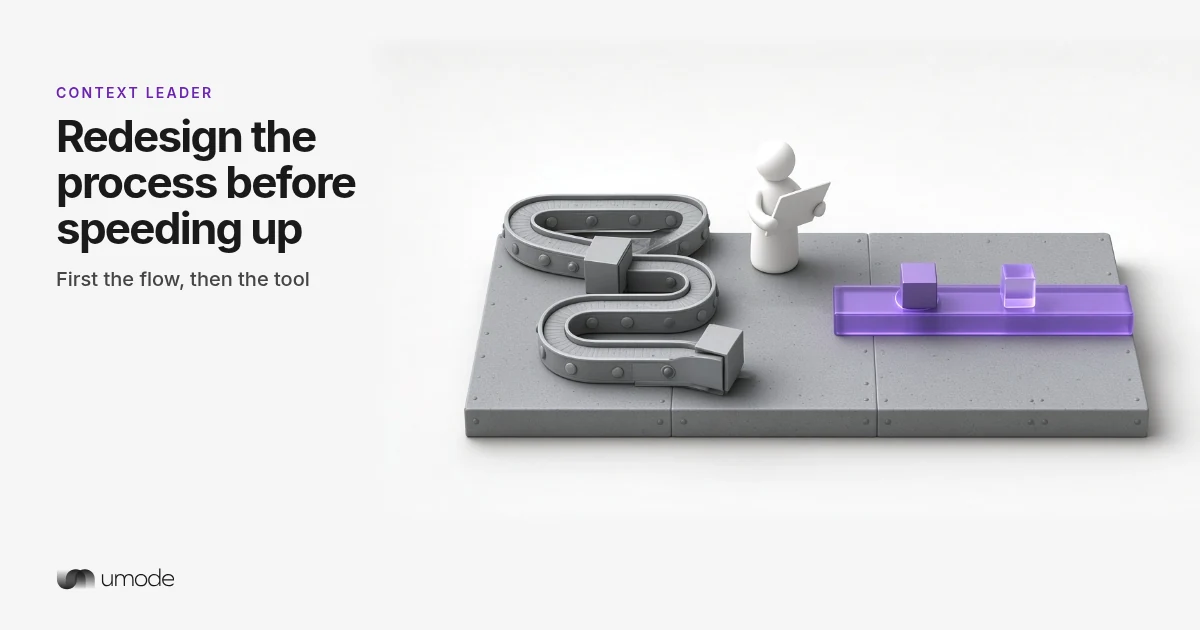
Redesigning the process with AI is mapping how the work happens today, separating coordination from execution and cutting the step that only exists because the information never arrived.
In short:
- The map has one line per step: what happens, who does it, in what tool and where the information lives.
- Coordination (chasing, warning, consolidating, forwarding) takes most of your time and is the first to leave your lap.
- Before speeding up a step, ask why it exists. The big gain comes from eliminating.
- The thirty-second capture keeps the decision and the why, the number that matters, the reference and the way that worked.
I think the question "how do I do this faster with AI?" arrives too early in most companies. It accepts the process as it is and only changes the speed. The question that pays the bill comes before: does this step need to keep existing?
This text is part of the guide Context Leader: what it is, the six steps of the track and how to develop one.
Redesigning the process is part of the Context Leader (HIC), the method uMode created to develop what the world calls an HIC, adapted to develop superhuman professionals.
Why is speeding up not enough?
Because speeding up keeps the design that generated the delay. The track sums it up this way: the small gain comes from speeding up, the big one from eliminating.
Whoever uses AI to write the collection email faster gains a few minutes per email. Whoever discovers why it exists, and solves the cause, stops writing it. The first gain shows up in the week; the second changes the whole week of the area.
How do you make a process map without makeup?
You write one line per step, the way it really happens, with four columns: what happens, who does it, in what tool and where the information lives. Without makeup means including the shortcut, the parallel spreadsheet and the message on the phone, even when the manual says otherwise.
An illustrative example, from a pilot sample approval process:
| What happens | Who does it | Tool | Where the information lives |
|---|---|---|---|
| Supplier says the pilot has shipped | Supplier | Phone message | In the conversation of whoever received it |
| Someone chases the status of the other pilots | Development | Message and phone | In the memory of whoever chased |
| Status becomes a spreadsheet for the meeting | Development | Spreadsheet | In a copy on a computer |
| Meeting decides what to approve | Design and product | Room | In the minutes, when there are minutes |
| Decision goes back to the supplier | Development | Message | In the conversation, again |
The fourth column is the one that reveals the most. When the answer is "in someone's conversation" or "in the memory of whoever chased," you found the point where the process depends on one person. The entry on how to reduce spreadsheets and WhatsApp in collection management shows the same symptom seen from operations.
How do you separate coordination from execution?
You mark each line of the map with one of two letters. Coordination is chasing, warning, consolidating and forwarding. Execution is the work that transforms something: drawing, pattern making, calculating, deciding.
In the example above, only the meeting is execution. The other four lines move information from one place to another. The track records that coordination takes up most of the time of whoever coordinates, and that it is the first to leave your lap when the information starts to live in one place. Execution stays yours; you just stop being the thread between people.
Want to practice now? The Context Leader Track lessons are free, and a free account saves your progress. The course is in Portuguese. Create your free account.
How do you decide whether a step should exist?
You ask why the step exists and listen to the whole answer. If the answer is "because the information was not available to whoever needed it," the step goes away.
Think about the line from spreadsheet to meeting. It exists because the status of the pilots is scattered across conversations. If the status lived in a place everyone reads, the spreadsheet would have no reason to exist, and half the meeting neither. That place can be a product lifecycle system, as the guide on fashion PLM shows, or a well-kept folder, as long as it is one place and up to date.
Not every step goes away. Sample approval keeps existing, because it is judgment. What goes away is the coordination around it.
Where does context come into this calculation?
Context decides more than the request. When the AI errs at step 3, the useful question is what it did not know, and almost always it is a house rule never written down.
The track gives the measure: without a Brain, you spend ten to fifteen minutes explaining who you are and how the area works; with a Brain, one line is enough. The track sentence I repeat most: an old note does not stay quiet, it lies.
A file sent to the tool enters as a copy; if the rule changes every week, it needs to live at the source and be read through a connector. The guide on context levels explains that difference between C1 and C2, and the guide on what a Brain is shows how to build the place where the notes live.
What is the thirty-second capture?
It is the short record you make right after deciding something, with four items: the decision and the why, the number that matters, the reference and the way that worked.
The rule is the track's: thirty good notes are worth more than three hundred lukewarm ones. A good note answers the question someone will ask when you are not in the room. A lukewarm note repeats what is already in the email and only increases what the machine reads. The entry on how to preserve institutional knowledge covers the same problem from the company's side.
Why do most people stall at this step?
Because step 3 touches other people's work. Most people climb the first two steps alone, with the material and a week of work; from the third on, almost nobody climbs without someone who has already done it inside a fashion company.
Eliminating a step means convincing whoever takes part in it, changing a meeting and, sometimes, taking a report away from whoever liked receiving it. That calls for a conversation with another area, and technique alone does not solve a conversation.
How the track trains this: the Projects exercise compares a short request, with the context stored in the project, against the telegraphic request without context, and ends with a sentence to record: "Which step of my process goes away now:". The next exercise asks for a page you use every Monday, with one screen, one highlighted number and one button, which solves the task in thirty seconds. If you are still at the previous step, start with the five-part request.
How do you know you have moved up a step?
You move up when you have the before map and the after map, one step eliminated, two weeks running in the new process and the area's context at C2, read at the source. It is the step 3 proof in the Context Leader track.
The two weeks matter. The proof is the meeting that stopped happening without anyone missing it.
Frequently asked questions
What is process redesign with AI?
It is mapping the process as it happens, separating coordination from execution and eliminating the step that only exists because the information never arrived. AI comes in afterward, on what is left.
What is the difference between coordination and execution?
Coordination moves information: chasing, warning, consolidating, forwarding. Execution transforms: drawing, calculating, deciding. Coordination takes most of the time and is the first to leave your lap.
How do you know whether a step can be eliminated?
Ask why it exists. If the answer is that the information was not available to whoever needed it, the step goes away when the information starts to live in a place everyone reads.
What should you note in the thirty-second capture?
The decision and the why, the number that matters, the reference and the way that worked. If it costs more than thirty seconds, nobody notes it, and the folder ends up with last month's spreadsheet.
How do you start with the track?
Start with the free account on the Context Leader Track. It brings together free lessons and step-by-step exercises in Claude, and the account saves your progress. At the end of the track, you take your own diagnosis on the TLC yardstick. The course is in Portuguese. Create your free account at tlc.umode.tech.
Want to apply this to your operation?