One motor per machine, one agent per task: how to split the work among AI agents
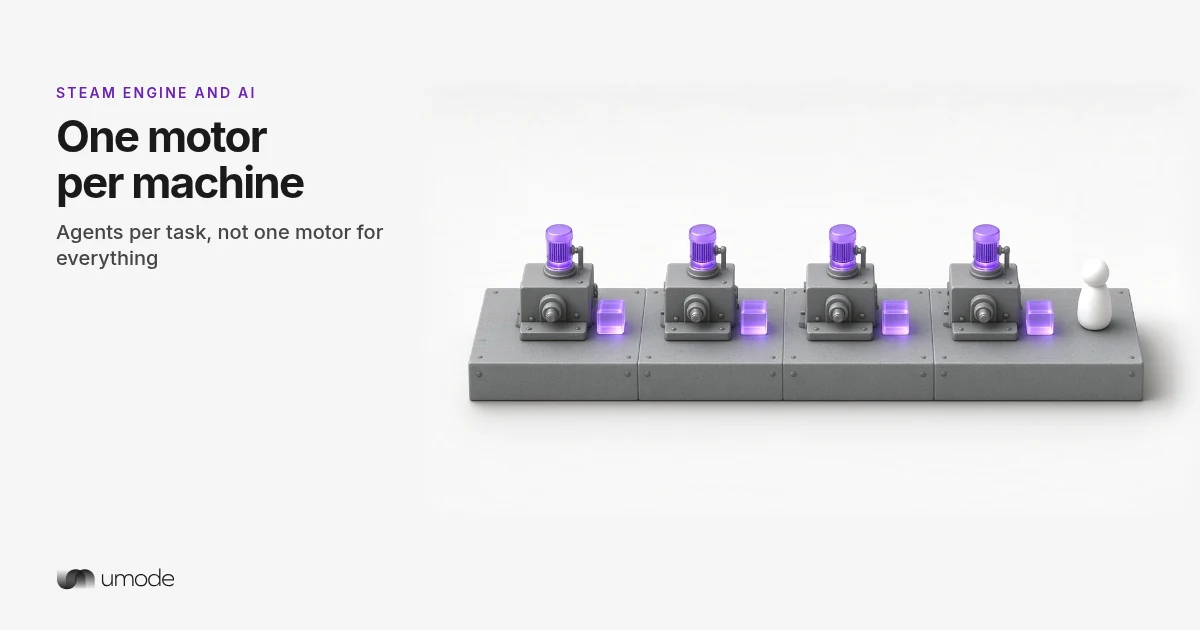
One agent per task is the design in which each task gets its own AI agent, with a rule, an owner and a brake, instead of a single assistant for everything; the AI agents for each task make up the area's fleet.
In short:
- The single assistant that does everything repeats the central shaft of the steam-powered factory: one point that everything depends on.
- A task deserves an agent when it repeats, has a stable rule and more than one person does it.
- An area's agents read the same area context, and when volume grows, one produces and another checks.
- Part of the work should not become an agent, and choosing that part is as important as building the fleet.
You have probably seen the attempt to build "the company agent," which answers questions, writes emails and checks spreadsheets. It impresses in the demo and disappoints on Tuesday. Nobody knows which rule it followed, nobody answers for the error, and when it fails, it fails at everything at once.
This text is part of the guide Steam engine and AI: without redesigning the work, the tool does not change the result.
What does one motor per machine teach about AI agents?
It teaches that the big gain came from the division, not from the power. As the pillar tells it, based on Paul David (1990), factories moved up a level when each machine got its own motor and the building could be organized by the order of the work.
Taken to AI, the lesson is the same. An agent, which is an AI routine that reads the company's context, decides within a rule and delivers something finished, works best when it has a single task. With one task, you can write the rule and know who checks. With twenty, the rule becomes a text nobody reads in full.
The division also changes the risk. An agent with one task decides inside a corridor; an agent for everything decides in any of them.
Why is a single assistant for everything not enough?
Because it concentrates three problems that the division solves. The first is context: it needs to know everything about the company and knows little about each thing, from the size chart to the supplier's deadline. The second is checking: if it does everything, nobody knows whether it checks the tech pack or the email. The third is maintenance: changing a sales rule can break what it did for pattern making.
The general assistant works well for thinking together, drafting or answering a question. The problem starts when the company expects from it the area's repeated work, which calls for a written rule and someone who answers for the result.
How do you choose the task that deserves an agent?
With the three questions the Context Leader Track (TLC) uses to decide when it is worth writing an instruction: does it repeat, does it have a stable rule, does more than one person do it. I use the same ones to choose an agent: three yeses, and the task deserves one.
The best place to look is coordination, which the pillar teaches how to separate from execution on the process map. In fashion, it shows up in chasing the supplier for the sample, consolidating the fitting feedback and warning pattern making of a fabric change: small, repeated tasks with a clear rule, which today eat the week of expensive people.
The chosen task's rule follows the six-field instruction: goal, input, rule, exception, done criterion and output.
Want to practice now? The Context Leader Track lessons are free, and a free account saves your progress. The course is in Portuguese. Create your free account.
How do an area's agents work together?
By reading the same Brain and passing the work from one to the other, each with its own stop. A Brain is the place where the company's context lives, organized and with control over who accesses what. If each agent has its own context, the area goes back to having several versions of the truth.
The table shows one possible design, as an example, for collection development.
| Task | What the agent does | Who checks | Where it stops |
|---|---|---|---|
| Sample status | Consolidates supplier feedback into a daily summary | Another agent, against the order list | Does not change an agreed deadline |
| Supplier follow-up | Prepares the follow-up message with the history | The person responsible for purchasing | Sending waits for approval |
| Record check | Flags a missing field or one outside the rule | Whoever looks after records | Does not correct production data |
| Change notice | Warns the affected areas when a fabric changes | The product owner | Only warns, does not decide |
The "who checks" column follows another technique from the track: when volume grows, one agent produces and another checks. And when the agent errs, look at the Brain first: often it only obeyed what was there.
The "where it stops" column applies the approval stop, one of the three brakes the text on AI agent brakes details: anything that leaves the company, spends money or changes production data waits for a human.
Illustrative scene, not a real case: a brand builds the Collection Agent, which does everything in development. In the second week, it confirms to the supplier a deadline the buyer had just renegotiated, because it read the old email. In the meeting about the case, nobody can say which rule it followed. The following month, the Collection Agent becomes four small agents. The team's favorite is the one that only chases late samples, and it does so with a politeness no human would have at six on a Friday evening.
What should not become an agent?
Hard conversations, decisions that depend on a relationship, judgment that needs an owner and tasks too rare to be worth the maintenance. The list comes from the Context Leader Track, on the step where the person already looks after a queue of agents.
In fashion, that includes negotiating with the strategic supplier and the final choice of the showroom range. AI prepares the material; the decision stays with a person, with a name.
The track points to a mistake that also holds for the fleet: the tool that is born big. Nobody understands it, nobody uses it. The one that is born small and grows at the request of those who use it becomes part of the day.
How do you build the fleet without losing control?
One agent at a time, starting with reading.
How to build the area's fleet: list the week's coordination tasks and run each through the three questions. Choose the one with three yeses and the lowest risk, write the instruction and turn the agent on with read-only permission. The track reminds that reading, writing and sending are three different permissions, and that you start with the first. When it runs without surprises, give it the next permission or move on to the next task. A good fleet grows one agent at a time, and each one starts only by reading.
To read next: first AI agents, the role of the Context Leader, who looks after the fleet, AI maturity, which puts the fleet at the One Motor per Machine stage, and the signs the company only swapped the engine.
Frequently asked questions
What are AI agents per task?
They are agents that do a single task, with a written rule, an owner and a brake, such as one that only chases late samples. The division makes it easier to check, fix and maintain each one.
Why use one agent per task?
Because a narrow task lets you write the rule, define what done means and know who checks. If the records agent errs, the error stays in the records and does not reach the supplier.
How do AI agents work together?
They read the same Brain and pass the work from one to the other. When volume grows, one agent produces and another checks. What leaves the company or changes production data waits for a human.
What tasks should not become an AI agent?
Those that depend on a relationship or on judgment with an owner, such as negotiating with the strategic supplier or closing the showroom range, and those too rare to be worth the maintenance. AI prepares the material; the person decides.
How do you start with the track?
Start with the free account on the Context Leader Track. It brings together free lessons and step-by-step exercises in Claude, and the account saves your progress. At the end of the track, you take your own diagnosis on the TLC yardstick. The course is in Portuguese. Create your free account at tlc.umode.tech.
Want to apply this to your operation?