Signs the company only swapped the engine: how to know whether AI is paying off
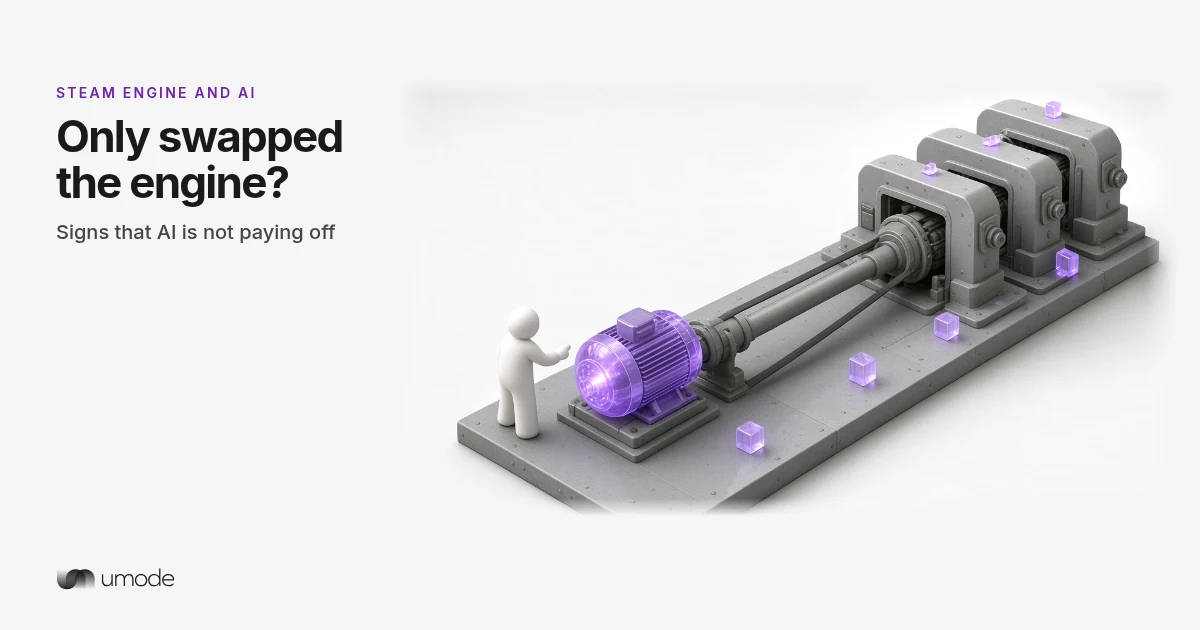
AI is paying off when something has disappeared from the work: a step, a meeting, a retyping. Signs that the company only swapped the engine are observable facts that show AI in use and the work, the meetings and the decisions the same as before.
In short:
- The most common sign is measuring AI use instead of measuring work that changed.
- The signs show up in three places: in the workflow, in people and in leadership.
- You can see almost all of them without an internal survey, by looking at a normal week in the area.
- Finding the signs is good: they show where to start the redesign.
I prefer signs to questionnaires. An internal survey question invites the person to answer what they think should be true, and almost everyone thinks they use AI well. A sign does not depend on opinion. Either the spreadsheet is still being retyped, or it is not.
This text is part of the guide Steam engine and AI: without redesigning the work, the tool does not change the result.
How do you know whether AI is paying off in the company?
Look at the work, not the tool: what disappeared from the day, whether a step, a meeting or a manual check. If nothing disappeared, the company probably hung the new engine on the old shaft, as the pillar tells it.
The AI maturity pillar describes this state as the Swapped Engine stage, where the typical evidence is a corporate license and use measured per person. That evidence proves adoption. Results are another conversation, and the pillar itself sums up the rule: a stage without evidence is opinion.
What signs show up in the workflow?
In the workflow, the easiest signs to see are in the path of information between areas.
| Sign | Where it shows up | What to ask |
|---|---|---|
| The same information typed twice | Old spreadsheet next to the new tool | Which of the two is the official one? |
| The status meeting has the same agenda as before | The week's calendar | What does this meeting decide that a summary would not? |
| Nobody can say which step left the process | Process map, when there is one | Which step stopped existing since AI? |
| Every conversation with AI starts from zero | Long requests, with the company explained again | Where does the context AI should read live? |
| Automation nobody opens | Automatic reports with no reader | Who used this last week? |
Retyping is the most revealing sign. In fashion, the common version is the tech pack that is born in AI, copied into the pattern-making spreadsheet and then into the management system. Three copies, three chances to diverge.
The sign of conversations that start over comes from the Context Leader Track (TLC): without a Brain, every conversation starts from zero, and the person spends ten to fifteen minutes explaining who they are (TLC, method). A Brain is the place where the company's context lives, organized and with control over who accesses what. If each person explains the company to AI every morning, the context still has no home. The text on the AI Brain shows how it is assembled.
Want to practice now? The Context Leader Track lessons are free, and a free account saves your progress. The course is in Portuguese. Create your free account.
What signs show up in people?
In the way they ask and the way they check. The uMode track describes three signs of someone on the first step: they ask for the number instead of giving the data and asking for the calculation; they cannot say why the answer came out that way; they use a personal account with company files.
The third combines weak results and risk: without context in the company's tool, the file goes wherever the answer looks better. Shadow AI is the use of AI outside the company's tools and control; the glossary entry covers it.
Another sign is in the verb. The maturity pillar notes that the person who advances swaps "explain to me how I do the reconciliation" for "reconcile this statement." Whoever still asks for an explanation uses AI as a private tutor. It helps, but the work stays entirely in the hands of whoever asked.
There is also the fluency that deceives. The track warns, on the second step, against believing that a well-written answer is a right answer: the more fluent the text, the more attention the number inside it deserves. If nobody in the area remembers an error they caught in AI in the last month, perhaps nobody is checking.
What signs show up in leadership?
The leadership AI report is usually the worst place to look for results. It shows active licenses, hours of use and number of prompts: engine-on numbers.
The second sign is the question leadership does not ask. Nobody asks which step went away, which error was avoided or what work the area started doing. The text on the AI productivity paradox explains why that count misleads and proposes another.
The third is the eternal pilot: the test that worked and never became routine, or that failed and nobody knows why. It hangs in the air as an "AI project," with no owner.
Illustrative scene, not a real case: the director presents the board with the AI usage chart, rising month after month. A board member asks which step of the collection launch got shorter. The director looks at the product manager, who looks at the analyst, who says the meeting minutes are now ready right away. "And the meeting that generates the minutes?" "Still there. Now it has minutes." The chart kept rising the following quarter. So did the meeting.
How do you run the scan for signs?
In a normal week, with outside eyes.
How to scan one area: choose a deliverable the area produces every week and follow its path from request to delivery. Note each time information is retyped, each meeting that only relays status and each manual check. Then ask a few people which step stopped existing since AI arrived. A vague answer is the first point of the redesign.
The scan comes before the AI maturity self-assessment by area: it shows, without a questionnaire, where the engine swap was left half done.
What do you do after finding the signs?
Choose one and redesign the task around it, before buying another tool. The question that guides the redesign is whether the step needs to exist, not how to do it faster.
The order I suggest follows the pillar. First, context: the task's rules written in a place AI reads. Then, process: the step that goes away and who checks what stays. Last, the agent that runs the task, with a brake and an owner, as the text one motor per machine, agents per task describes. Whoever will lead this in the area needs to know how to look after what the machine knows; the Context Leader guide describes that training.
A company that finds the signs and solves one at a time is already making the investment the tool does not make by itself.
Frequently asked questions
How do you measure the result of AI in the company?
Measure, on a real deliverable, the work handed back, the error avoided with a concrete case and the new capacity, before and after the redesign. The guide on the AI productivity paradox shows the first measurement.
Why does AI not deliver results in my company?
The most common reason is using AI inside the old process, with no written context and no steps eliminated. It is the tech pack that is born in AI and keeps being copied into the spreadsheet and the management system.
What are the signs that AI was only bought, not adopted?
Information retyped between the new tool and the old spreadsheet, meetings with the same agenda, conversations with AI that start over from zero and reports that measure use instead of work handed back.
Does high AI use mean results?
No. High use shows the engine is on. A result is one step fewer, an error avoided with a concrete case or work the area started doing that it did not do before.
How do you start with the track?
Start with the free account on the Context Leader Track. It brings together free lessons and step-by-step exercises in Claude, and the account saves your progress. At the end of the track, you take your own diagnosis on the TLC yardstick. The course is in Portuguese. Create your free account at tlc.umode.tech.
Want to apply this to your operation?