AI maturity stages: the seven steps of the ladder, with the signal and the lock of each
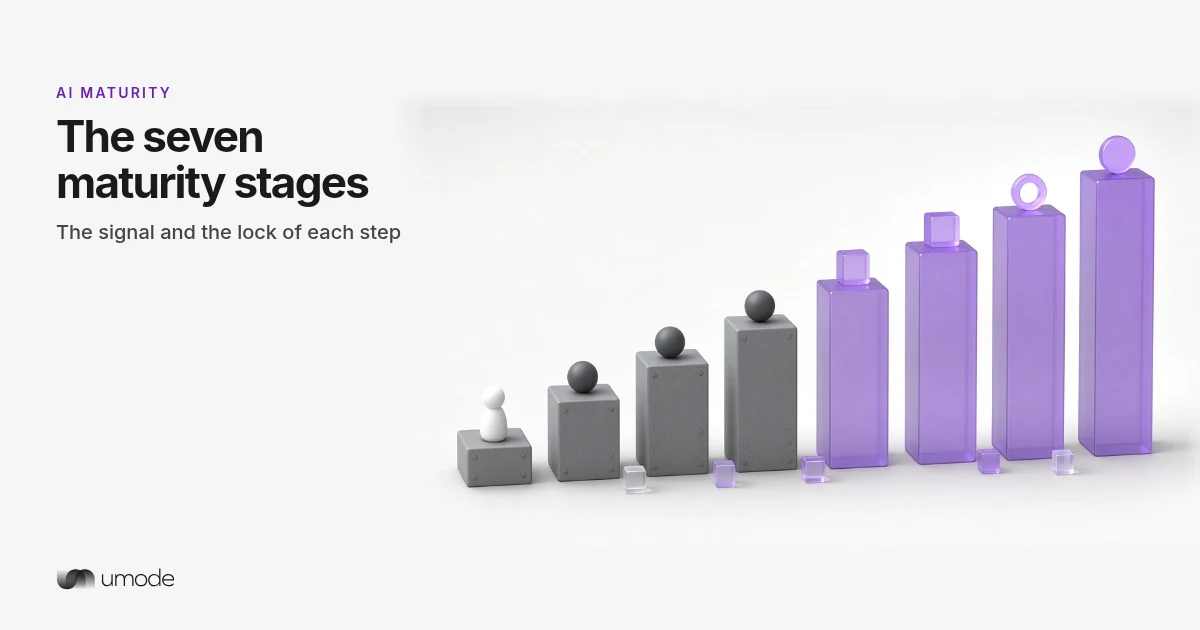
The AI maturity stages are seven positions on a scale, from Steam to Frontier, that show how a company area uses AI in real work.
In short:
- The scale has seven stages: Steam, Swapped Engine, App Shortcut, Seeded Brain, Connected Brain, One Motor per Machine and Frontier.
- Each stage has an observable signal. Without the signal, the area stays in the previous stage.
- What blocks the climb is almost never the tool. It is usually context without an owner or a ritual that does not stick.
- The company's stage is the one most areas are in, and an advanced pilot does not change that count.
The question I hear most from fashion leadership teams is "what stage are we in?". In my experience, the honest answer comes area by area and lands one stage below what leadership expected.
This text is part of the guide AI maturity model for fashion companies: from Steam to Frontier, measured by area.
How do you read each stage of the scale?
Each stage brings what it is, the signal that confirms it and what usually blocks the step up. The same task, the finance team's bank reconciliation, runs through every stage to keep the comparison concrete.
The scale measures the area, each one by its anchor task. To do the reading, the AI maturity self-assessment by area has the questions for each dimension.
How do you recognize stages 1 and 2, Steam and Swapped Engine?
In Steam, the company has not taken ownership of AI, and the team uses it on its own, with personal accounts. In Swapped Engine, the company bought licenses for everyone, but the process stays the same.
Steam. People who use it take company documents to a personal account, with no written rule. Bank reconciliation is done by hand, line by line, at close.
- Signal: no corporate license.
- What usually blocks it: the ban. When leadership discovers the hidden use and prohibits it, the use continues and gets more hidden. The entry on shadow AI shows how to bring that use inside with a rule.
The fear of leaking data comes before any stage, and the entry condition answers it: a corporate account, a written guideline and sensitive data kept off the machine.
Swapped Engine. Some use it a lot and others never open it. Each request starts by explaining the company from scratch. In reconciliation, the analyst asks AI for help building the spreadsheet, and the work goes on the same.
- Signal: a corporate license and use measured per person.
- What usually blocks it: training the request without choosing the task. The team writes better for the machine, no task changes shape and nobody points to the result of the license.
How do you recognize stages 3 and 4, App Shortcut and Seeded Brain?
In App Shortcut, areas build their own applications without waiting for IT. In Seeded Brain, the company has, for the first time, one place of context that apps and agents read.
App Shortcut. This is the liveliest stage and the trickiest: spreadsheets become small systems and the first redesigned task appears. The analyst builds a reconciliation app, and the rule lives in her head.
- Signal: how many apps are in use and how many read from a common source.
- What usually blocks it: the app depends on whoever built it. When that person goes on vacation, the app stops, and IT finds out it has to support something it never saw. The person who built the app usually stays on step 3, and the track says why: nobody is recognized above step 3 with context below C2.
Seeded Brain. Processes, customers, products and rules are written in one place, fed by hand by one person. The reconciliation rules are written in the Brain, and the app reads from there.
- Signal: a Brain with an owner, a last-updated date and a ritual on the calendar. Agents cite the source, refuse to make things up and say what is missing.
- What usually blocks it: the keeper with no time. The Brain lives in the leftovers of a busy person's calendar and goes stale. The guide on the AI brain shows how to build that place.
Want to practice now? The Context Leader Track lessons are free, and a free account saves your progress. The course is in Portuguese. Create your free account.
How do you recognize stages 5 and 6, Connected Brain and One Motor per Machine?
In Connected Brain, each person feeds the company Brain through a ritual, and calls and decisions become context the same day. In One Motor per Machine, routines keep the context up to date on their own and agents warn leadership before anyone asks.
Connected Brain. Context starts being fed by everyone, and agents answer with history. Reconciliation runs with the rules the team taught, and the exception arrives with the supplier's history.
- Signal: calls and decisions logged in the Brain the same day. On the person's yardstick, C2 has a signal published by the track: capture coverage above 50% for four weeks.
- What usually blocks it: the fear of exposure. People who do not know what is theirs and what is the company's log little, so that separation has to be written down before the ritual.
One Motor per Machine. Routines update the context, and whoever knows the pain builds the application. The Brain reconciles and explains the exceptions, and the finance person takes care of cash and new fronts.
- Signal: context routines with a daily log, and an indicator deviation reaching leadership first through an agent.
- What usually blocks it: the human cadence of approving. The machine produces more than people check. The text on human approval by stage shows who approves what at each stage.
What is stage 7, Frontier?
Frontier is the destination uMode uses for the ladder: the company becomes a network of outcome squads, each with a Context Leader and its agents, all reading from the same Brain.
Suppliers and workshops work inside that context, with permission. In reconciliation, the cash squad answers for the company's cash result, and reconciliation becomes one of the routines it governs.
- Signal: squads with their own result, a Context Leader in each and partners reading from the same Brain with a written access rule.
- What usually blocks it: the access rule. Deciding what each partner sees takes longer than the technology.
The role that holds this design up is the Context Leader (HIC), the method uMode created to develop what the world calls an HIC (high individual contributor), adapted to develop superhuman professionals.
Can you skip a stage?
An initiative can sit above the company's stage, but the company only changes stage when most areas change. A company at stage 3 with a stage 5 pilot is still at stage 3.
The advanced pilot shows the way and develops people. The risk is leadership thinking the whole company has arrived.
An area that writes the task rules in one place with an owner and a date goes from stage 3 to 4 without changing tools. The quick wins by stage suggest a first move for each point on the scale.
Frequently asked questions
What are the AI maturity stages?
There are seven: Steam, Swapped Engine, App Shortcut, Seeded Brain, Connected Brain, One Motor per Machine and Frontier. Each stage has an observable signal, and the area is only in it when the signal shows up in the work.
Which stage is the most common in fashion companies?
In my experience with leadership teams, most areas sit between Swapped Engine and App Shortcut: a license bought, a few apps and scattered context.
What separates stage 3 from stage 4?
The common source. At stage 3, each app keeps its own rules. At stage 4, the rules sit in a Brain with an owner, a date and a ritual, and apps and agents read from there.
Does buying a new tool move the area up a stage?
No. The stage changes when the signal shows up in the work. A new tool without context usually leaves the area at the same stage, with one more app.
How do you start with the track?
Start with the free account on the Context Leader Track. It brings together free lessons and step-by-step exercises in Claude, and the account saves your progress. At the end of the track, you take your own diagnosis on the TLC yardstick. The course is in Portuguese. Create your free account at tlc.umode.tech.
Want to apply this to your operation?