What is the difference between PDM and PLM?

PDM (Product Data Management) and PLM (Product Lifecycle Management) differ in scope in fashion: PDM stores the technical data of the piece; PLM carries that data through the whole collection. PDM looks after the sketch, the materials, the measurements and the versions. PLM includes all of that and adds the people, the stages, the approvals and the product's path to the store.
The confusion between the two has an explanation: both deal with the same tech pack. In fashion, PDM matches the core of the tech pack, and PLM matches the whole collection in motion, with who approved, when and what comes next.
This text is part of the guide Fashion PLM: the complete guide, from tech pack to collection launch.
What is PDM?
PDM is the software that organizes the technical data of the product and the versions of that data. It answers the question "what is this piece?" with a sketch, a specification, materials, measurements and composition, and makes sure everyone opens the current version.
In fashion, a PDM covers what lives in the tech pack: the construction notes, the bill of materials and trims, the size chart and the revisions of the style. The focus is the data itself, stored in order and under version control.
The limit of PDM shows up when the piece leaves the development desk. It knows which tech pack is current, but it usually does not record whether the supplier already received that tech pack, whether the pilot sample was approved or whether the product has already reached the ERP.
What is PLM software?
PLM software is the system that follows the product through every stage, from collection planning to sale, with the technical data at the center. It answers another question: where does the piece stand, who decides the next step and what changes if someone touches it now?
In fashion PLM, the software works as a collection management system: it brings together what PDM stores and adds layers of process:
- Planning and assortment: the size of the collection, the categories and the purchase budget.
- Creation: references, sketches and the choice of what moves on to development.
- Supplier: the exchange of tech packs, questions and comments with whoever produces, in the same place where the tech pack lives.
- Approval: the record of the pilot sample, with adjustments and owners. When the pilot comes back with the wrong length, the correction request is noted in the tech pack itself.
- Calendar: the dates for each stage and what is late. The buyer who asks whether the color has been approved finds the answer without messaging anyone.
- Integration and sale: the approved product moving on to the ERP and to the catalog without retyping.
The article PLM in fashion: how it works shows this cycle in detail, and the text what PLM is and why fashion is talking about it explains the definition for people just starting out.
What is the difference between PDM and PLM?
The difference between PDM and PLM in fashion is one of scope: PDM stores the technical data of the piece and stops there, while PLM includes that management and carries the data through the whole collection, with people, stages and approvals.

On one side, the right tech pack stored; on the other, the same tech pack moving through design, supplier, approval and ERP. uMode diagram, 11/26/2026.
In short, PDM answers what the piece is, is used by development and runs from the sketch to the closed tech pack; PLM answers where the piece stands and who decides, is used by every area and by the supplier and runs from collection planning to sale.
| Aspect | PDM | PLM |
|---|---|---|
| Question it answers | What is this piece? | Where does this piece stand and who decides the next step? |
| What it stores | Sketch, specification, materials, measurements, versions | Everything in PDM, plus planning, approvals, supplier, calendar and decision history |
| Who uses it | Development, pattern making and product engineering | Design, development, sourcing, planning, supplier, catalog and leadership |
| When it comes in | From the sketch to the closed tech pack | From collection planning to sale |
| Relationship with the ERP | Expected role: keep the tech pack another system will use | Expected role: carry the approved product to the ERP through integration |
| What it does not do | Follow stages, deadlines and approvals | Invoice, control physical inventory, handle tax |
The boundary is not rigid in the market. Some software sold as PDM already handles approval, and some software sold as PLM barely goes beyond the tech pack, so look at the function before the label.
Why does fashion talk more about PLM than about PDM?
Fashion talks more about PLM because the collection's problem goes beyond the technical data and includes the path it travels between areas, suppliers and deadlines. A perfect tech pack that does not reach the supplier is worth as much as an incomplete one: the pilot comes out of the old file.
Other industries can work for years with the same product and several revisions. Fashion swaps the whole collection at the pace of the collection calendar. The same blouse, in several colors and a full size run, goes through design, pattern making, sourcing and the supplier in the same week, and each one swears to have the newest version. At that pace, knowing who needs to act now weighs as much as knowing which tech pack is current.
Illustrative scene: you open the PDM and find the right tech pack, revised and tidy. The supplier, however, is sewing from the file received by email the week before, and the tracking spreadsheet says "approved" without saying which version. The data was right; the path was missing.
What should you look for when choosing PLM software for fashion?
When choosing PLM software for fashion, look at whether the tech pack adapts to your product, whether the history is reliable and whether the system talks to the people outside the company and to the ERP. The list below works as a script for the demo:
- Configurable tech pack: the fields should reflect your product, with different types, closed lists and filling rules. In the demo, ask to create or change a field live and see who does it: someone on your team or the software vendor. The article on configurable base tech pack and size chart goes deeper on this point.
- Libraries: colors, materials, compositions, suppliers and size runs registered once and reused across all tech packs.
- History and lock: each change with author and date, and the approved tech pack protected from change without a reason, as tech pack version control requires.
- Supplier inside: the partner sees the tech pack that is theirs, comments and sends it back without depending on email. Ask to see the supplier's screen, not only the brand's.
- ERP integration: the approved product moves on without retyping. Ask to see an integration error and check whether the message says what to fix in words the records team understands.
- Access by role: each person sees and edits what their role calls for, with the brand's data isolated from other companies'.
- Entry in stages: the rollout starts with the most urgent pain and grows module by module, instead of demanding everything at once.
The criterion that usually gets left out is how long your team takes to change a field. If every adjustment becomes a ticket to the software vendor, the tech pack ages faster than the collection.
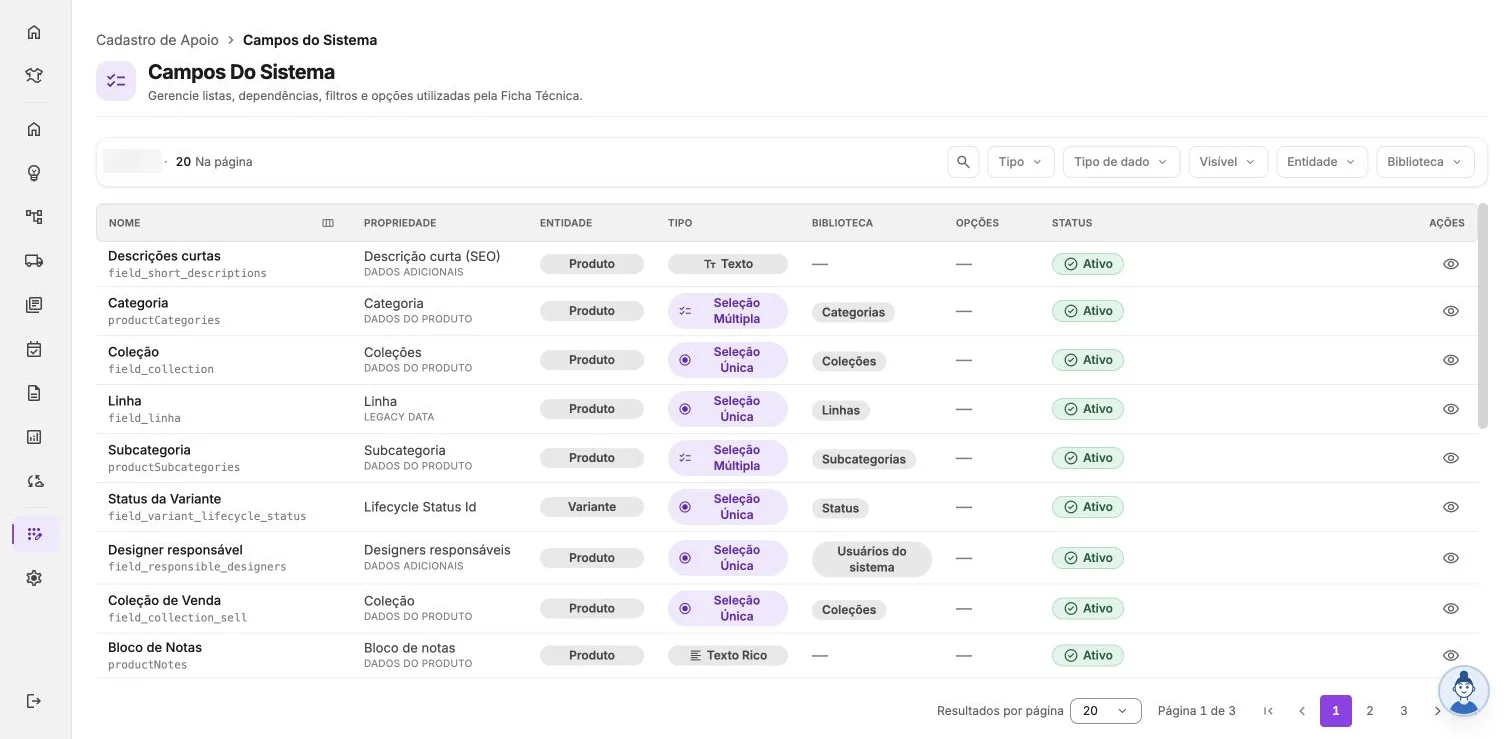
On the System Fields screen, each tech pack field appears with property, entity, type, library, options and status. Screenshot of uMode's PLM, demo account, 11/12/2026.
How uMode's PLM handles it. In Configurações (Settings), the Construtor de Fichas Base (Base Tech Pack Builder) assembles the tech pack with text, selection, currency, date and formula fields, links to a library and rules to show, hide, make read-only or require. The Bibliotecas (Libraries) hold colors, materials and size runs; Cadastro de Apoio (Support Records) ties each selection field of the tech pack to a library and holds the Validações (Validations), rules with an error or warning message. The base tech pack plays the role of the PDM core, and what it defines moves on to the PLM layer: what Desenvolver (Develop) shows, what Fornecedor (Supplier) sees and what Integração (Integration) sends to the ERP. Get to know uMode's PLM (in Portuguese).
When is a PDM enough?
A PDM is enough when the brand's problem is concentrated in the technical data and the rest of the process already works with few people and little exchange with suppliers. For a manufacturer that produces to order, with a stable tech pack and little new collection, organizing the data may be enough.
The sign that the PDM has become too small is the right data arriving late or reaching the wrong people. When the question stops being "which is the tech pack?" and becomes "who has already seen this tech pack?", the brand needs to follow the cycle, not only store the file. The entry on PLM or spreadsheet helps measure that point for anyone still working in loose files.
Frequently asked questions
Does PLM replace PDM?
PLM absorbs PDM instead of replacing it. Managing the technical data stays at the center, with tech pack, materials, measurements and versions, and PLM adds the stages, approvals, supplier and calendar around it.
Is PLM a collection management system for fashion?
Yes, fashion PLM works as a collection management system. It follows each piece from planning to sale, with the tech pack at the center and the approvals, the supplier and the calendar around it.
What is the difference between PDM, PLM and ERP?
PDM keeps the right tech pack, PLM gets that tech pack to approval and to the supplier, and the ERP handles what comes after: invoicing, physical inventory and tax. The entry on ERP, PLM and PIM details that boundary.
Can I start with PDM and migrate to PLM later?
You can start by organizing the technical data and expand later. What preserves the history is the tech pack already having versions with author and date; in the demo, ask how that history follows the tech pack when the process enters the system.
Is rolling out PLM software a multi-year project?
The timeline depends on the scope, the number of modules contracted and the ERP integration, so each brand needs to measure its own in the conversation with the software vendor.
PDM knows which tech pack is the right one; PLM knows whether the supplier is already sewing from it.
Want to apply this to your operation?