What is production planning and control (PCP) in apparel manufacturing and how do you schedule?
Understand how production planning and control connects order, materials and capacity, with a filled-in table and steps to correct a schedule that exceeds the available minutes.
On this page
PCP, production planning and control, organizes materials, capacity, orders and work sequence to produce and follow orders in fashion apparel manufacturing.
You promised 150 Aurora shirts for tomorrow, and collar attaching cannot handle 150: only 144 are ready by then. The Spreadsheet stays green. Whoever explains the six that are missing is you.
What does PCP do in apparel manufacturing?
PCP decides how much work fits in the operation, in what order it runs and when it needs to happen, and then follows what escaped the plan.
It brings together four activities: loading (how much work each part of the operation receives), sequencing (the order of execution), scheduling (the timetable) and monitoring and control. Planning formalizes what is desired for the future; controlling is dealing with variations, which may call for a redone plan or an intervention in the operation (Information system for the production planning and control process, Exacta, 2017, PDF p. 4).
In daily routine, you weigh the order against the resources before promising and compare what was scheduled with what was done while the lot moves. Demand planning says what needs to be done; scheduling turns that into work that fits in sewing.
When should you release a production order?
Release it when all the components are available and the volume fits the capacity, respecting the time of each stage.
The order is born in PCP, according to prior planning, and the volume released needs to be compatible with the machine-minutes and labor-minutes available (GEPROS, PDF pp. 3, 4 and 6). Before letting it go, check fabric and trims and add up the load against the minutes. Lead time comes in here, because each stage has its own time.
An order issued does not mean a lot is ready. Fabric in stock answers half the question; the other half is whether there are minutes to carry it out.
How do you schedule production, step by step?
Calculate the order's load, compare it with the capacity of each operation and reschedule what goes over the limit.
Capacity is the maximum quantity a production unit makes in a given time interval. Operation capacity = minutes available per operator ÷ standard time × number of operators; in the example, 360 ÷ 5 × 2 = 144 pieces. In the 2017 sewing study, the operation with the lowest capacity limited production (Application of the time and motion study as a tool, Proceedings of the 5th SIMEP, 2017, PDF pp. 8 and 9).
The six shirts without a collar at 5 pm have a calculation behind them. Put numbers on the Aurora, an invented woven shirt, with two operations and their own crews.
| Field | Value |
|---|---|
| Reference and order | Aurora, woven shirt; 150 pieces: S 50, M 50, L 50 |
| Lot materials | Consumption adopted: 1.5 m per piece; requirement: 225 m; stock available: 240 m; trims complete |
| Standard time adopted | Attach collar: 5 min per piece; close shoulders: 3 min per piece |
| Availability reserved | Each operation has its own 2 operators, with 360 min each: 720 min for the collar alone and 720 min for closing shoulders alone |
| Capacity to attach collars | 360 ÷ 5 × 2 = 144 pieces in the day |
| Capacity to close shoulders | 360 ÷ 3 × 2 = 240 pieces in the day |
| Before: whole lot scheduled on the collar | 150 × 5 = 750 min required; excess of 30 min over the 720 |
| After: operation limit | 144 pieces on the collar; balance of 6 pieces to reschedule |
- Record the 150 pieces and the size run distribution of the order.
- Confirm that the 240 m of fabric covers the 225 m required and that the trims are complete: the order only releases with everything available.
- Calculate the capacity of each operation in the routing. In this example, attaching collars (144 pieces) is the operation with the lowest capacity, against 240 for closing shoulders.
- Compare the lot's load of 750 min with the 720 min reserved for the collar and see the excess.
- Sequence the orders competing for the collar: record the order of entry of each one, follow the sequence as they complete and reschedule when necessary.
- Schedule 144 pieces on the collar and set aside another date for the remaining 6.
The Spreadsheet showed the lot green, and at 5 pm six shirts were waiting without a collar while the shoulder bench had already finished. The operation with the lowest capacity defines how many pieces come out in the day; adjust that operation before the others.
Frequently asked questions about PCP in apparel manufacturing
What should you do when the executed sequence changes?
When sewing runs a different sequence, PCP compares it with the plan and reschedules the affected orders. The difference can create delays or finished goods inventory (GEPROS, PDF p. 2). Reorder the orders at the operation with the lowest capacity and update the date of the balance; also follow the work in progress.
Does a material calculation system solve PCP?
Not by itself. The 2017 case study in the journal Exacta points out that the system only pays off with defined processes, information management and responsibilities.
How do you record the balance of a rescheduled lot?
Mark the balance with the next expected date and reschedule as orders complete, so that nobody mistakes it for a finished delivery.
Promise the 144 that the collar can sustain and the date of the six that are missing: a delivery promise is only worth something when it fits in the minutes of sewing.
Verified facts
- Planning formalizes what is desired to happen in the future; controlling involves dealing with variations, redoing plans or intervening in the operation.
Source: redalyc.org ↗ - Production planning and control (PCP, from the Portuguese acronym) involves four activities: loading, sequencing, scheduling, and monitoring and control.
Source: redalyc.org ↗ - Loading corresponds to the amount of work in each part of the operation, sequencing to the order of execution and scheduling to the timetable of activities.
Source: redalyc.org ↗ - Production orders are issued and controlled by PCP according to prior planning.
Source: revista.feb.unesp.br ↗ - The volume of released orders needs to be compatible with the capacity to produce, which can be expressed in machine-minutes and labor-minutes available.
Source: revista.feb.unesp.br ↗ - Releasing an order requires the availability of all components and respect for the times of each stage.
Source: revista.feb.unesp.br ↗ - Follow-up on the shop floor includes sequencing orders as they are completed and rescheduling when necessary.
Source: revista.feb.unesp.br ↗ - Executing a sequence different from the one planned by PCP can result in delays or finished goods inventory.
Source: revista.feb.unesp.br ↗ - Capacity is the maximum quantity of products that a production unit can make in a given time interval.
Source: bdtd.ufcg.edu.br ↗ - In the 2017 sewing study, the capacity of each operation was calculated by dividing the minutes available per operator by the standard time and multiplying by the number of operators; the operation with the lowest capacity limited production.
Source: bdtd.ufcg.edu.br ↗ - Implementing a material calculation system does not guarantee efficient PCP without defined processes, information management and responsibilities.
Source: redalyc.org ↗ - The 2017 document used for the capacity calculation is called Application of the time and motion study as a tool and is part of the Proceedings of the 5th SIMEP.
Source: bdtd.ufcg.edu.br ↗ - The article Information system for the production planning and control process: case study applied to an apparel manufacturing industry was published in 2017 in the journal Exacta.
Source: redalyc.org ↗
Related entries
Work in progress in fashion production
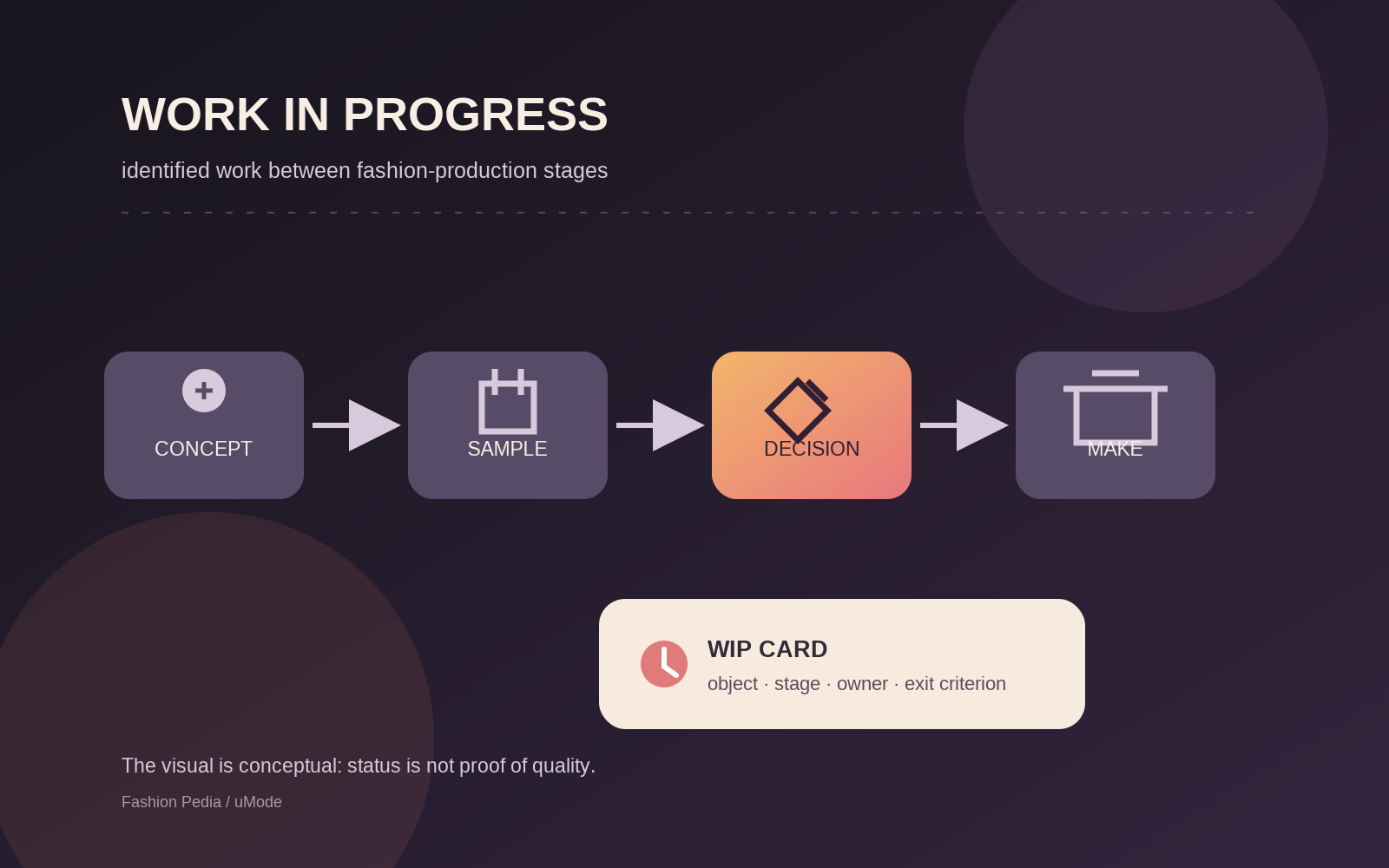
Work in progress in fashion production. Work in progress (WIP) is work located between processing steps and not yet at its defined exit state. In fashion production, the idea helps distinguish samples, approvals and garments in manufacture by stage, criterion and owner.
Lead time in the fashion supply chain
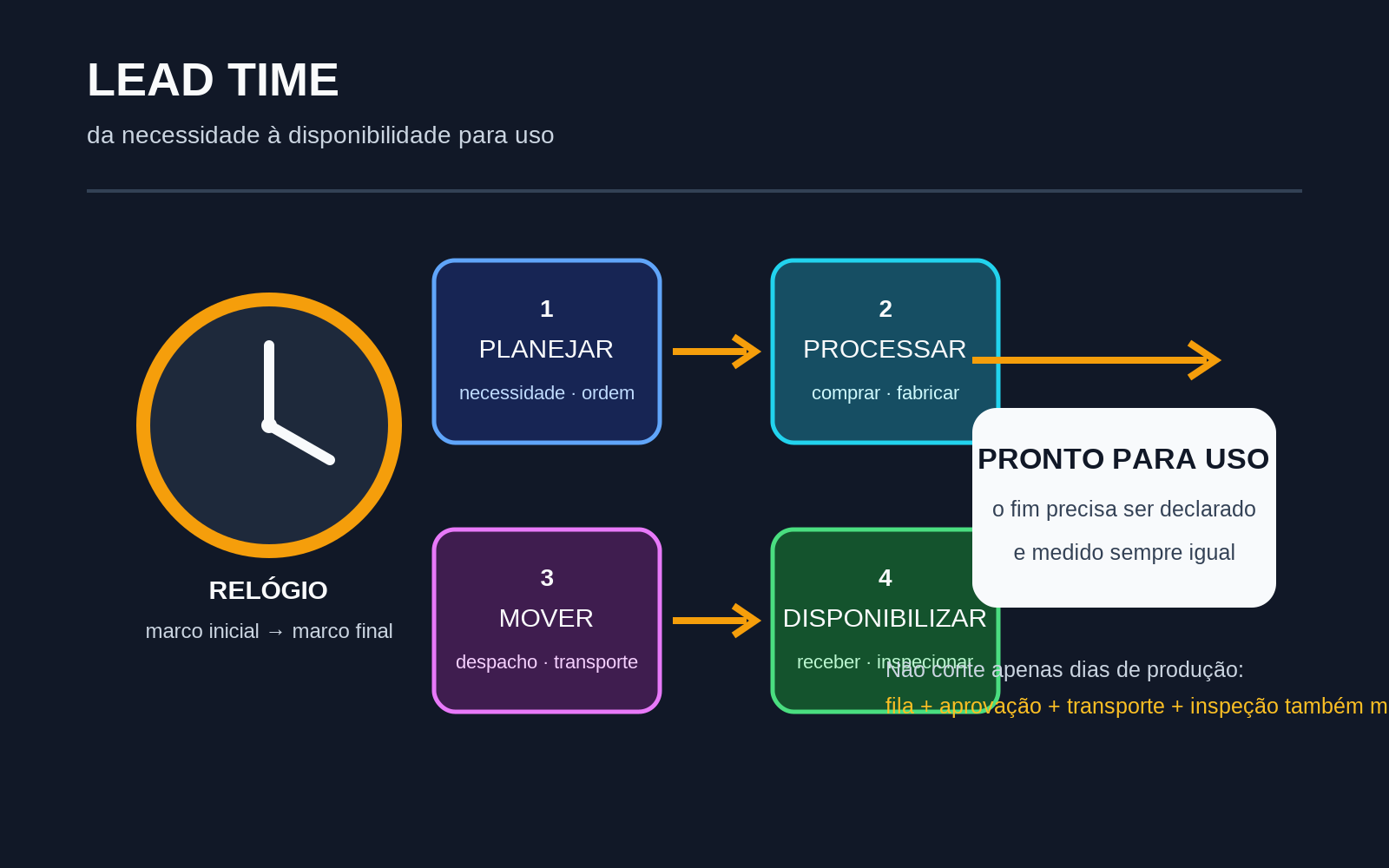
Lead time in the fashion supply chain. Lead time in a fashion supply chain is the elapsed time between defined operational milestones, such as ordering and receipt or design and production. A useful measure states its object, start, end, waiting periods, calendar, unit and availability condition.
Demand planning in fashion
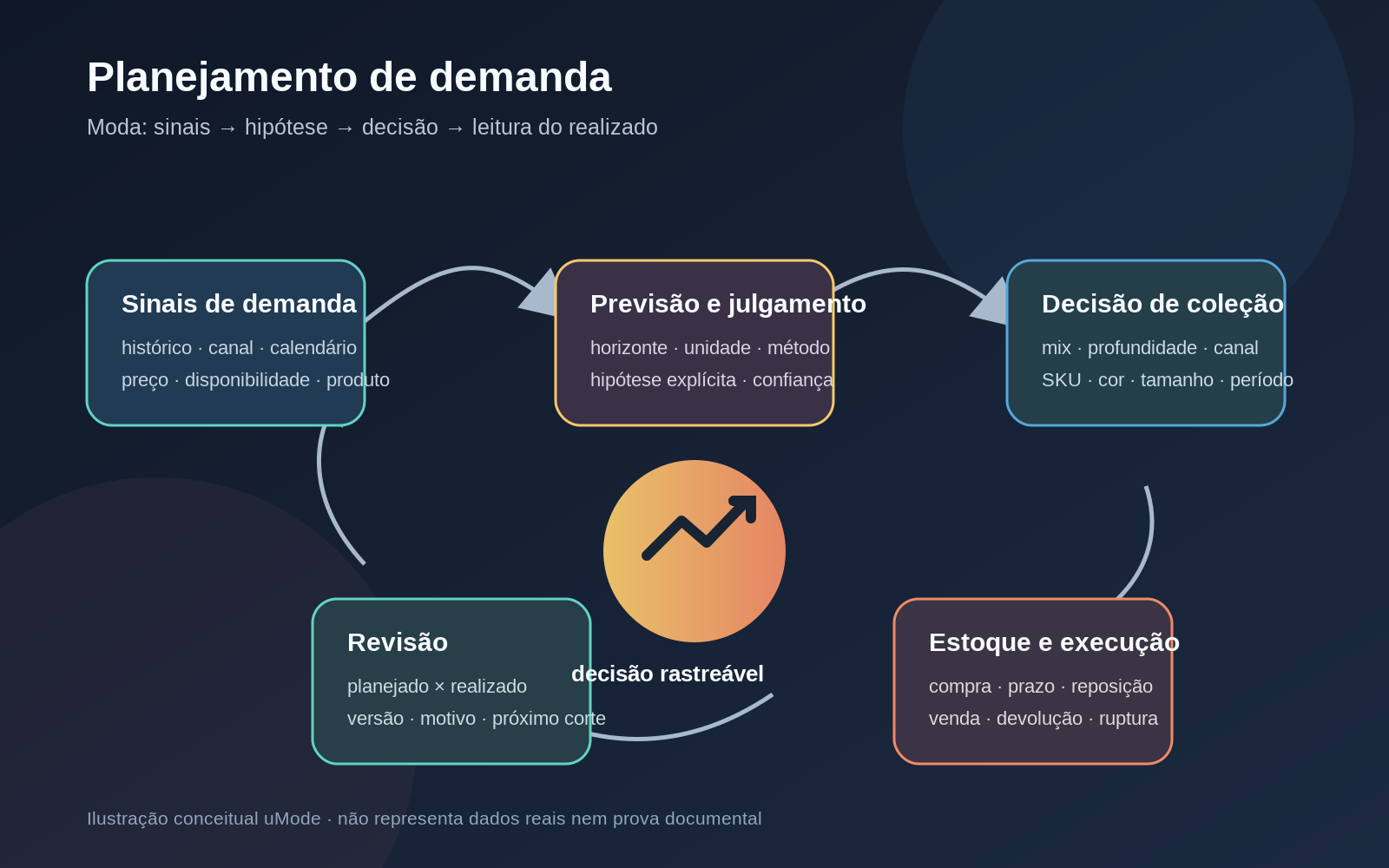
Demand planning in fashion turns demand signals, history, calendar context and judgement into explicit decisions about assortment, volume, channel and review. It combines forecasting with governance: every hypothesis needs a horizon, unit, owner and rule for revision when the collection or market changes.
Sources
Want to apply this to your operation?