What is sewing subcontracting (facção de costura): how it differs from a garment factory
A facção de costura is a company that sews garments for another brand. See how it differs from a garment factory, who the faccionista is and how to record the lot, with the Brazilian rules that apply.
On this page
- Facção or garment factory: what is the difference?
- How do you record the lot sent to the facção?
- What is the CNAE code of a sewing facção?
- Which invoices go with the facção?
- Who pays for the kit lost at the facção?
- When does the contracting company answer for labor debts?
- What other questions still come up about sewing subcontracting?
A facção de costura, also called a facção de roupas, is a company hired to sew fashion garments for another company, which supplies the raw material and trims. In English, the closest terms are sewing subcontractor, contract sewing and cut-make-trim (CMT). You release a lot because The Spreadsheet says "done", and it almost pays for the crooked collars; the review catches the error before packing.
Facção or garment factory: what is the difference?
The garment factory (confecção) makes the clothing inside the textile and apparel chain and may outsource parts; the facção carries out the part ordered, such as sewing. Sebrae/RS lists sewing subcontractors next to print shops, embroidery, pattern making, cutting and finishing among the outsourced parts (Production Process Management, Sebrae/RS, 2007, p. 26). In the order to the facção, describe the operation: "assemble body, sleeves and collar" says more than "produce t-shirt".
How do you record the lot sent to the facção?
Record separately what went out, what came back, what was approved and what needs rework. The spec sheet and the pilot sample guide the facção to reproduce garments with the same characteristics and qualities (Outsourcing in the apparel industry, Projética, 2021, p. 3).
Think of the Aurora, an example t-shirt.
| Field | Value |
|---|---|
| Garment and service | Aurora t-shirt; assemble body, sleeves and rib collar |
| References | Aurora spec and pilot sample; return on the agreed Friday |
| Shipment | 600 cut kits, trims supplied by the contractor |
| Return and balance | 588 pieces received; 600 − 588 = 12 kits to locate |
| Review | 561 approved + 27 crooked collars (rework) = 588 received |
| Wrong calculation | The Spreadsheet almost paid the whole return: 588 × R$ 3.20 = R$ 1,881.60; the review caught it in time |
| Right calculation | Approved only: 561 × R$ 3.20 = R$ 1,795.20; the R$ 86.40 for the 27 collars is held back, with no discount |
| Agreed | Collars redone at no cost by the following Monday and paid at R$ 3.20 after approval; balance located before closing; cause and person responsible for losses noted |
- Note the service, spec and pilot sample; check the CNAE code.
- Record the shipment and the agreed return.
- Count what came back and mark the balance.
- Separate approved pieces and rework, with the defect.
- Pay for the approved pieces and hold the rework.
- Settle the balance before closing.
Marking everything as approved is pinning the collar with pins and calling it finishing. In sourcing and supplier management, the record should let you pick the open item back up without rebuilding the conversation.
What is the CNAE code of a sewing facção?
The National Classification of Economic Activities (CNAE) splits the facção into three codes: 1412-6/03, Subcontracted sewing of apparel, except underwear; 1411-8/02, Subcontracted sewing of underwear; and 1413-4/03, Subcontracted sewing of workwear (CNAE Subclasses 2.3, IBGE/CONCLA, 2020, p. 51). For the Aurora, the first applies.
Which invoices go with the facção?
You ship the kits under 5.901 or 6.901. The facção returns the applied inputs under 5.902 or 6.902, the unused ones under 5.903 or 6.903, and bills "Manufacturing performed for another company", its service and materials, under 5.124 or 6.124. The first code applies within the state and the second between states (CONFAZ, CFOP table, Convênio s/nº of 12/15/1970). A kit to be located is not an unused input: record the occurrence before deciding the tax treatment. These are Brazilian tax rules; outside Brazil, the equivalent paperwork depends on local law.
Who pays for the kit lost at the facção?
The answer needs to be in the order before shipping. In a labor-only work contract, risks without fault of the contractor fall on the owner, and the contractor pays for the materials it ruins through lack of skill or negligence (Civil Code, Law no. 10,406/2002, arts. 610, 612 and 617). These articles do not make the facção a work contract, and art. 610, § 1, says that the obligation to supply materials is not presumed; so also say who buys the thread and trims.
When does the contracting company answer for labor debts?
In a case reported by the Superior Labor Court (TST) on 10/06/2026, the contracting company answered secondarily for the facção's labor debts because it carried out daily inspection of the pieces and quality control inside it (Textile industry will answer for debt of subcontractor company, no pagination). It was a single case, decided on the interference.
What other questions still come up about sewing subcontracting?
Faccionista: what is it?
The faccionista is the owner of the facção. In a thesis about Blumenau (SC), the women interviewed sew for other companies in the same line of business, alone or with employees, often at home (Fronza, doctoral thesis, UFSC, 2017, pp. 137 and 161).
Is a facção the same as private label?
No. In a facção the client supplies raw material and trims and hires only the labor; in private label, the contractor delivers the finished garment with the client's label (Emídio and Sabioni, Projética, 2010, p. 7).
On the Aurora, the review caught the collars in time, and "done" became received, approved and pending.
"Done," in The Spreadsheet, is only an opinion; an approved piece is what counts.
Verified facts
- Emídio and Sabioni, in the 2010 Projética article, describe the facção as a process in which the client supplies raw material and trims and hires the labor; in private label, the contractor delivers the finished garment with the client's brand label.
Source: ojs.uel.br ↗ - Production Process Management, from Sebrae/RS, 2007, describes the outsourcing of parts of the garment manufacturing process to sewing subcontractors, print shops, embroidery, pattern making, cutting and finishing.
Source: bis.sebrae.com.br ↗ - Goulart, Silveira, Da Rosa and Novelli, in Outsourcing in the apparel industry, published in Projética in 2021, describe the spec sheet and the pilot sample as guidance for subcontractors to reproduce garments with the same characteristics and qualities.
Source: ojs.uel.br ↗ - The National Council of Fiscal Policy (CONFAZ), in the CFOP table of Convênio s/nº of 12/15/1970, classifies the shipment for contract manufacturing under codes 5.901 and 6.901; the return of inputs applied under codes 5.902 and 6.902; and the return of inputs not applied under codes 5.903 and 6.903. The first code of each pair corresponds to the operation within the state and the second to the operation between states.
Source: confaz.fazenda.gov.br ↗ - In the CONFAZ table of Fiscal Codes of Operations and Services (CFOP), Convênio s/nº of 12/15/1970, manufacturing performed for another company corresponds to codes 5.124 within the state and 6.124 between states and covers the service and the contractor's goods used in the process.
Source: confaz.fazenda.gov.br ↗ - The Brazilian Civil Code, Law no. 10,406/2002, allows a work contract (empreitada) for labor only or for labor and materials; the obligation to supply materials is not presumed. In a labor-only contract, risks without fault of the contractor fall on the owner, but the contractor must pay for materials ruined by lack of skill or negligence. These articles do not classify the facção contract as an empreitada.
Source: planalto.gov.br ↗ - The Superior Labor Court (TST), in the news item Textile industry will answer for debt of subcontractor company, of 10/06/2026, reports that daily inspection of the pieces and quality control inside the subcontractor amounted to interference in the production process in the case judged, with secondary liability of the contracting company.
Source: tst.jus.br ↗ - The publication National Classification of Economic Activities: Subclasses for Public Administration Use, Version 2.3, by IBGE/CONCLA, 2020, presents 1412-6/03 as Subcontracted sewing of apparel, except underwear; 1411-8/02 as Subcontracted sewing of underwear; and 1413-4/03 as Subcontracted sewing of workwear.
Source: biblioteca.ibge.gov.br ↗ - In the doctoral thesis The exploitation of labor in the fourth-tier outsourcing process in the textile-apparel sector in Blumenau/SC, by Claudia Sombrio Fronza, Federal University of Santa Catarina, 2017, the facções are small companies that sew for other companies in the same line of business; the faccionistas interviewed own the facção and sew alone or with employees, often at home.
Source: repositorio.ufsc.br ↗
Related entries
Textile and apparel supply chain
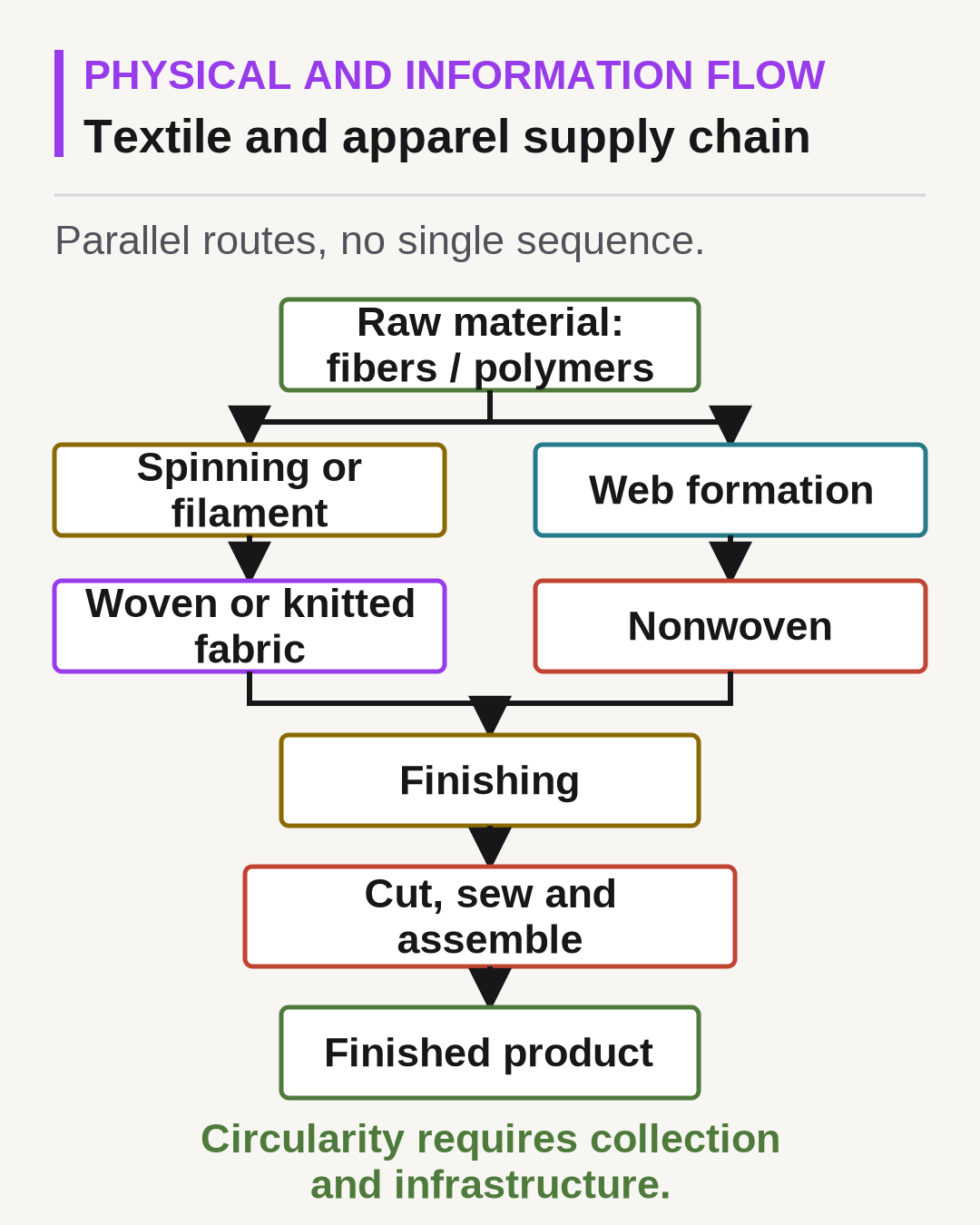
The textile and apparel supply chain transforms natural or manufactured raw materials into yarns, woven or knitted fabrics, and then finished articles. Its reference flow covers fibres, spinning, material formation, wet processing, cutting and assembly, while the real system also includes suppliers, subcontracting, distribution, use and recovery routes.
Sourcing and supplier management
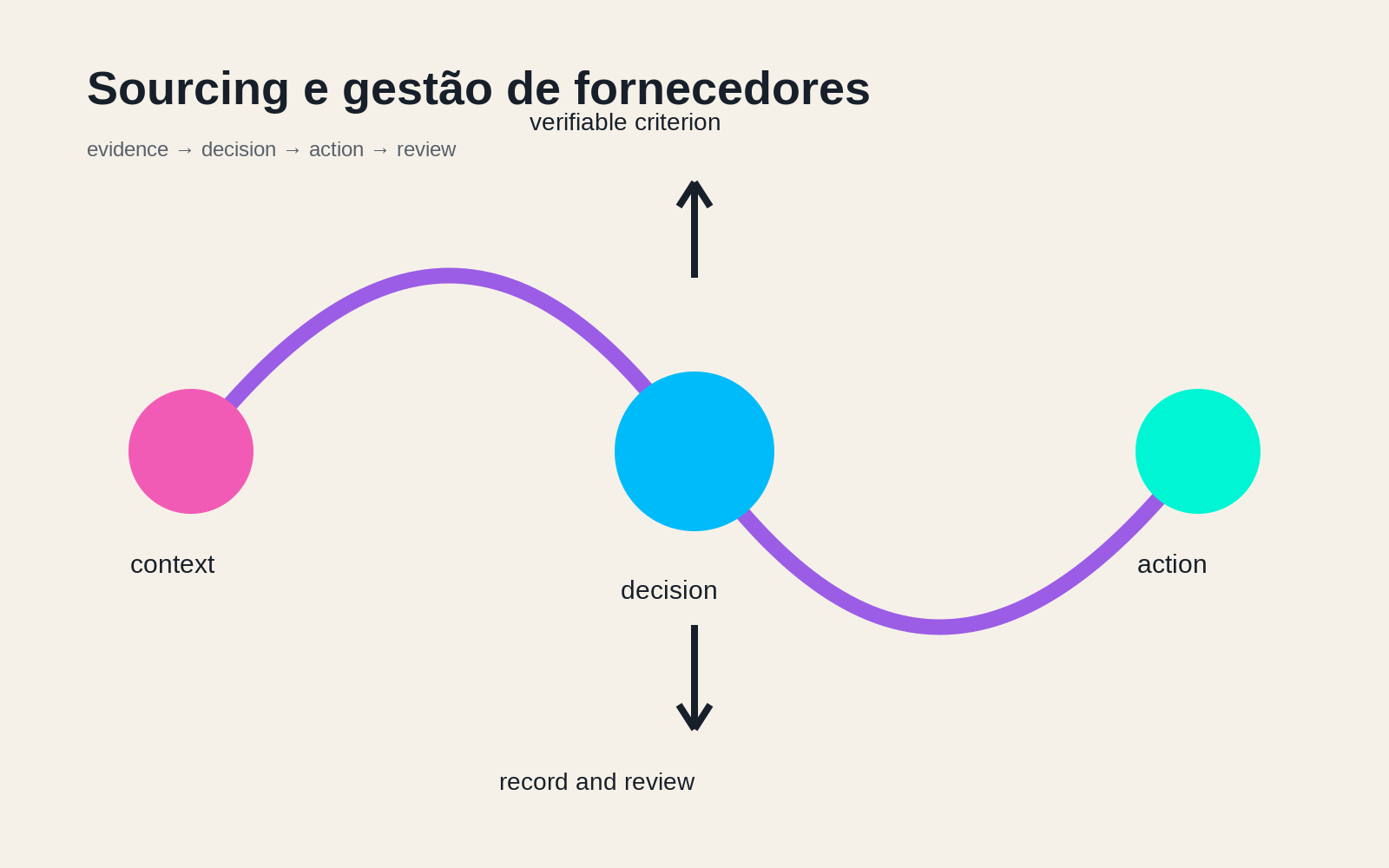
Sourcing and supplier management. Fashion sourcing requires visibility into units and processes, prioritization of human risks, worker dialogue, remediation and a decision trail tied to orders and lots.
Sources
- https://ojs.uel.br/revistas/uel/index.php/projetica/article/download/7724/6867
- https://bis.sebrae.com.br/bis/download.zhtml?t=D&uid=4D917E1B8D6C668F8325745700482839
- https://ojs.uel.br/revistas/uel/index.php/projetica/article/download/42980/30830/230063
- https://www.confaz.fazenda.gov.br/legislacao/ajustes/sinief/cfop_cvsn_70_vigente
- https://www.planalto.gov.br/ccivil_03/leis/2002/l10406compilada.htm
- https://www.tst.jus.br/-/industria-textil-respondera-por-divida-de-empresa-de-faccao
- https://biblioteca.ibge.gov.br/visualizacao/livros/liv101721.pdf
- https://repositorio.ufsc.br/xmlui/bitstream/handle/123456789/182871/349676.pdf?sequence=1&isAllowed=y
Want to apply this to your operation?