What is context engineering and how do you apply it in fashion?
See the difference between context and prompt and prepare the information for AI with a filled-in example table for the Aurora t-shirt and a review script.
On this page
Context engineering is the discipline that organizes the information given to AI, beyond the prompt, and in fashion it decides which spec goes into the request.
In an invented scene, you attach two specs for the Aurora t-shirt, the old one and the approved one, and ask for the catalog description. The AI returns an elegant sentence with the collar from the old spec, and you redo the catalog entry. The mistake was attaching both together and expecting it to guess which one counted.
What goes into the AI's context?
What goes in is the information you give the model for the task, and preparing it involves retrieving or generating, processing and managing that material (Mei et al., abstract).
On the Aurora, retrieving is finding the approved spec, processing is taking the old spec out of the package and managing is deciding the order and size of what goes to the AI. The same reasoning, at company scale, appears in AI context in the company.
Context plays the role of the AI's tech pack: the prompt says to describe the garment, and the spec says which garment it is.
Prompt and context: what changes in practice?
The prompt is the instruction; the context is the package of information that travels with it.
In atelier language, the prompt is a fixed note stuck on the box, and the context is the suitcase packed piece by piece, with a rule for what goes in and a limit on what fits (Mei et al., section 3.1 and table 1). On the Aurora, the rule is the status column: only an approved spec goes in. The note "use the correct spec" leaves the choice open when two specs arrive together. The rule decides before sending, and you know which file supported the answer.
How do you assemble the context for a product description?
Choose the approved spec, fill in the table below and only then ask for the description.
The Spreadsheet, the one that only one person understands, has a status column that looks simple until that person goes on vacation the week of the catalog entry. That is why the Aurora table says where each attribute comes from:
| Field | Value |
|---|---|
| Task | Write the catalog description of the t-shirt |
| Garment | Aurora t-shirt |
| Selected source | File aurora-approved-spec, status approved |
| Garment attributes | Round neck; short sleeve; blue color |
| Missing information | Composition left blank in the source |
| Rule for the gap | Flag the missing composition; do not fill it in by assumption |
| Deliverable | Description, source file and flagged gap |
| Review | Comparison of each attribute with the approved spec |
- Open the file indicated in the table and confirm the approved status before assembling the request.
- Set the old spec aside and note the collar divergence in your own log; this record stays with you and does not go to the AI.
- Place the approved spec at the beginning or the end of the package when it includes history or other specs.
- Send the table with the request and require the composition gap to be flagged.
- Compare each attribute of the description with the approved spec and send back what it does not support.
Step 3 comes from a 2023 finding: in long inputs, performance was better with the relevant information at the beginning or the end than in the middle (Liu et al., abstract).
How do you know whether the context is good?
Five criteria help: relevance, sufficiency, isolation, economy and provenance. For the research, context engineering is designing, structuring and managing the information environment in which an agent decides (Vishnyakova, abstract).
Applied to the Aurora, they become five questions:
- Relevance: does this spec serve this garment?
- Sufficiency: is any attribute missing, such as the composition?
- Isolation: did the old spec stay out of the package?
- Economy: can something be cut without losing an attribute?
- Provenance: can you say which file each attribute came from?
The preprint lists the criteria; the questions above are the reading applied to the Aurora.
Frequently asked questions about context engineering
Does prompt engineering change the model?
Prompt engineering provides specific instructions to improve performance on a task without modifying the model's parameters (Sahoo et al., abstract).
Does context engineering require several agents?
Context engineering brings together several implementations; multi-agent systems are one of them, alongside retrieval, memory and tool-integrated reasoning (Mei et al., abstract).
Back to the Aurora catalog entry: you have a description to compare against a defined source and a composition gap in plain sight. Someone needs to own the status column, and that is the job of the Context Leader, detailed in context and information governance.
The AI writes with the spec you let in, and choosing the spec was your call.
Verified facts
- The survey by Mei et al., from 2025, presents context engineering as a discipline that goes beyond prompt design and systematically organizes the information provided to the model.
Source: arxiv.org ↗ - Mei et al. break context engineering down into context retrieval and generation, context processing and context management.
Source: arxiv.org ↗ - Mei et al. contrast context as static text in prompt engineering with structured components assembled by functions, under a size limit, in context engineering.
Source: arxiv.org ↗ - Mei et al. describe retrieval-augmented generation, memory systems, tool-integrated reasoning and multi-agent systems as implementations that integrate components of context engineering.
Source: arxiv.org ↗ - Liu et al., in 2023, observed better performance when the relevant information appeared at the beginning or the end of long inputs, with lower performance when it appeared in the middle.
Source: arxiv.org ↗ - Sahoo et al., in a 2024 survey revised in 2025, describe prompt engineering as providing specific instructions to improve performance on a task without modifying the model's parameters.
Source: arxiv.org ↗ - Vishnyakova, in a 2026 preprint, defines context engineering as designing, structuring and managing the information environment in which an agent decides.
Source: arxiv.org ↗ - Vishnyakova proposes relevance, sufficiency, isolation, economy and provenance as quality criteria for context.
Source: arxiv.org ↗
Related entries
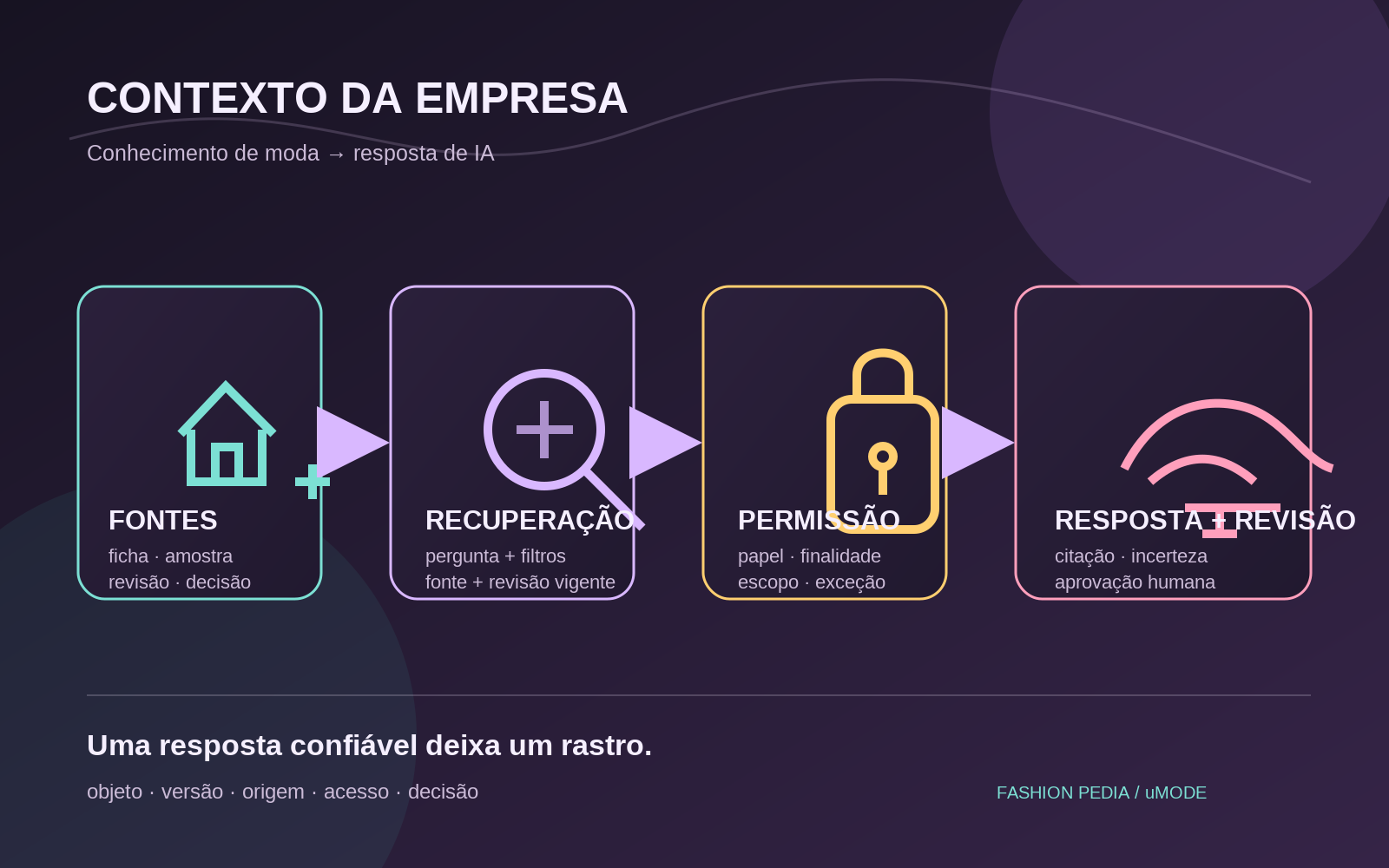
How to Give Company Context to AI
How to Give Company Context to AI. Giving company context to AI means turning scattered knowledge into retrievable information bounded by source, scope, freshness, and permission. The process combines a trusted knowledge base, relevant retrieval, clear instructions, and human evaluation—not simply a longer prompt.
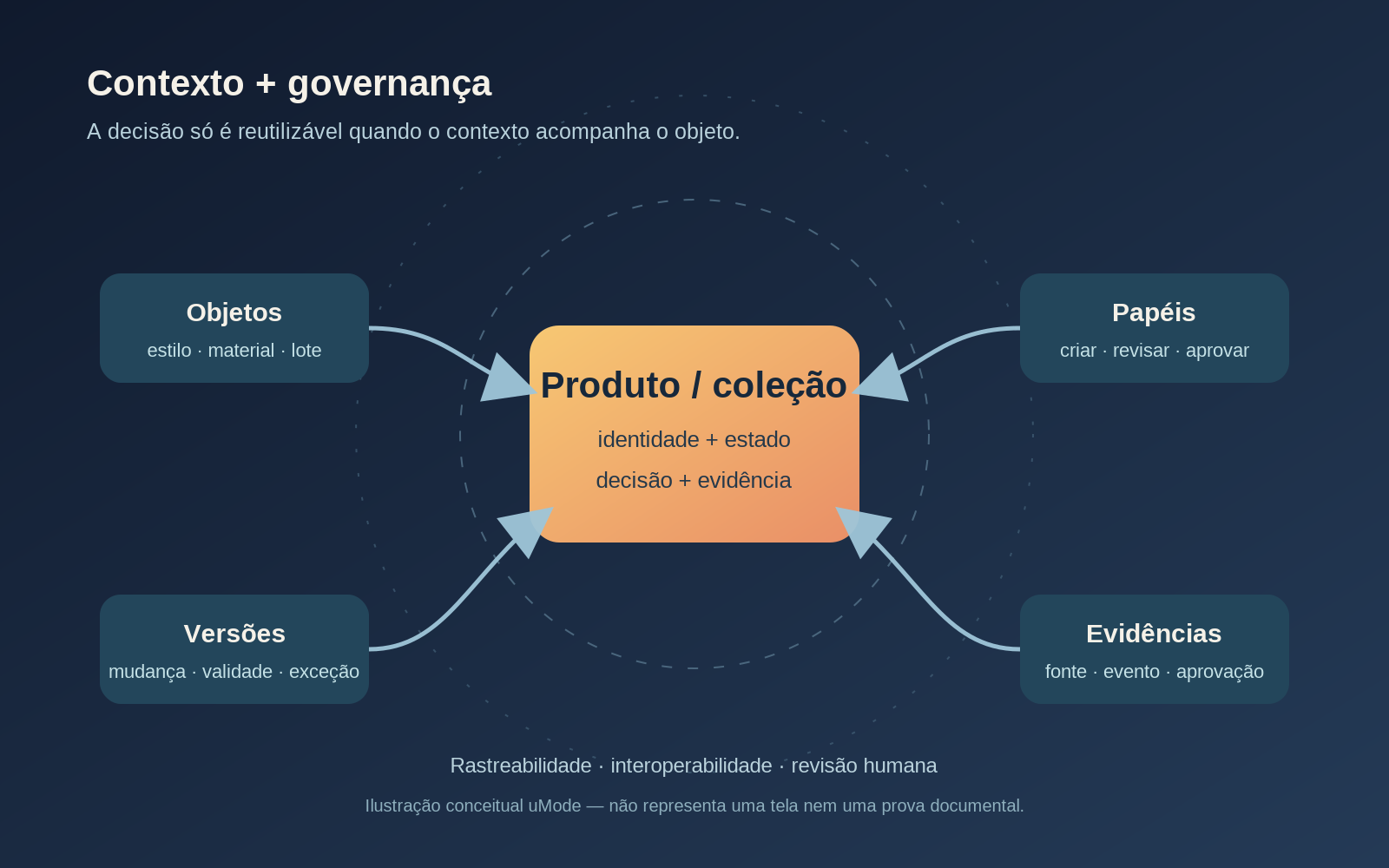
Information context and governance in fashion
Information context and governance in fashion is a process for keeping product and collection objects connected to decisions, versions, responsibilities and evidence. It combines provenance, identifiers, access rules, controlled change and interoperability criteria; it is not merely archiving or selecting a tool.
Sources
Want to apply this to your operation?