Size chart: how to measure bust, waist and hip
Learn how to measure bust, waist and hip with the right tape, and the difference between a body measurement and a garment measurement, before you pick a size.
On this page
- How do you measure bust, waist and hip?
- What is a size chart used for in apparel manufacturing?
- What is the difference between a body measurement and a garment measurement?
- A 36-inch (92 cm) bust or a 30.7-inch (78 cm) waist: what size is that?
- How do you organize the chart for pattern making and grading?
- What questions come up when using a size chart?
A size chart is the set of body dimensions by size that guides pattern making for fashion products. To measure bust, waist and hip, run the tape over the nipples, around the smallest circumference of the waist and around the fullest part of the buttocks.
How do you measure bust, waist and hip?
Run the tape over the nipples for the bust, around the smallest circumference for the waist and around the fullest part of the buttocks for the hip (pattern-making material from the UDESC library, Santa Catarina State University, p. 30).
The step by step, in the order the tape works:
- Bust: circumference with the tape over the nipples.
- Waist: circumference at the smallest point.
- Hip: circumference at the fullest part of the buttocks.
- Sleeve, if the garment has one: length with the arm bent at a right angle, from the shoulder to the head of the ulna, the forearm bone.
The tape measures people, and a finished garment has a different ruler. Record each result as a body measurement and compare bust with bust, waist with waist and hip with hip.
What is a size chart used for in apparel manufacturing?
It gives pattern making a body reference by size, based on the measurements of the customer the company wants to dress (UDESC Menswear Pattern Making e-book, p. 9).
This relationship between body and size is the starting point for apparel pattern making. In industrial pattern making you work with reference measurements standardized by dress form, instead of individual measurements.
That is why taking one person's measurements and calling the result the brand's size chart are different decisions. The brand's chart has to match the target customer and the sizing adopted, like a pattern that only fits the dress form it was drafted for.
What is the difference between a body measurement and a garment measurement?
A body measurement describes the person; a garment measurement describes the finished piece and goes in a separate field.
The body chart leaves out seams, ease for movement and design ease (pattern-making material from the UDESC library, p. 32). Whoever carries the chart over to the garment spec needs to keep that separation, like someone who does not confuse the tape on the body with the tape on the garment laid flat on the table.
A field labeled just "bust" leaves the question open: body circumference or garment circumference? Write "body bust circumference" when that is the data, and reserve another field for the garment. Do the same with waist and hip.
Adding ease to the body chart mixes two pieces of information that need to travel separately.
A 36-inch (92 cm) bust or a 30.7-inch (78 cm) waist: what size is that?
The size depends on the brand's chart, because each manufacturer may adopt its own (pattern-making material from the UDESC library, p. 32).
A single bust or waist measurement does not point to a universal size, since the standard varies between manufacturers. Look in the chart you are using for the bust, waist and hip measurements, and read the name of the measurement, the unit and the matching size.
If the measurement you have comes from the finished garment, treat it as a garment measurement and do not compare it with a body chart.
How do you organize the chart for pattern making and grading?
Organize the body measurements by size and use that chart to guide the base pattern and its grading.
As a suggested layout, put the measurements in rows and the sizes in columns, with the unit and a note that these are body measurements. When you carry a column over to the garment spec, keep the source size visible and leave the garment fields separate.
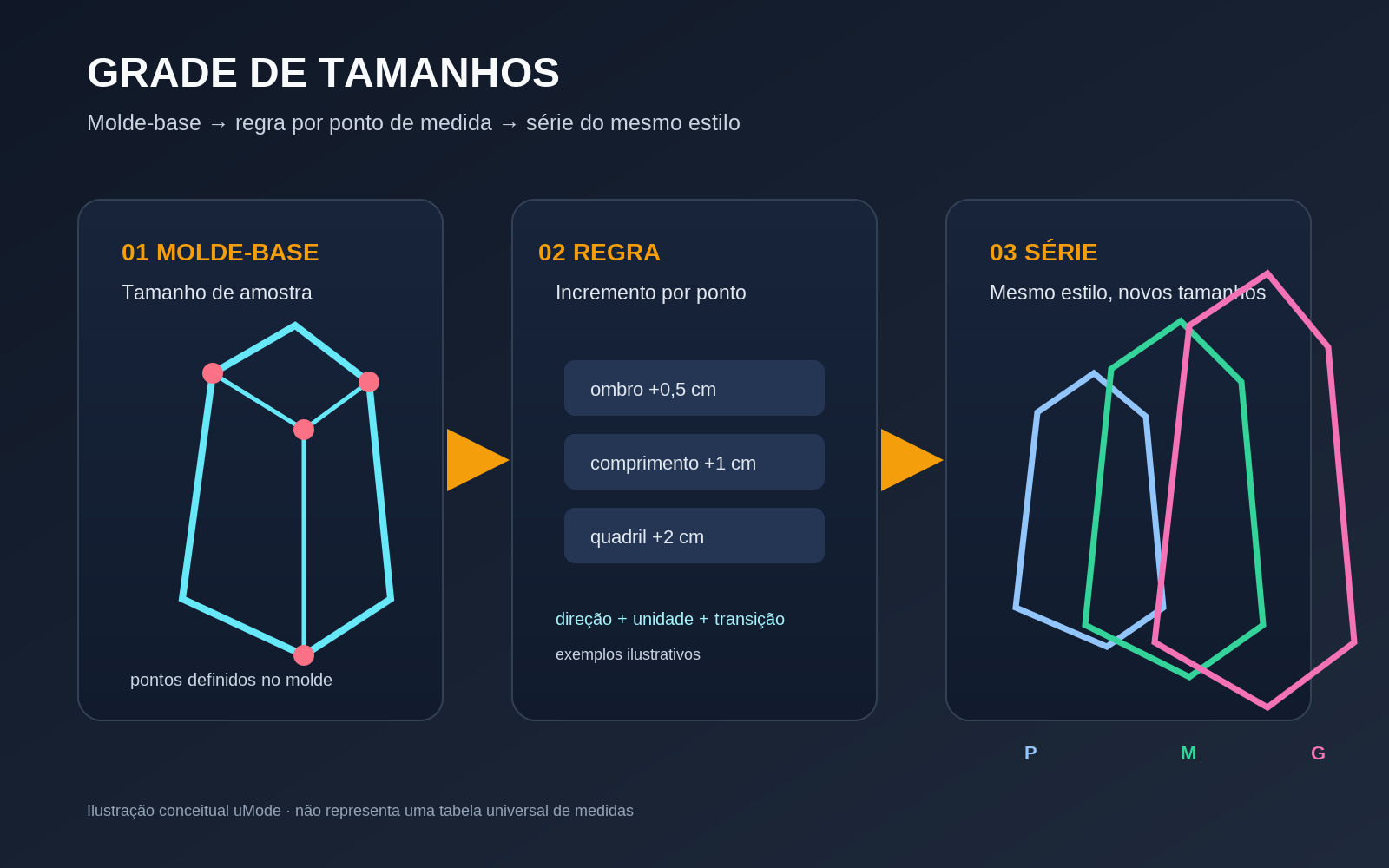
The pattern maker works with charts close to the average body standard, within a defined size numbering, and grading enlarges or reduces the base pattern following the chart (IFSC Pattern Making Handbook, Federal Institute of Santa Catarina, pp. 5 and 10). In the size run, each size stays linked to the measurements that guide it.
To build the chart with body measurements kept apart from garment measurements, see the tools at https://www.umode.com.br/ferramentas (page in Portuguese).
What questions come up when using a size chart?
How do you measure bust, waist and hip?
Tape over the nipples for the bust, smallest circumference for the waist and fullest part of the buttocks for the hip.
What is a size chart for in apparel manufacturing?
It gives pattern making a body reference by size, starting from the company's target customer.
What is the difference between a body measurement and a garment measurement?
The body measurement excludes seams and ease; the garment measurement describes the clothing and has its own field.
The tape speaks about the body, the spec speaks about the garment, and the chart only works when each one stays in its own field.
Verified facts
- A size chart represents human body dimensions by size and should be based on the measurements of the company's target customer.
Source: udesc.br ↗ - Industrial pattern making works with reference measurements standardized by dress form, instead of individual measurements.
Source: sistemabu.udesc.br ↗ - The body measurements in the chart do not include seams, ease for movement or design ease.
Source: sistemabu.udesc.br ↗ - Each manufacturer may adopt a different size chart, because the standard is not universal.
Source: sistemabu.udesc.br ↗ - To measure the bust, the tape goes over the nipples; for the waist, around the smallest circumference; for the hip, around the fullest part of the buttocks.
Source: sistemabu.udesc.br ↗ - Sleeve length is measured with the arm bent at a right angle, from the shoulder to the head of the ulna.
Source: sistemabu.udesc.br ↗ - In industrial pattern making, the pattern maker works with charts close to the average body standard, within a defined size numbering; grading enlarges or reduces the base pattern following the chart.
Source: wiki.ifsc.edu.br ↗
Related entries
Size grading
Size grading is the process of turning base-size or sample-size patterns into additional sizes by using a specification sheet or grading increments. A rule changes defined points on the pattern to form a size range for the same style; it does not replace patternmaking or create a new shape.
Garment patternmaking
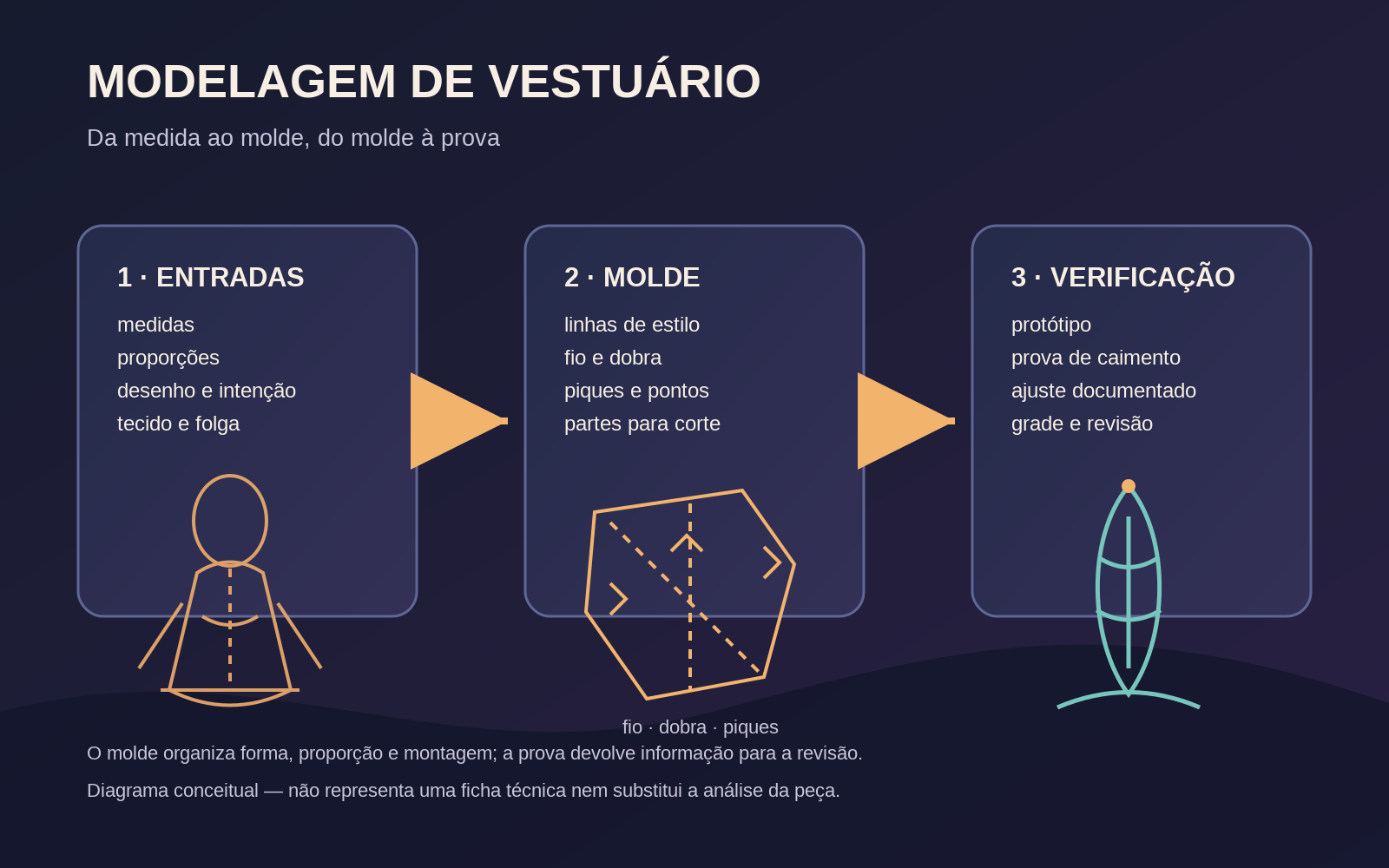
Garment patternmaking is the technique of turning measurements, proportions, and design intent into patterns used to cut and assemble a garment. It connects a block, flat pattern construction or draping with fabric information, production markings, fitting, alterations, and grading; the result is a testable development basis, not an automatic guarantee of fit.
Sources
Want to apply this to your operation?