Operation sequence: what it is, how to make one and a filled-in example
See how to record operations, machines and times from the pilot sample, with a filled-in example and the correction of the mix-up between normal time and standard time.
On this page
- What goes into the operation sequence?
- Where does the sequence of a new garment come from?
- How do you measure the time of each operation?
- What does a filled-in operation sequence example look like?
- How do you make the operation sequence step by step?
- How does the sequence help with line balancing?
- What other questions still come up?
The operation sequence is the record of the operations, machines, tools, stitch types, stitches per centimeter and stitch profile needed to produce a fashion garment. Imagine the Aurora blouse, hypothetical: you entered the normal time as if it were the standard, promised production more pieces per hour than the workstation delivers and only noticed on Friday, with the lot late.
What goes into the operation sequence?
A garment's operation sequence brings together operations, machines, tools, stitch type, stitches per centimeter and stitch profile (Apparel Technology handbook of the Federal Institute of Santa Catarina, IFSC, p. 12).
This record lives inside the tech pack, next to the assembly order and the time of each operation. "Sew and finish" does not work as an operation. Naming the side seam, the machine and the stitch works like the notches on the pattern: it shows where each part meets the other before joining them.
Where does the sequence of a new garment come from?
The operation sequence of a new garment comes from making the pilot sample.
In sampling, the pattern maker analyzes production feasibility, identifies the assembly changes and only then passes the sequence on to the spec sheet and to the production sectors. The spec sheet is born with the pilot and states the process time of each operation (Production Process Management, Sebrae/RS, pp. 13 and 15). An order copied from another blouse reaches the spec sheet without having passed through the workstation.
How do you measure the time of each operation?
Delimit the task, standardize the method and only then measure.
Standard time is what a qualified, trained person takes to perform the task at a normal pace, and it supports planning and training (Application of the time and motion study as a tool, proceedings of the 5th SIMEP, Production Engineering Symposium, 2017, p. 3). Closing side seams and assembling the whole blouse are different tasks, each with its own time. The normal time in the example below comes from the IFSC handbook; the standard comes from it multiplied by the allowance factor and the irregularity coefficient.
What does a filled-in operation sequence example look like?
Four lines of the Aurora show the order of operations, and only the side seams carry a time, because only that one has a calculation backed by a source. The times come from the handbook example (IFSC Apparel Technology handbook, pp. 49 and 53) and were attached to "close side seams" only to illustrate; order, machine and stitch remain to be confirmed on the pilot.
| Order | Operation | Machine and stitch | Time |
|---|---|---|---|
| 1 | Join shoulders | to be defined on the pilot | to be measured |
| 2 | Attach sleeves | to be defined on the pilot | to be measured |
| 3 | Close side seams | to be defined on the pilot | normal 0.36 min; standard 0.36 × 1.13 × 1.07 = 0.435276 min, rounded to 0.44 min |
| 4 | Finish the side seam allowance | to be defined on the pilot | to be measured; its own operation |
| Field | Value |
|---|---|
| Wrong entry | standard time = 0.36 min; 60 ÷ 0.36 ≈ 166.7 pieces/h |
| Corrected entry | standard time = 0.44 min; 60 ÷ 0.44 ≈ 136.4 pieces/h |
The wrong entry promises 0.36 min where the workstation takes 0.44 min, about 22% more; in output, that is about 30 pieces per hour less than the plan, 18% of the promise. The 22% applies to time and the 18% to output. The 136.4 pieces/h apply to one operator on the close-side-seams operation, at 100% efficiency. This number measures one operation, and the whole garment adds up the times of all of them.
How do you make the operation sequence step by step?
List each operation of the garment, with resource and time, from the first to the last.
- List all the operations of the pilot, one per line, as the table does with shoulders, sleeves, side seams and allowance.
- Record the previous operation that the pilot showed, instead of copying the order of another blouse.
- Define the machine, tool and stitch of each operation on the pilot; until validated, write "to be defined".
- Fill in stitches per centimeter and stitch profile before releasing the spec sheet.
- Enter the time of each operation already with allowance and irregularity, as in the side seams of the table.
- Add up the times of all operations to arrive at that of the whole garment and link the record to the spec sheet sent to production.
The Spreadsheet accepts any time typed in, always with the same calm. Whoever charges for the difference is the workstation. The corrected time is what cost formation will read.
How does the sequence help with line balancing?
The sequence delivers the activities and times that will be distributed among people and machines.
Balancing requires considering operators, available resources, production time and deadline (Moura, Borges and Kohlrausch, journal Gestão da Produção, Operações e Sistemas, GEPROS, 2020, pp. 10 and 11). Measuring only the side seams leaves the rest of the blouse out of that distribution.
What other questions still come up?
What is the difference between the operation sequence, the assembly sequence and the time study?
The operation sequence describes operations, machines, tools and stitch parameters; the assembly sequence gives the sewing order; the time study gives the time of each operation.
What is the difference between normal time and standard time?
Normal time is the starting point; standard time is the normal multiplied by allowance and irregularity.
Does the sequence also guide the layout?
Yes. The industrial layout follows the operation sequence to reduce the movement of materials and people and to support visual management, even with outsourced stages (Production Process Management, Sebrae/RS, p. 26).
Time erased from the spec sheet reappears at the workstation.
Verified facts
- The IFSC Apparel Technology handbook, 2008, distinguishes the assembly sequence, which records the sewing order, the operation sequence, which describes operations, machines, tools, stitch types, stitches per centimeter and stitch profile, and time study (minutagem), which records the time of each operation.
Source: wiki.ifsc.edu.br ↗ - On the pilot sample, design adjustments and the technical analysis of production feasibility are made; the pattern maker identifies assembly changes and passes the operation sequence on to the spec sheet and the production sectors.
Source: bis.sebrae.com.br ↗ - The spec sheet is developed together with the pilot sample and must state the design, assembly procedures, type and quantity of materials, fabric composition and process time of each operation.
Source: bis.sebrae.com.br ↗ - The article Application of the time and motion study as a tool, from the proceedings of the 5th SIMEP in 2017, defines standard time as the time a qualified, trained person needs to perform a specified task at a normal pace; the method must be standardized beforehand, and this time supports planning and training.
Source: bdtd.ufcg.edu.br ↗ - In the example in the IFSC Apparel Technology handbook, 2008, the normal time of 0.36 min multiplied by the allowance factor 1.13 and the irregularity coefficient 1.07 results in 0.435276 min, rounded to 0.44 min. As an arithmetic comparison derived from these times, 60 ÷ 0.36 gives approximately 166.7 pieces per hour and 60 ÷ 0.44 gives 136.4; using the rounded time represents about 22% more time and 18% less output, an approximate difference of 30 pieces per hour.
Source: wiki.ifsc.edu.br ↗ - Line balancing distributes activities considering number of operators, available resources, time to produce the product or lot and deadline, according to Moura, Borges and Kohlrausch, in GEPROS 2020.
Source: revista.feb.unesp.br ↗ - The industrial layout should follow the operation sequence to reduce losses from moving materials and people and to support visual management, including when parts of the process are outsourced.
Source: bis.sebrae.com.br ↗
Related entries
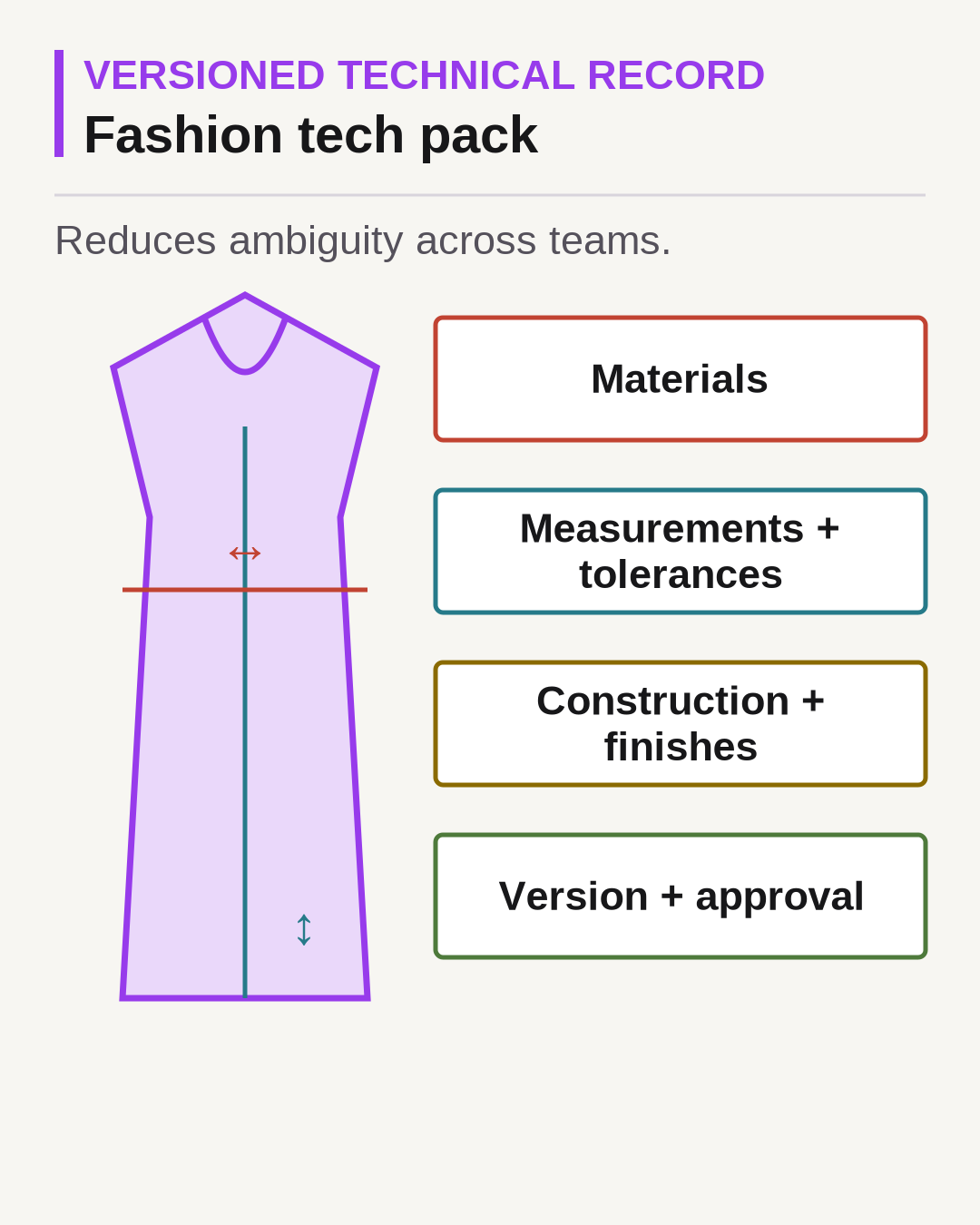
Fashion product technical specification
A technical specification is the controlled information set that translates an approved fashion product into verifiable sampling and manufacturing requirements. It brings together drawings, materials, measurements, construction, tolerances, identification, labelling, comments and revision history; its content varies by category, company, market and stage.
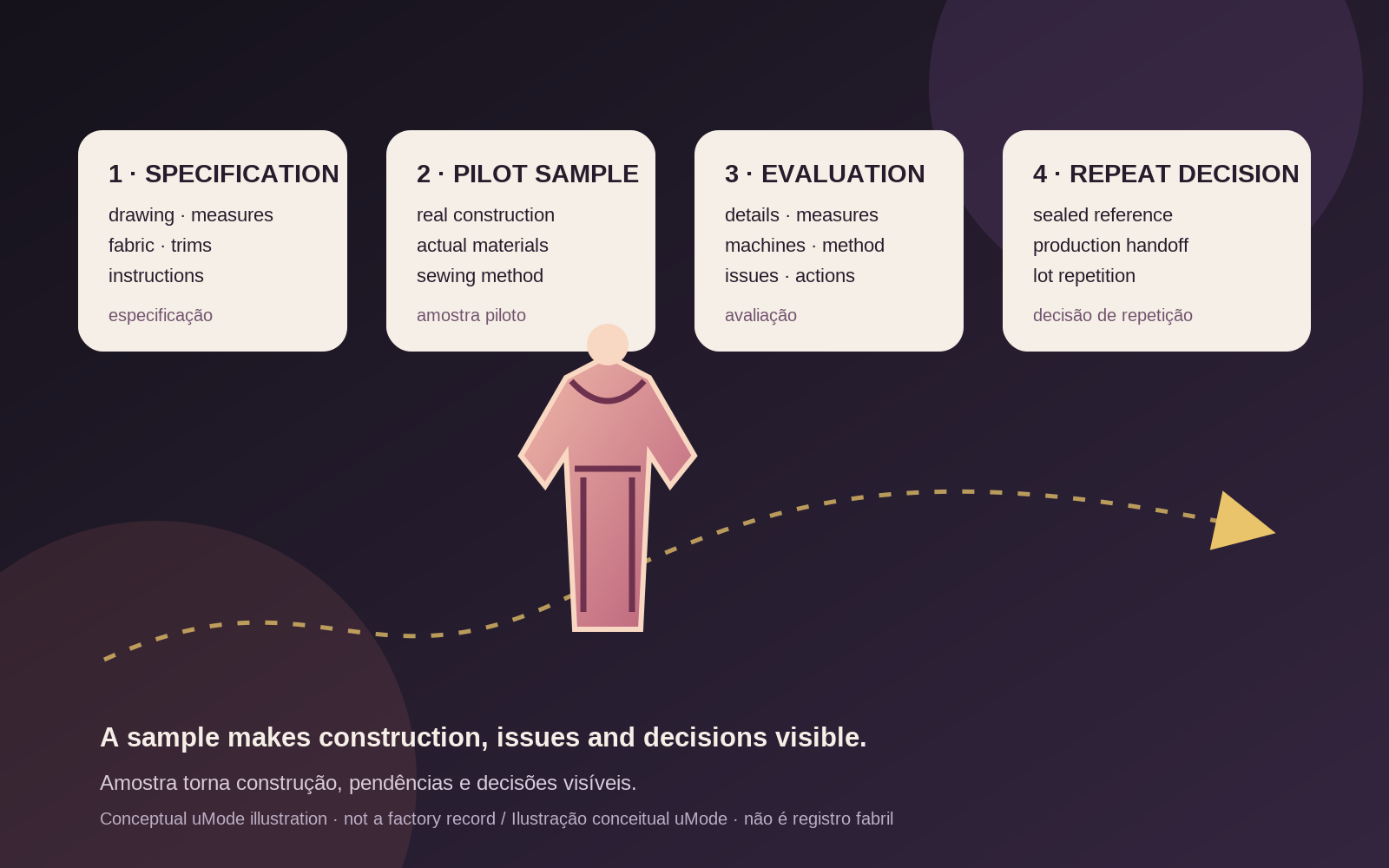
Garment production pilot sample
Garment production pilot sample. A garment production pilot is the development, review and approval of a product sample under product-making conditions. It connects the technical pack, materials, measurements, tests, construction and decision-making before the garment is repeated in production.
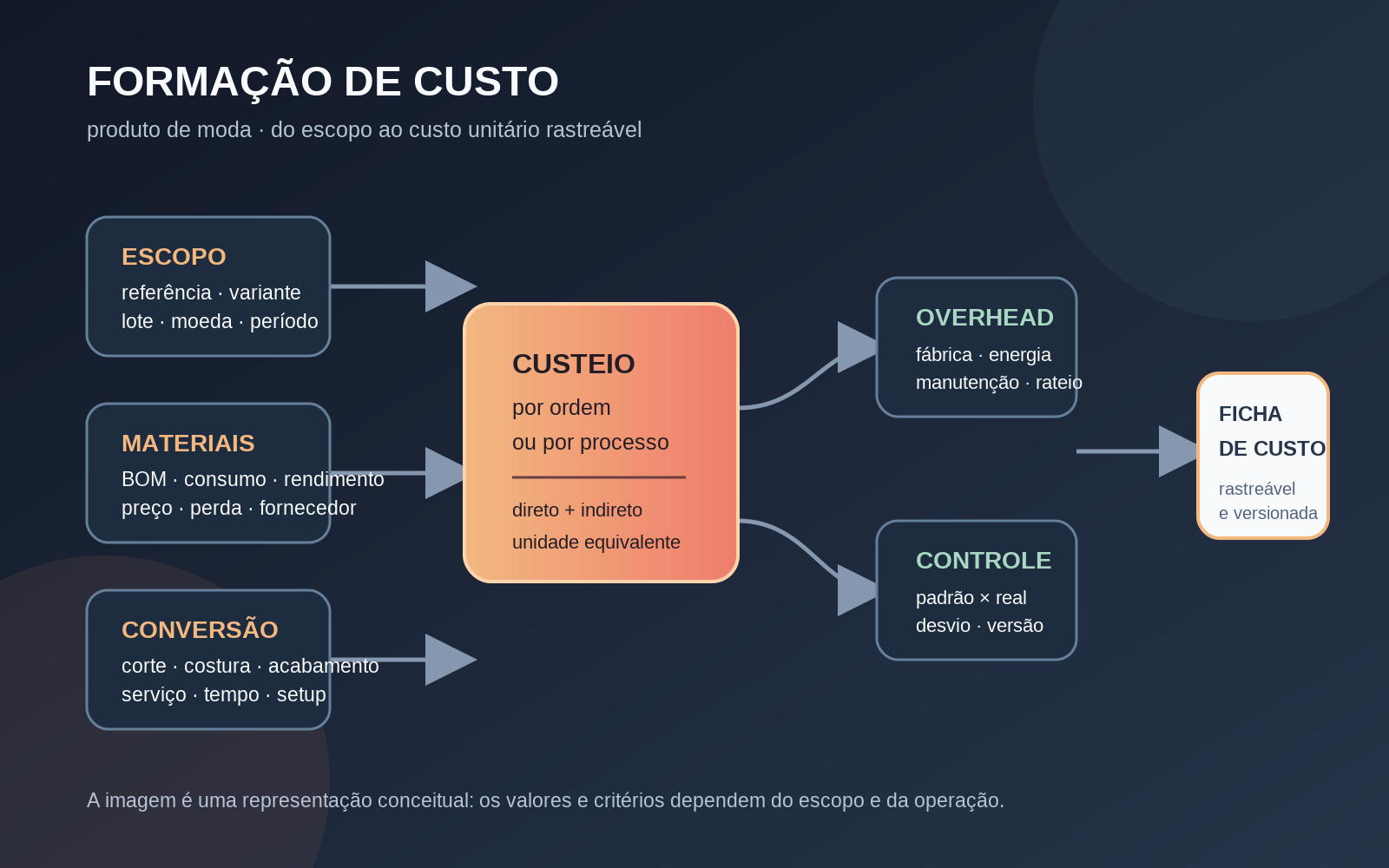
Fashion Product Cost Formation
Fashion product cost formation is the process of identifying, measuring, and assigning resources consumed by a garment, variant, or batch within a stated scope. It combines materials, conversion, waste, services, and overhead in a versioned cost sheet while distinguishing manufacturing cost, landed cost, and selling price.
Sources
- https://wiki.ifsc.edu.br/images/b/b0/Apostila_de_Costura.pdf
- https://bis.sebrae.com.br/bis/download.zhtml?t=D&uid=4D917E1B8D6C668F8325745700482839
- https://bdtd.ufcg.edu.br/jspui/bitstream/riufcg/30372/1/APLICA%c3%87%c3%83O%20DO%20ESTUDO%20DE%20MOVIMENTOS%20E%20TEMPOS%20COMO%20FERRAMENTA%20-%20ANAIS%20V%20SIMEP%20ARTIGO%202017.pdf
- https://revista.feb.unesp.br/gepros/article/download/2412/pdf/8797
Want to apply this to your operation?