Order backlog: what it is, how to calculate the balance and a fashion example
The order backlog is the consolidation of the orders to be fulfilled. See how to calculate the balance, ready pieces and the cutting needed, with a fashion example.
On this page
- What does the order backlog bring together in fashion?
- How do you calculate the balance to deliver without cutting again?
- How do you organize the order backlog, step by step?
- How does the backlog enter production planning?
- What should you look at before promising the date?
- What other questions still come up?
The order backlog (carteira de pedidos in Portuguese) is the consolidation of the orders received and the customer requests that the fashion company still needs to fulfill. You open The Spreadsheet, see 60 Aurora t-shirts open, from two customers, and almost send everything to cutting; 40 are already at shipping and 20 are waiting for embroidery.
What does the order backlog bring together in fashion?
The backlog includes the orders received and each customer's specific requests, which together form the demand you need to fulfill (Revista Produção Online, 2024, p. 3).
The quantity column mixes pieces to be cut, ready pieces and pending delivery. That is why each purchase order needs a delivery date and a status by color and size.
How do you calculate the balance to deliver without cutting again?
Backlog balance = confirmed quantity minus delivered quantity, order by order and size by size. The new cut covers only what is left after locating the pieces already made and those still in process.
Put numbers on an invented t-shirt, the Aurora, with two orders in the backlog.
| Field | Value |
|---|---|
| Order A, customer 1 | 40 white Aurora pieces: 20 M and 20 L; delivered 0; delivery on 10/20/2026 |
| Order B, customer 2 | 20 black Aurora pieces: 10 M and 10 L; delivered 0; delivery on 10/27/2026 |
| Balance to deliver | (40 - 0) + (20 - 0) = 60 pieces |
| Ready pieces at shipping | 40 white Aurora: 20 M and 20 L |
| Pieces in finishing | 20 black Aurora: 10 M and 10 L, waiting for embroidery |
| Allocation by order, color and size | A receives the 20 M and 20 L white ready pieces, balance zero; B receives the 10 M and 10 L black from embroidery |
| Cut requested by the hasty reading | 60 pieces |
| Cut needed | 60 - 40 - 20 = 0 pieces |
Cutting the 60 from the hasty reading would leave 60 extra Aurora stranded in inventory after delivery, with fabric, sewing and shelf space used for nothing.
The color and size grid shows why the total misleads. If the 40 ready pieces were black, the total would still add up, but order A, white, would be left without pieces and the color would enter the cut. The same goes for size: with 20 L in embroidery and no M, order B would be missing 10 M. On the Aurora, the ready pieces went to order A, which is due first; it is an allocation choice by date, and priority can change by customer or by complete order.
An order only ships whole: missing pieces prevent closing and dispatch, and all of them, including those with additional finishing, need to arrive at shipping (Lot Simulation Model for Production in the Apparel Manufacturing Industry, SEGeT, 2007, pp. 1 and 4).
How do you organize the order backlog, step by step?
Each order becomes a line, and the status of the pieces answers whether the date holds.
- List each order on a line, with product, color and size grid, quantity and date.
- Subtract what was delivered from each order and add up the balances.
- Locate the ready pieces and those waiting for finishing, by color and size.
- Calculate the cut needed: balance minus ready minus what is in process.
- Check the raw material and the finishing inputs before agreeing on the date, because scheduling orders goes through the raw material available.
- Group orders of the same garment to reduce setup time and cost (Revista GEPROS, 2020, p. 6) and update the status of each one.
The Spreadsheet showed the "status" column, which only whoever built it updates, next to the "quantity" column, which shouts the total. With the balances subtracted, the real pending item fits on one line: the embroidery.
How does the backlog enter production planning?
Negotiated orders and sales forecasts feed the master production schedule, and PCP (production planning and control) evaluates the bottlenecks and adjusts the plan until it is feasible (Revista Gestão & Análise, 2020, p. 3).
Orders A and B are for the same t-shirt and could have shared the setup, instead of going through embroidery separately. When working on demand planning, mark what came from a negotiated order and what came from a forecast.
What should you look at before promising the date?
The promised lead time depends on the time between confirming the order and delivering, which swings with maintenance, staff shortages and raw material delays; the final lead time comes from the adjustment between load and capacity (Revista de Ciências da Administração, 1999, p. 6).
Suppose an outside embroiderer with a hypothetical capacity of 10 pieces per day receives the pieces on 10/21: the 20 for order B take 2 days and leave on 10/22; with 1 day of transport back, they arrive on 10/23 and 4 days remain until 10/27 for review and shipping. Lead time asks for exactly this crossing of load and capacity.
What other questions still come up?
What is an open order backlog? It is the backlog with a balance to deliver: demands already received and with no delivery completed yet. Each open order shows how much is still to ship and what status it is in.
What is the difference between the order backlog and the sales forecast? The backlog is orders already negotiated with customers; the forecast is an estimate of sales. One is the customer's commitment, the other is the company's bet.
How do you measure whether orders ship on time? Divide the orders delivered on time by the total in the period (Dissertation on PCP in apparel manufacturers, UFC, 1999, p. 98). This measures only punctuality, not a complete order; see OTIF. In a month with 20 example orders, 18 on time give 90%.
Whoever reads only the quantity sends fabric to cutting; whoever reads the status chases the embroidery.
Verified facts
- The Revista Produção Online, 2024, defines the order backlog (carteira de pedidos) as the union and consolidation of customer demands, reflecting the orders received and the specific requests the company needs to fulfill.
Source: producaoonline.org.br ↗ - The study published in the Revista Gestão & Análise, 2020, describes that the master production schedule serves sales forecasts or backlog orders already negotiated, while PCP (production planning and control) evaluates bottlenecks and adjusts the plan until it is feasible.
Source: periodicos.unichristus.edu.br ↗ - The study published in GEPROS, 2020, describes that sales sends orders to PCP, which can group orders of the same garment to reduce setup time and cost, and that scheduling orders requires checking the raw material available.
Source: revista.feb.unesp.br ↗ - The article published in the Revista de Ciências da Administração, 1999, relates the promised lead time to the time between order confirmation and delivery, subject to maintenance, staff shortages and raw material delays; the final lead time results from the adjustment between load and capacity.
Source: dialnet.unirioja.es ↗ - The paper Lot Simulation Model for Production in the Apparel Manufacturing Industry, from the proceedings of SEGeT 2007, describes that missing pieces can prevent an order from being closed and dispatched; all pieces, including those with additional finishing, need to arrive ready at shipping, and quantities, lead times and capacity make it possible to anticipate missed deadlines.
Source: aedb.br ↗ - The dissertation on PCP in apparel manufacturers, 1999, suggests measuring the effect of PCP on the customer by dividing the number of orders delivered on time by the total orders in the period.
Source: repositorio.ufc.br ↗
Related entries
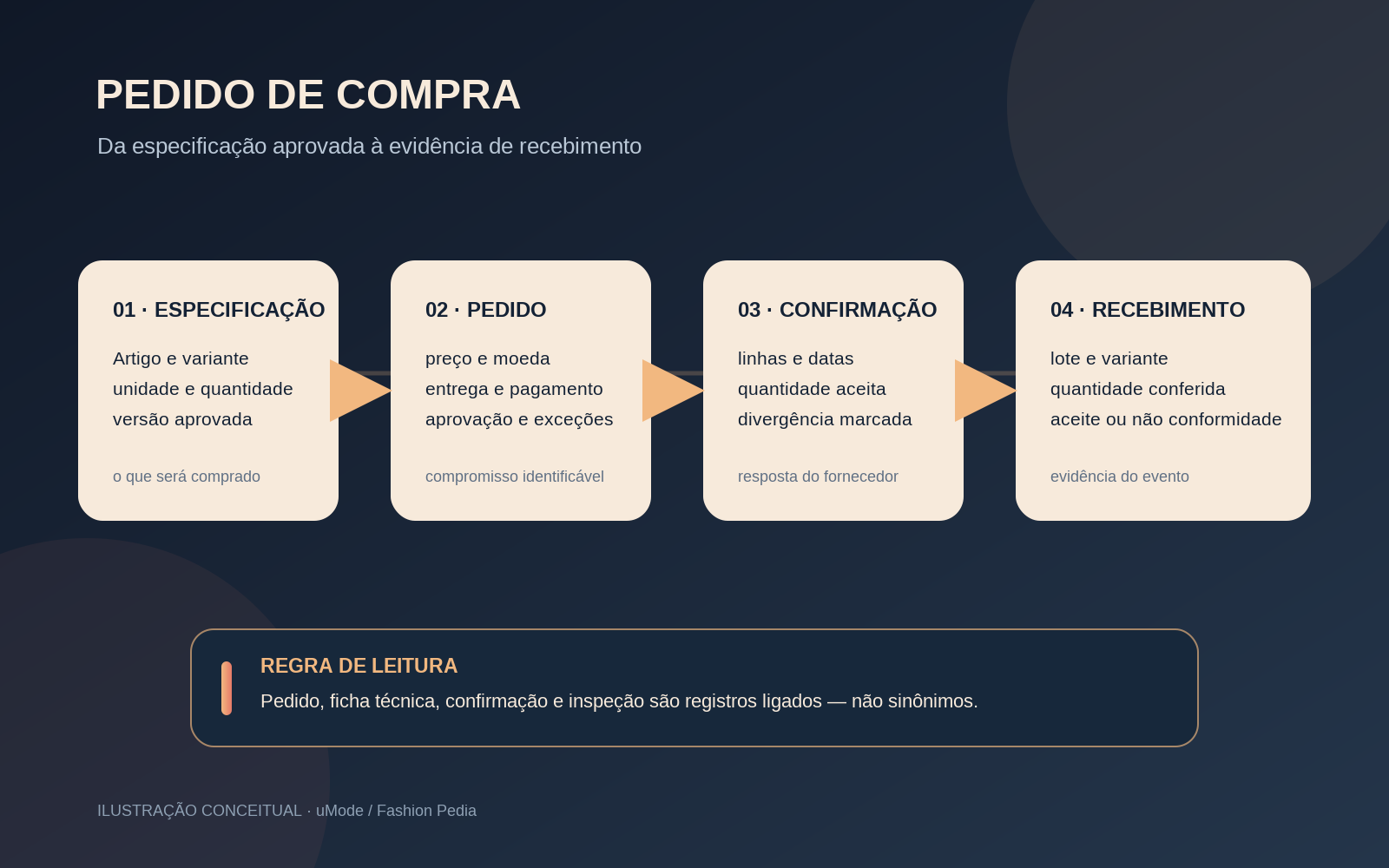
Purchase order in the fashion industry
Purchase order in the fashion industry. A purchase order is the document through which a buyer requests goods or services and records conditions such as price and payment. In fashion, it works best when it connects style, variant, specification, quantity, delivery and receiving criteria to an approved decision, without replacing the technical specification or inspection.
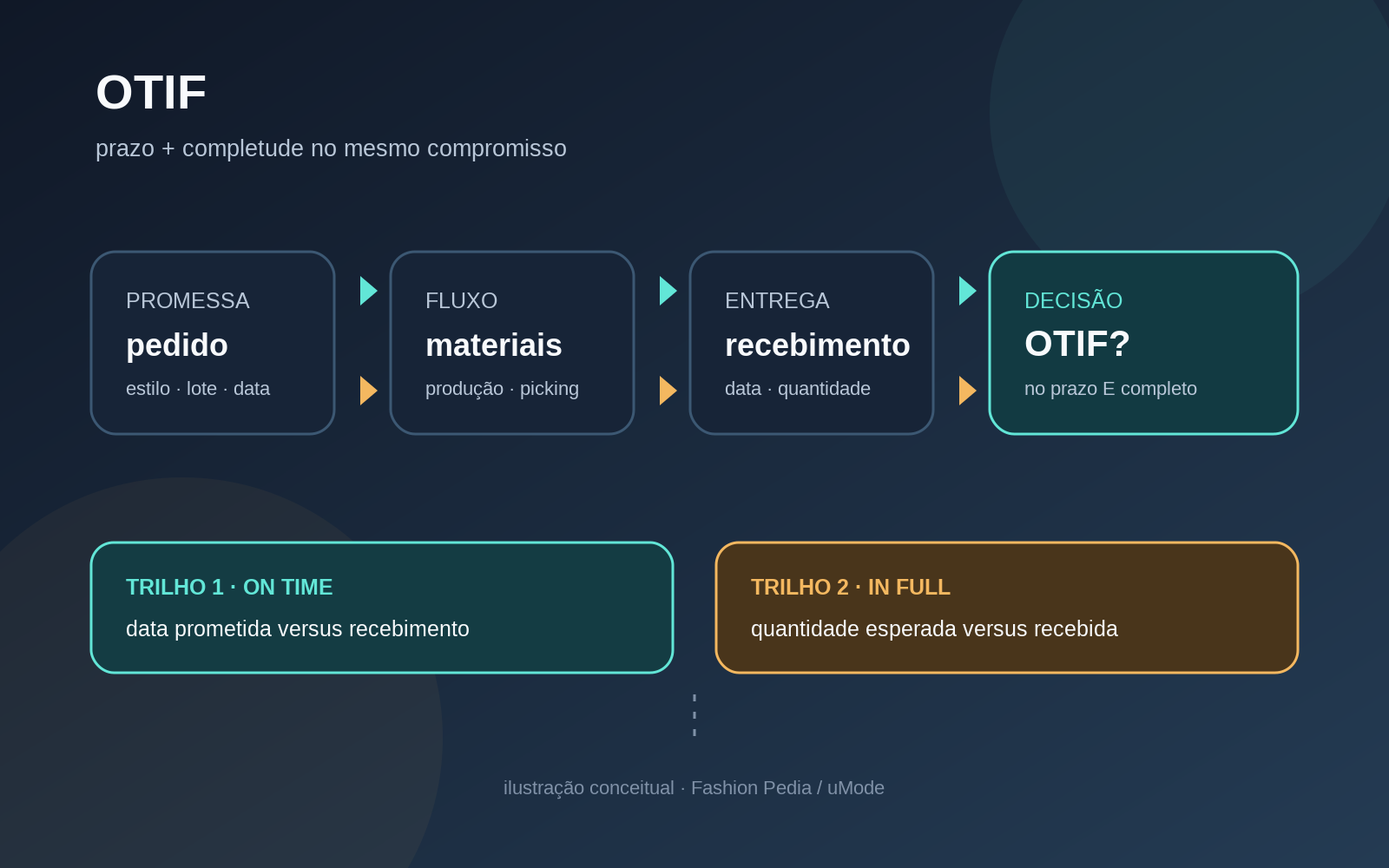
OTIF in the fashion supply chain
OTIF in the fashion supply chain. OTIF (on-time in-full) measures whether an order arrives on the agreed date with all expected items or quantities. In fashion, it can be applied to finished-goods orders, materials, or internal stages when the measured event, delivery window, and completeness rule are explicit.
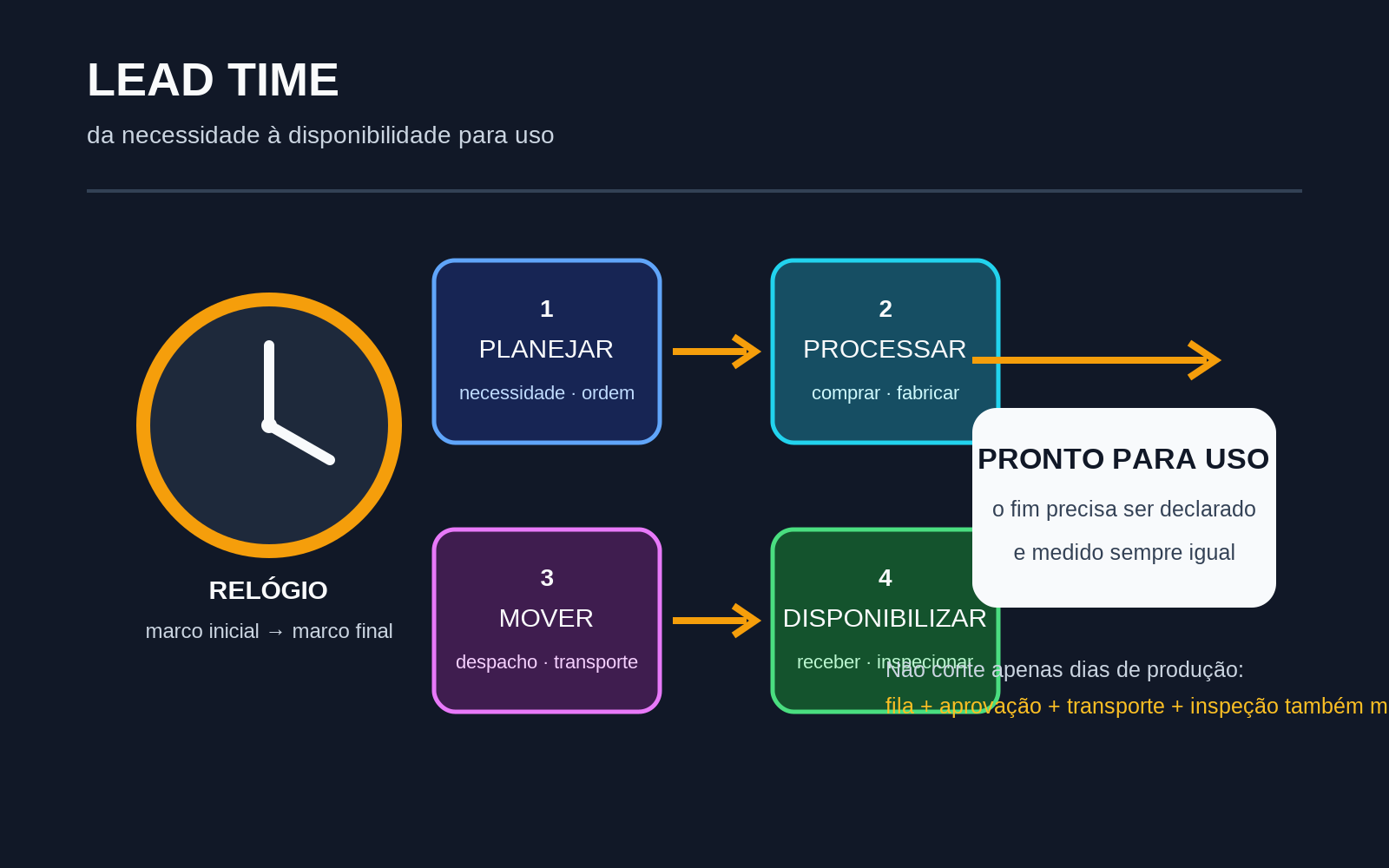
Lead time in the fashion supply chain
Lead time in the fashion supply chain. Lead time in a fashion supply chain is the elapsed time between defined operational milestones, such as ordering and receipt or design and production. A useful measure states its object, start, end, waiting periods, calendar, unit and availability condition.
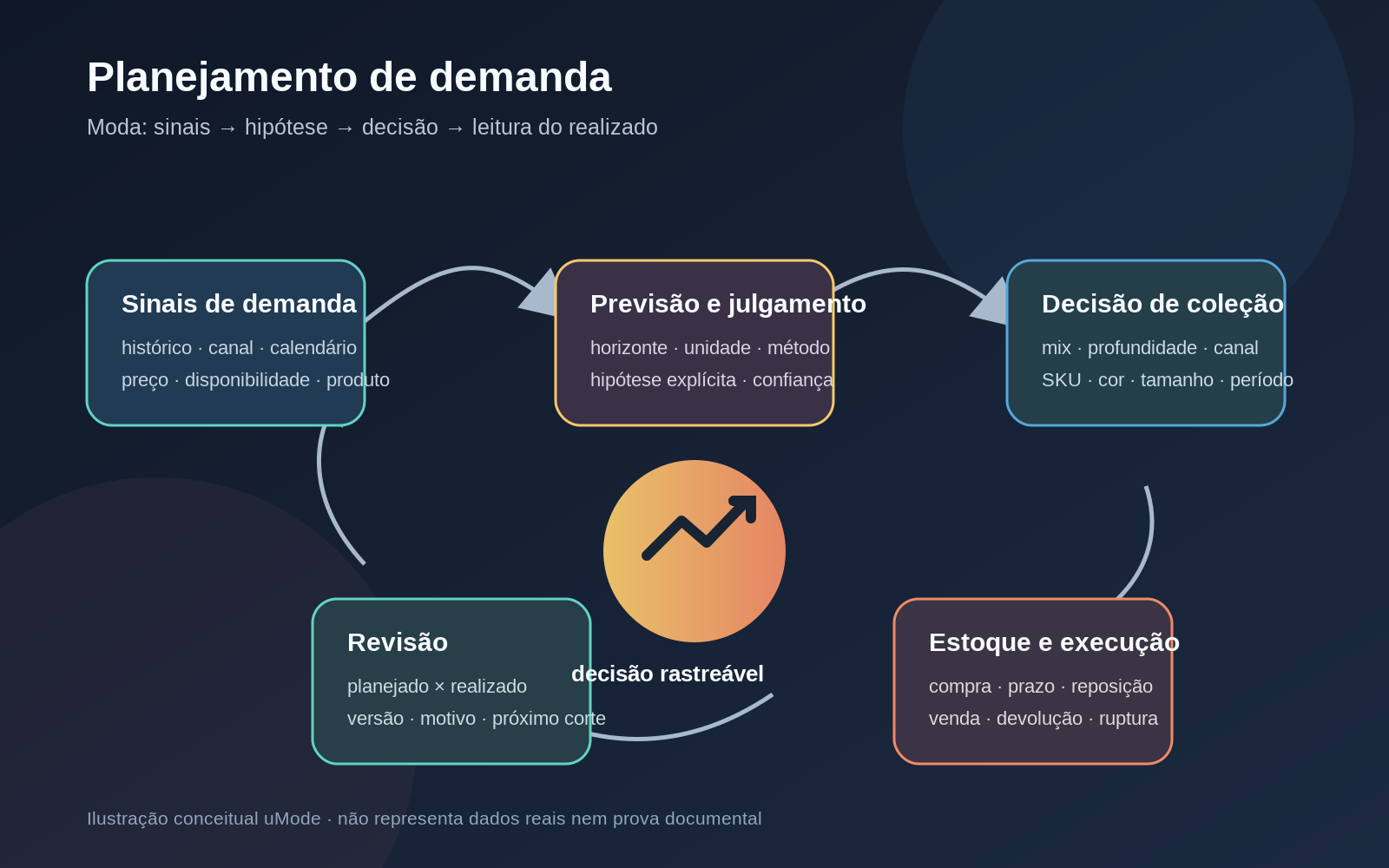
Demand planning in fashion
Demand planning in fashion turns demand signals, history, calendar context and judgement into explicit decisions about assortment, volume, channel and review. It combines forecasting with governance: every hypothesis needs a horizon, unit, owner and rule for revision when the collection or market changes.
Sources
- https://producaoonline.org.br/rpo/article/download/4972/2447/16911
- https://periodicos.unichristus.edu.br/gestao/article/download/2465/1164/12236
- https://revista.feb.unesp.br/gepros/article/download/2412/pdf/8797
- https://dialnet.unirioja.es/descarga/articulo/5164322.pdf
- https://www.aedb.br/seget/arquivos/artigos07/1183_Modelo%20de%20Simulacao%20de%20Lotes%20para%20a%20Producao%20na%20Industria%20de%20Confeccao.pdf
- https://repositorio.ufc.br/ri/bitstream/riufc/68259/1/1999_dis_sjbelias.pdf
Want to apply this to your operation?