Pilot sample (sample garment): what it is and how to approve the design
A pilot sample is the first garment of a design, made to test and approve it. See how to record the fitting, separate pattern adjustments from sewing ones and release grading.
On this page
A pilot sample, also called a sample garment or simply a pilot, is the first garment of a fashion design, made to test, approve and serve as the reference for the other copies.
Imagine the Aurora, an invented blouse: it looked beautiful on the hanger, you were about to release it, and at the fitting the bust dart shows up too high.
What is a pilot sample for?
It serves to discover in the fabric what the drawing does not show.
During the making of the pilot, design adjustments and the production feasibility analysis come out; the pattern maker identifies the assembly changes and passes the operation sequence on to the spec sheet and to production (Production Process Management, p. 13). It is the atelier's fitting: the mirror reveals the high dart that the sketch never would.
The Aurora's mistake was approving it from the hanger. The fix starts with taking the difficulty to apparel pattern making with the correction written down.
How do you make and record the pilot sample?
Make the pilot together with the spec sheet and record every finding of the fitting in the same place.
The spec sheet should be born with the pilot and gather the design, assembly, materials, fabric composition and the time of each operation (Production Process Management, p. 15). Structuring the tech pack helps organize this set. This is the Aurora's fitting:
| Field | Value |
|---|---|
| Design | Aurora blouse, short sleeve, bust dart |
| Material | Woven cotton fabric, 1.2 m per piece |
| Assembly recorded | Close darts, join shoulders, set sleeves, close sides, finish |
| Fitting result | Bust dart 2 cm above the planned point |
| Source of the adjustment | Pattern; the sewing followed the spec sheet |
| Adjustment requested | Lower the dart 2 cm on the pattern |
| Visual record | Photos of the pilot front and back |
| Status | Being adjusted; approval pending |
- Open the Aurora spec sheet with the woven cotton fabric and the consumption of 1.2 m per piece.
- Hand over the pattern and spec sheet to the sample sewer and ask for the assembly sequence actually sewn.
- Photograph the pilot front and back before any change.
- Measure the dart at the fitting and note the difference: 2 cm above the planned point.
- Classify the source as pattern and send the pattern maker the order to lower the dart.
- Change the status to "being adjusted" and keep the new fitting linked to the order.
The next morning, The Spreadsheet already shows the Aurora as "approved", marked by someone who saw the hanger and not the fitting. Change the status and leave the reason on the same line.
How do you separate a pattern adjustment from a sewing problem?
Ask where the difference was born: in the pattern or in the execution of the sampling.
The pattern making and grading service in the Sebraetec sheet makes this distinction, follows the fitting with client and designer, takes the adjustments to the patterns and tracks which pilots were approved and which go for adjustment (Sebraetec Sheet for Pattern Making and Grading for Apparel, pp. 3 and 4).
In sample approval, write the action so that it can be checked: "lower the dart on the pattern" points to the work; "improve the blouse" leaves the decision open.
When does the pilot release grading?
Only after the formal approval of the pilot.
In the Sebraetec sheet, the size run is prepared after the pilot samples are approved, and the patterns go on to grading after the approval meeting with the pattern-making consultant (Sebraetec Sheet for Pattern Making and Grading for Apparel, pp. 3 and 5). An Aurora "being adjusted" does not have a size run yet: grading now would be multiplying the high dart across all sizes.
When is it worth making a second pilot?
When the fitting leaves changes that only a second piece can verify.
In the jeanswear study, the changes noted at the fitting give rise to a second piece, the repilotagem or repiloto (Emídio and Sabioni, Projética, 2010, p. 73). With the Aurora pattern corrected, sew another blouse and try the dart position again, with the change request next to it.
What other questions still come up?
Who sews the pilot sample?
The piloteira (sample sewer), the seamstress in charge of making it (Production Process Management, pp. 35 and 36).
Does the pilot serve as the model for the other copies?
Yes. Once approved, it becomes the visual reference for making the other copies. That is why the Aurora approved from the hanger would have multiplied the error.
You go back to the Aurora with the dart corrected on the pattern and the new fitting scheduled.
The fitting ends when the decision also fits on the spec sheet.
Verified facts
- The glossary of Production Process Management, 2007, defines the pilot sample as the first piece produced of a design, used for demonstration to production, approval, testing and visual reference for making other copies.
Source: bis.sebrae.com.br ↗ - The glossary of Production Process Management, 2007, calls the seamstress in charge of making the pilot sample a piloteira (sample sewer).
Source: bis.sebrae.com.br ↗ - During the production of the pilot sample, design adjustments and the technical analysis of production feasibility are made; the pattern maker identifies assembly changes and passes the operation sequence on to the spec sheet and to production.
Source: bis.sebrae.com.br ↗ - The spec sheet must be developed together with the pilot sample and state the design, assembly procedures, type and quantity of materials, fabric composition and process time of each operation.
Source: bis.sebrae.com.br ↗ - In the Sebraetec sheet 14039-5, published in 2023, the pilot sample serves to approve pattern making, fittings are followed with the client and designer and the adjustments are transferred to the patterns.
Source: sebraetec.sebraemg.com.br ↗ - In the Sebraetec sheet 14039-5, the size run is prepared after the pilot samples are approved, and the patterns go on to grading after the approval meeting with the pattern-making consultant.
Source: sebraetec.sebraemg.com.br ↗ - The pattern making and grading service provides for tracking pilot samples that were approved and those sent for adjustment, distinguishing pattern adjustments from operational adjustments of the sampling; deliverables include front and back photos and, if requested, a spec sheet with an operation sequence based on the execution.
Source: sebraetec.sebraemg.com.br ↗ - In the jeanswear case study published by Emídio and Sabioni in Projética in 2010, the changes noted at the fitting give rise to a second piece, called a repilotagem or repiloto (second pilot).
Source: ojs.uel.br ↗
Related entries
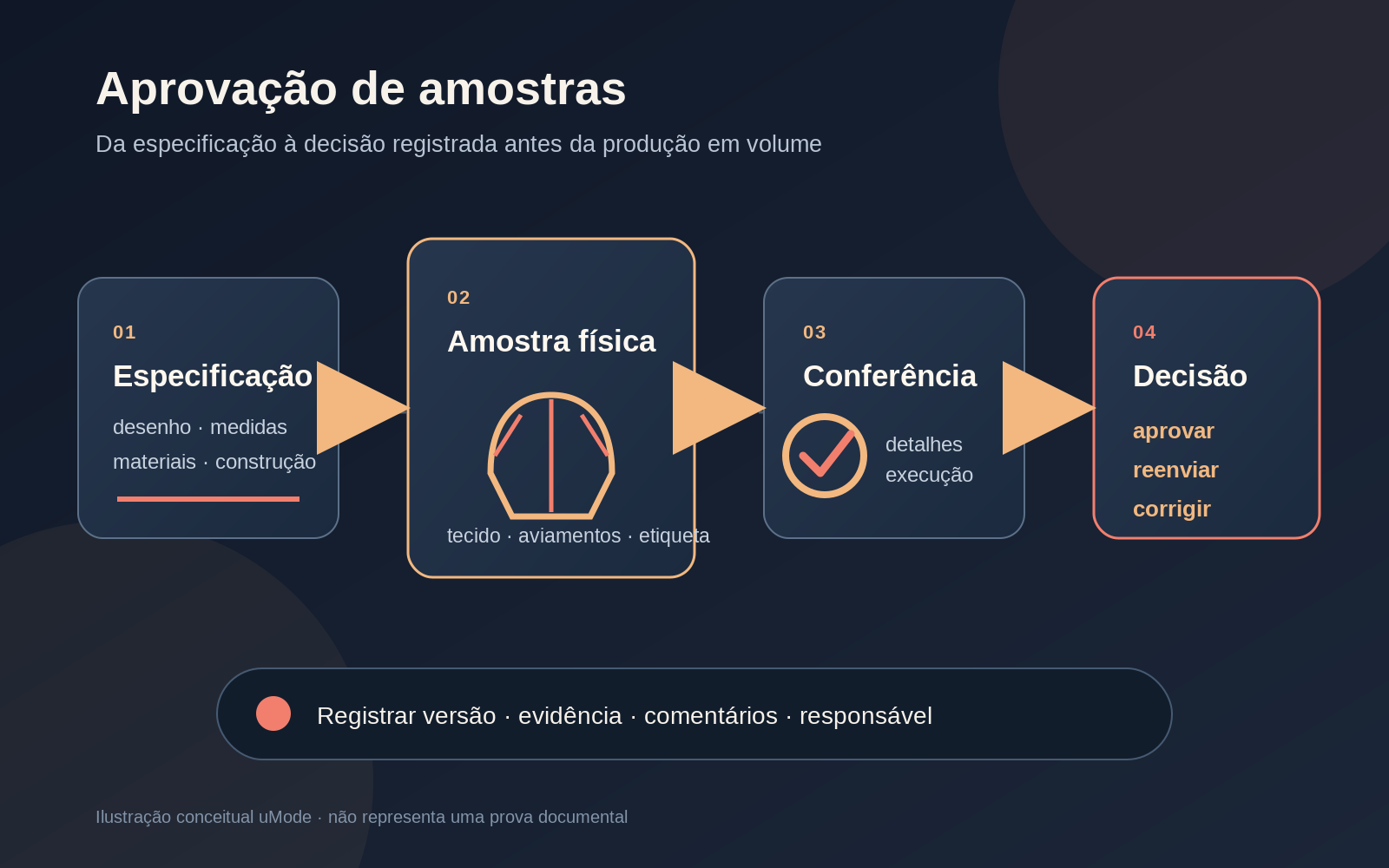
Fashion sample approval
Fashion sample approval is the process of comparing a physical sample with documented requirements for style, materials, construction and identification, recording deviations and deciding whether the garment can proceed, needs resubmission or requires correction before volume production.
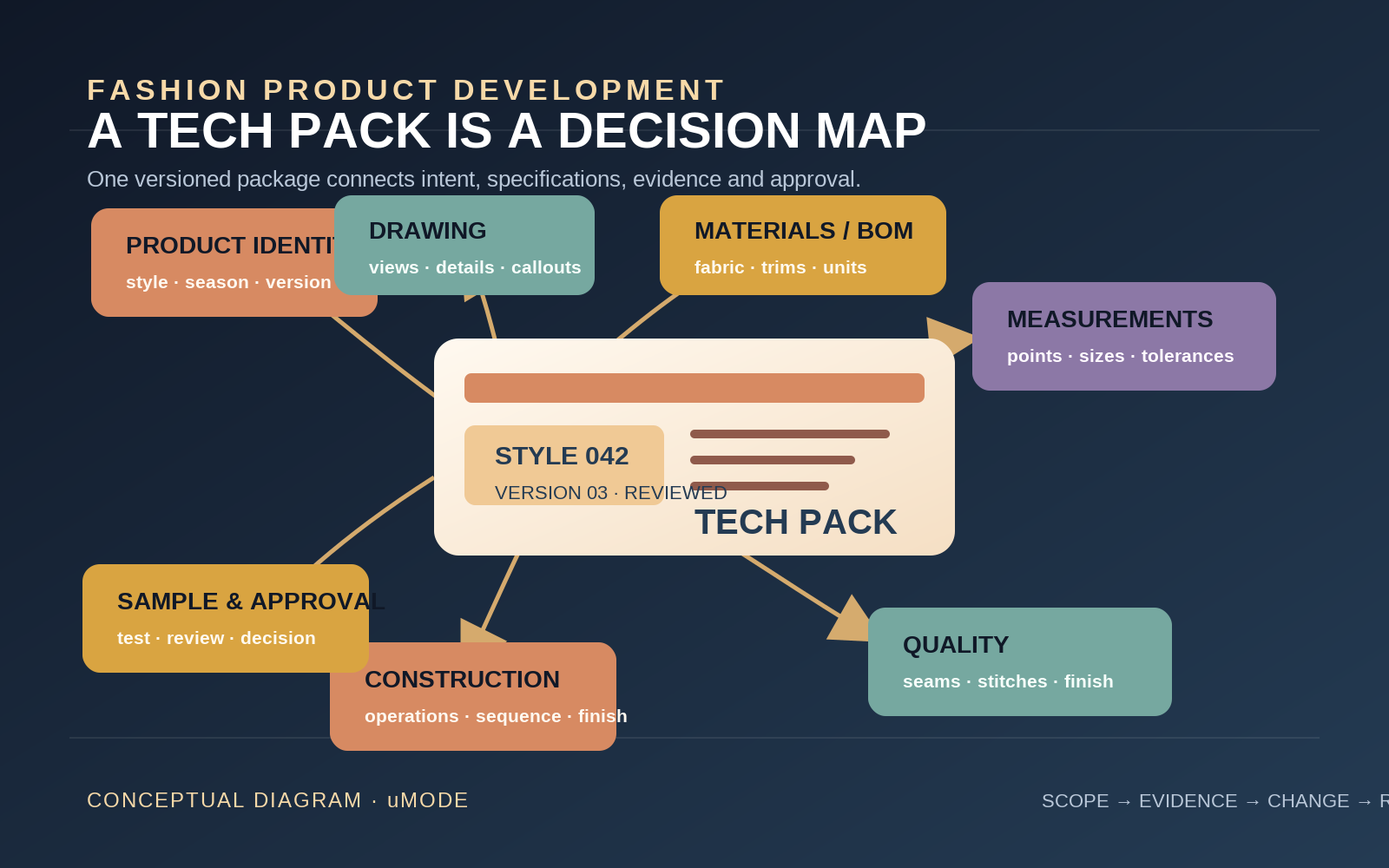
How to structure a fashion tech pack
How to structure a fashion tech pack: turn product intent into a verifiable technical package for development, sampling, and manufacturing. It should bring together scope, drawings, measurements, materials, construction, labelling, quality, tolerances, approvals, and change history under an identifiable version.
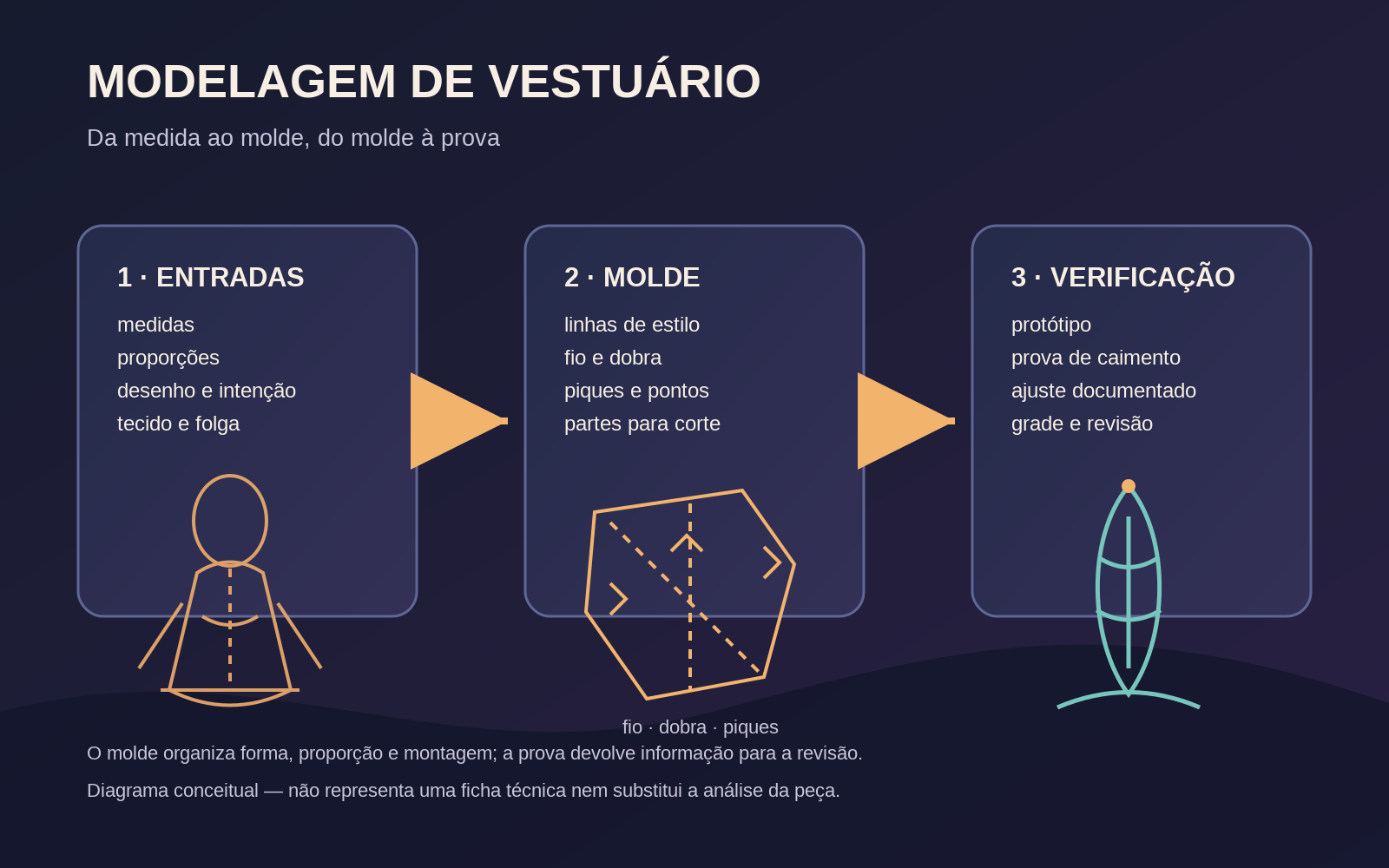
Garment patternmaking
Garment patternmaking is the technique of turning measurements, proportions, and design intent into patterns used to cut and assemble a garment. It connects a block, flat pattern construction or draping with fabric information, production markings, fitting, alterations, and grading; the result is a testable development basis, not an automatic guarantee of fit.
Sources
Want to apply this to your operation?