Marker making: how to do it and how to calculate fabric utilization
See the difference between marker making, the marker and spreading, and calculate fabric consumption and utilization with a filled-in spec, from the wrong calculation to the right one.
On this page
Marker making is the distribution of the pattern pieces of a fashion garment on a marker, on paper or on the fabric, which serves as the reference for cutting.
Imagine the Aurora, an invented blouse: you divide the marker length by the sizes, not by the pieces, and ask the supplier for twice the fabric you need. The Spreadsheet accepts the calculation without complaint.
What is the difference between marker making, the marker and spreading?
Marker making distributes the pattern pieces, the marker is the stage that generates the layout with that fit, and spreading stacks the fabric plies for cutting.
Each stage carries a different error. If fabric yield comes out poor, the cause is in how well the pattern pieces nest, which becomes the marker. If waste shows up with the layout well filled, look at the stack: the spread length follows the marker, and excessive leftovers in the width and at the ends increase loss (Sebrae/RS, Production Process Management, 2007, pp. 18 and 32).
How do you make a marker step by step?
Fix how many pieces of each size you will cut and simulate the graded pattern pieces inside the fabric width.
Consumption comes from that simulation, and the fabric width weighs as much as the size run (Ferreira et al., Design & Tecnologia, 2015, pp. 2 and 3). That is why the size run comes in before any marker. On the Aurora spec, the wrong calculation comes first and the right one after:
| Field | Value |
|---|---|
| Design and material | Aurora blouse; plain woven fabric bought by the meter; complete patterns per piece |
| Fabric width | 1.50 m (59 in) |
| Size run shown in the marker | S: 2 pieces; M: 2 pieces; total: 4 pieces |
| Marker length | 6.00 m |
| Wrong calculation per piece | 6.00 m ÷ 2 sizes = 3.00 m |
| Correct calculation per piece | 6.00 m ÷ 4 pieces = 1.50 m |
| Utilization | Patterns: 7.20 m²; fabric: 1.50 m × 6.00 m = 9.00 m²; 7.20 ÷ 9.00 × 100 = 80%; waste: 1.80 m² |
| Purchase for 60 pieces | Right: 15 markers × 6.00 m = 90.00 m (about 98 yd); wrong: 60 × 3.00 m = 180.00 m (about 197 yd); difference: 90.00 m |
- List the size run from the spec: 2 pieces S and 2 pieces M, 4 in total.
- Separate the complete Aurora patterns for each of those 4 pieces.
- Distribute the patterns inside the 1.50 m width, without leaving any part out.
- Measure the length the marker took up: 6.00 m.
- Divide that length by the 4 pieces and take 1.50 m to the consumption calculation.
- Multiply by the order of 60 pieces and compare with the wrong calculation: the difference in the purchase is 90.00 m.
Dividing by sizes is like counting the S and M tags on the rack to find out how many blouses are hanging there. Back to the budget, you realize that The Spreadsheet is happy with any divisor; the one who checks the size run is you.
How do you calculate fabric utilization?
Divide the sum of the pattern piece areas by the fabric area of the marker and multiply by 100; the closer to 100%, the less waste.
On the spec, the fabric area comes from the width times the length, and what is left after the patterns is waste. Utilization measures area occupation; consumption measures meters per piece. One calculation says how much becomes scrap, the other how much you buy, and the Aurora needs both. Since the geometry and arrangement of the pattern pieces weigh on the rate, apparel pattern making decisions change the result (Ferreira et al., Design & Tecnologia, 2015, p. 1).
Does striped fabric change the marker?
It does: pattern making marks match points on the pattern pieces, and the marker has to respect them.
If the Aurora were striped, the pattern pieces would lose the freedom to slide around to close gaps, because each match point ties one part to another. The price shows up in efficiency, which generally drops (Alves and Aymone, Projética, 2014, pp. 3 and 14).
What should you check before releasing the marker for cutting?
Check that the marker matches the quantity ordered, fits the fabric width and fits the cutting table.
The 2021 spec sheet for the pattern making, marker making and plotting service follows this logic: the marker considers the width and the size of the table, and the delivery brings full-size markers and a cutting map. The company states the number of pieces, the data that was missing from the Aurora's wrong calculation (Sebraetec, spec sheet 23004-3, 2021, pp. 2 and 3).
What questions about marker making still come up?
Do even and odd markers serve the same patterns?
Only partly. The even marker serves symmetrical and asymmetrical pattern pieces; the odd one serves only symmetrical ones and requires an even spread; the mixed one combines the two (IFSC Sewing Handbook, pp. 19 and 20).
Are the marker and the layout the same thing?
Almost. The marker is the stage; the layout is the sheet it generates, with the pattern pieces fitted together.
Why does consumption change when the size run changes?
Because consumption comes from a simulation with the quantities of each size. Change the size run and the fit changes, along with the marker length.
The Aurora goes back to the budget with the size run added up and the purchase cut in half. The Spreadsheet remains satisfied, now with the right divisor.
The scissors only repeat what the calculation already decided.
Verified facts
- Marker making (encaixe in Portuguese) is the distribution of pattern pieces on a marker that serves as the reference for cutting, made on paper or directly on the fabric.
Source: bis.sebrae.com.br ↗ - The marker stage is responsible for fitting the pattern pieces together and produces the marker; fabric yield depends on how well the pattern pieces nest.
Source: bis.sebrae.com.br ↗ - Spreading is the system of stacking fabric plies for cutting, with a length defined by the marker; excessive leftovers in the width and at the ends increase waste.
Source: bis.sebrae.com.br ↗ - To make a marker you have to fix the number of pieces and sizes; consumption results from a simulation with the graded patterns and the quantities of each size, with the fabric width as one of the main parameters.
Source: dialnet.unirioja.es ↗ - The fabric utilization rate is the ratio between the sum of the areas of the cut pieces and the total fabric area, and it depends on the geometry and arrangement of the pattern pieces.
Source: dialnet.unirioja.es ↗ - The pattern making, marker making and plotting service described in the 2021 Sebraetec spec sheet considers the fabric width and the size of the cutting table, provides full-size markers and a cutting map, and requires the number of pieces to be stated.
Source: datasebrae.com.br ↗ - In striped fabrics, pattern making indicates match points that must be respected in the marker; these restrictions generally reduce efficiency.
Source: ojs.uel.br ↗ - The even marker holds all the parts of the garment and serves symmetrical and asymmetrical pattern pieces; the odd marker holds half the pattern pieces, serves only symmetrical ones and requires an even spread; the mixed marker combines even and odd markers.
Source: wiki.ifsc.edu.br ↗
Related entries
Garment patternmaking
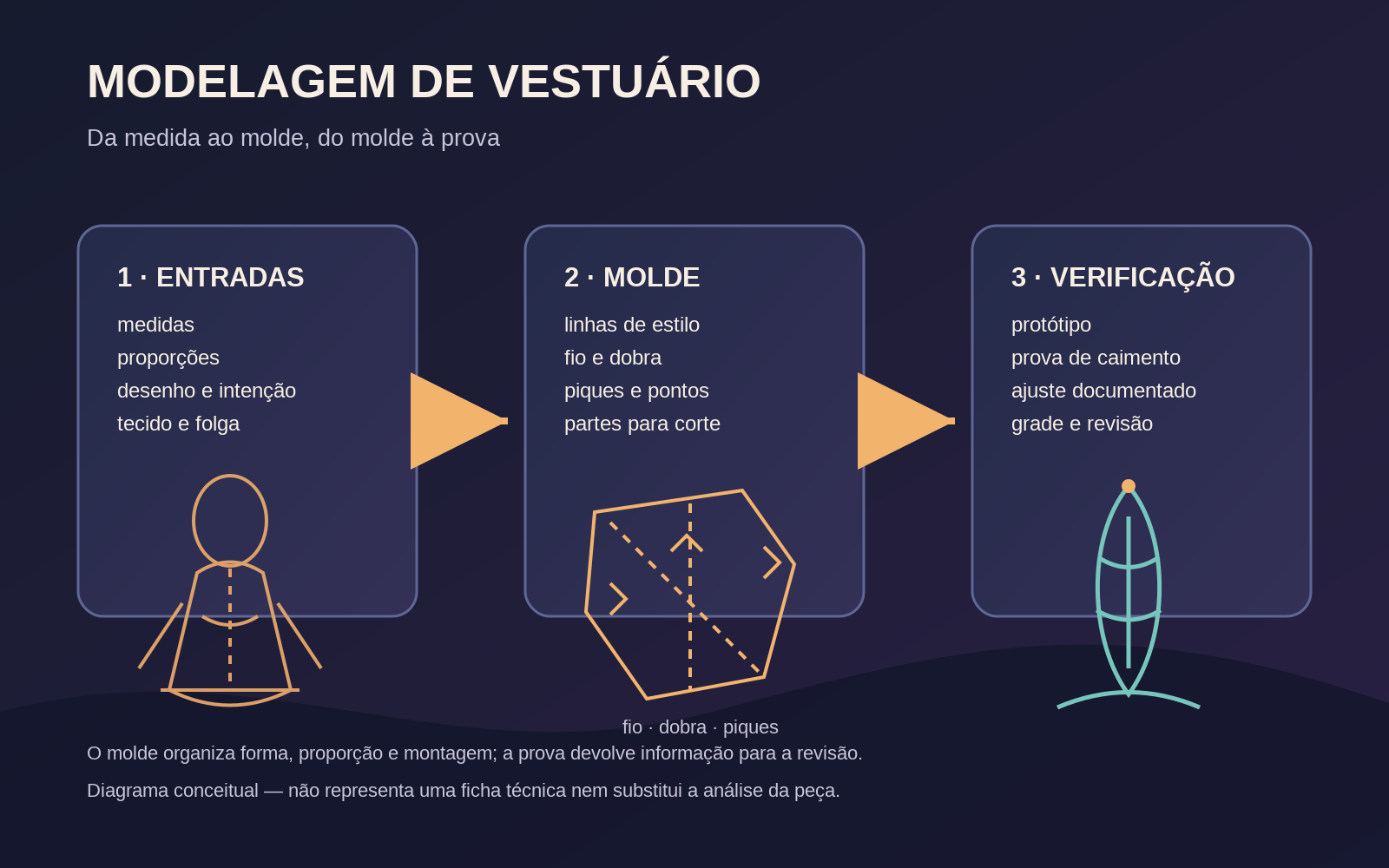
Garment patternmaking is the technique of turning measurements, proportions, and design intent into patterns used to cut and assemble a garment. It connects a block, flat pattern construction or draping with fabric information, production markings, fitting, alterations, and grading; the result is a testable development basis, not an automatic guarantee of fit.
Material consumption calculation
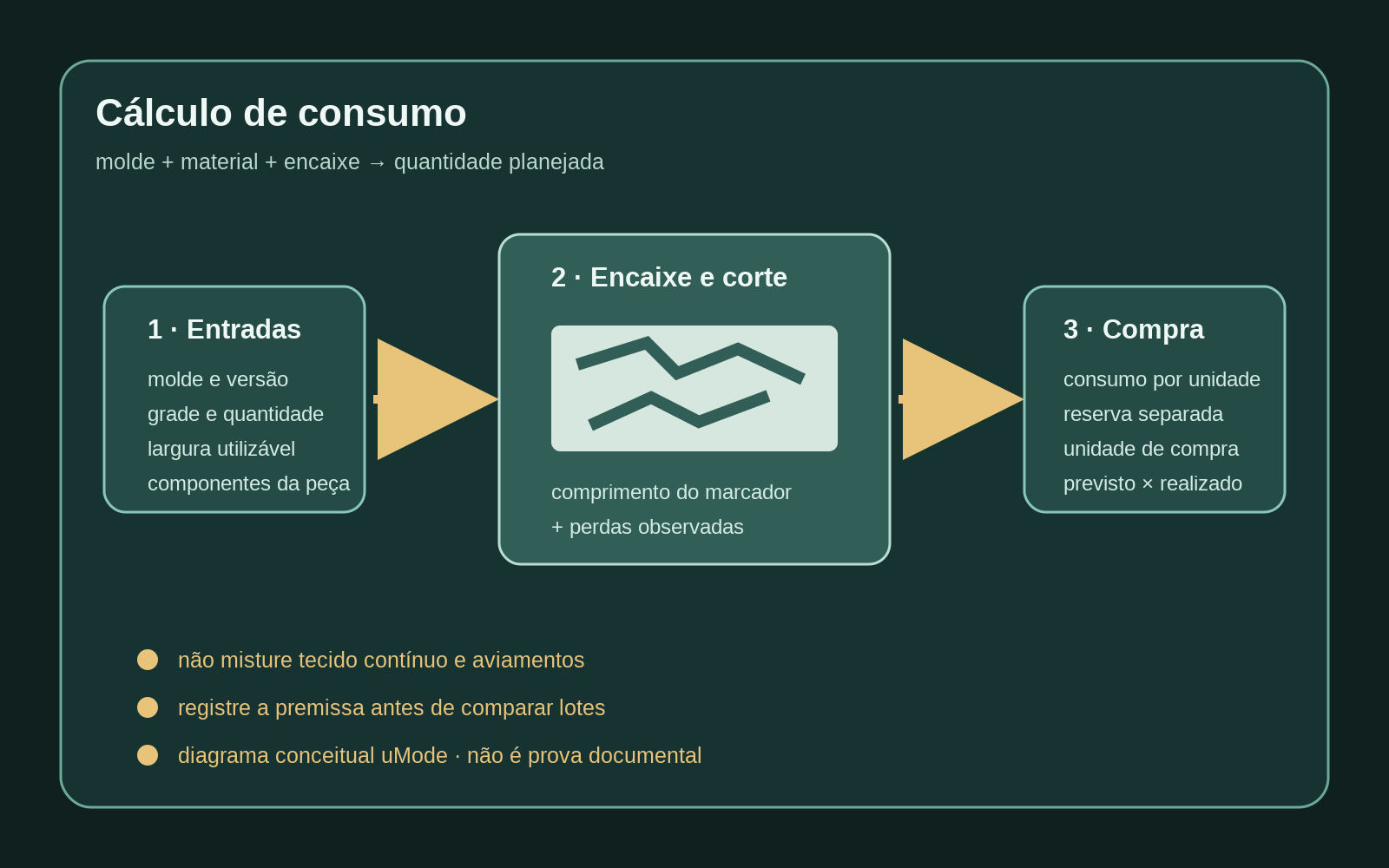
Material consumption calculation records the fabric and component quantities required for a product, size range, or production lot under explicit assumptions. In apparel, it connects the pattern, marker, material, observed losses, and purchasing unit without treating a development estimate as the same thing as measured production usage.
Size grading
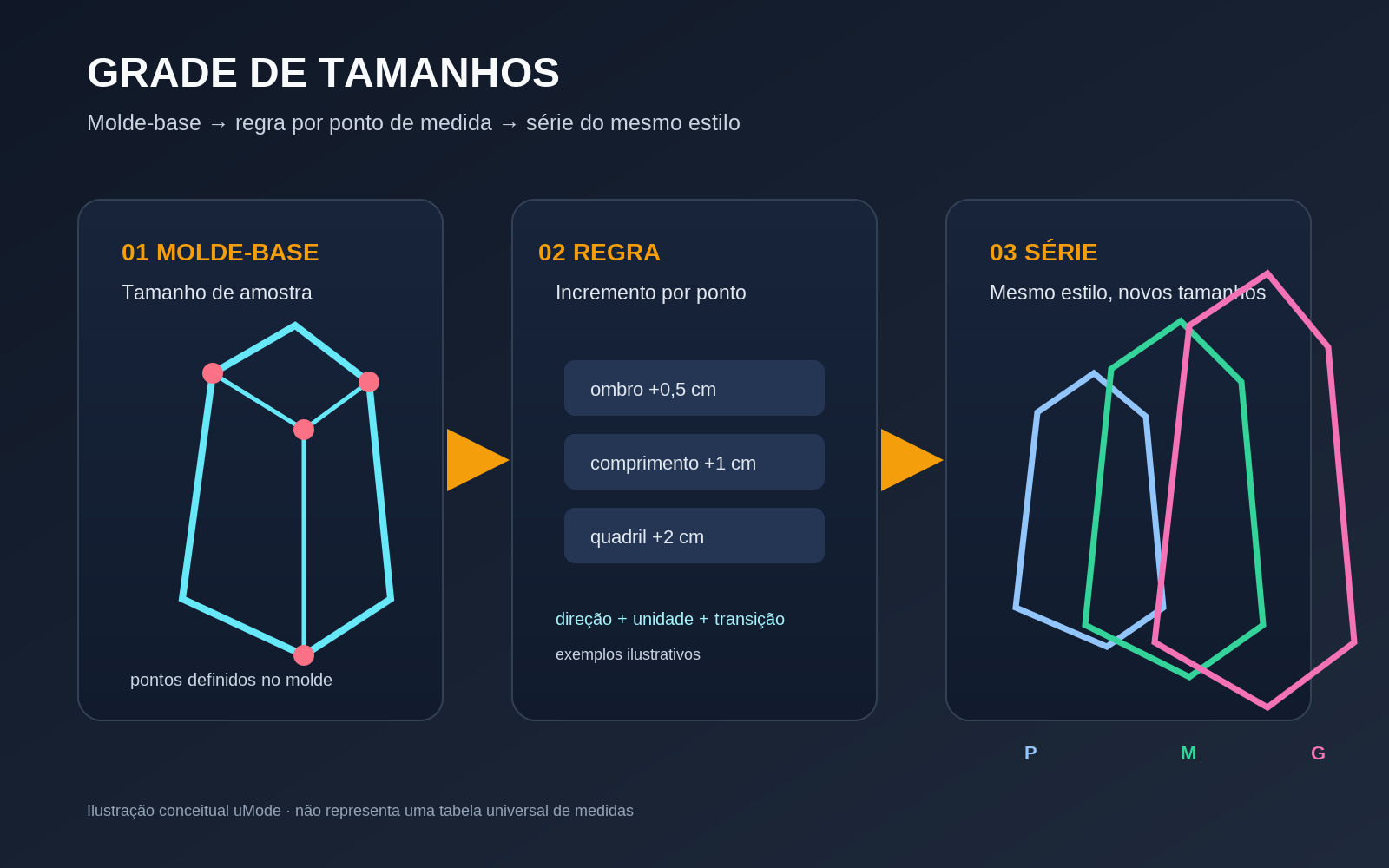
Size grading is the process of turning base-size or sample-size patterns into additional sizes by using a specification sheet or grading increments. A rule changes defined points on the pattern to form a size range for the same style; it does not replace patternmaking or create a new shape.
Sources
- https://bis.sebrae.com.br/bis/download.zhtml?t=D&uid=4D917E1B8D6C668F8325745700482839
- https://dialnet.unirioja.es/descarga/articulo/5440223.pdf
- https://datasebrae.com.br/wp-content/uploads/2021/10/Modelagem-Encaixe-e-Plotagem-DP23004-3.pdf
- https://ojs.uel.br/revistas/uel/index.php/projetica/article/download/17745/15031/83243
- https://wiki.ifsc.edu.br/images/b/b0/Apostila_de_Costura.pdf
Want to apply this to your operation?