Textile finishing and wet processing: what it is, the stages and the difference from finishing
Textile processing (beneficiamento, or ultimação in Brazil) brings together preparation, dyeing, printing and finishing. See what each stage does and how to separate color and hand feel in a filled-in spec for the supplier.
On this page
- What is part of textile processing?
- What is the difference between textile processing and textile finishing?
- What is preparation, or pretreatment, of the fabric for?
- What is desizing?
- When does fabric need scouring and bleaching?
- How does dyeing differ from printing?
- How do you specify textile processing on the spec?
- Can dyeing happen on the finished garment?
- Quick questions
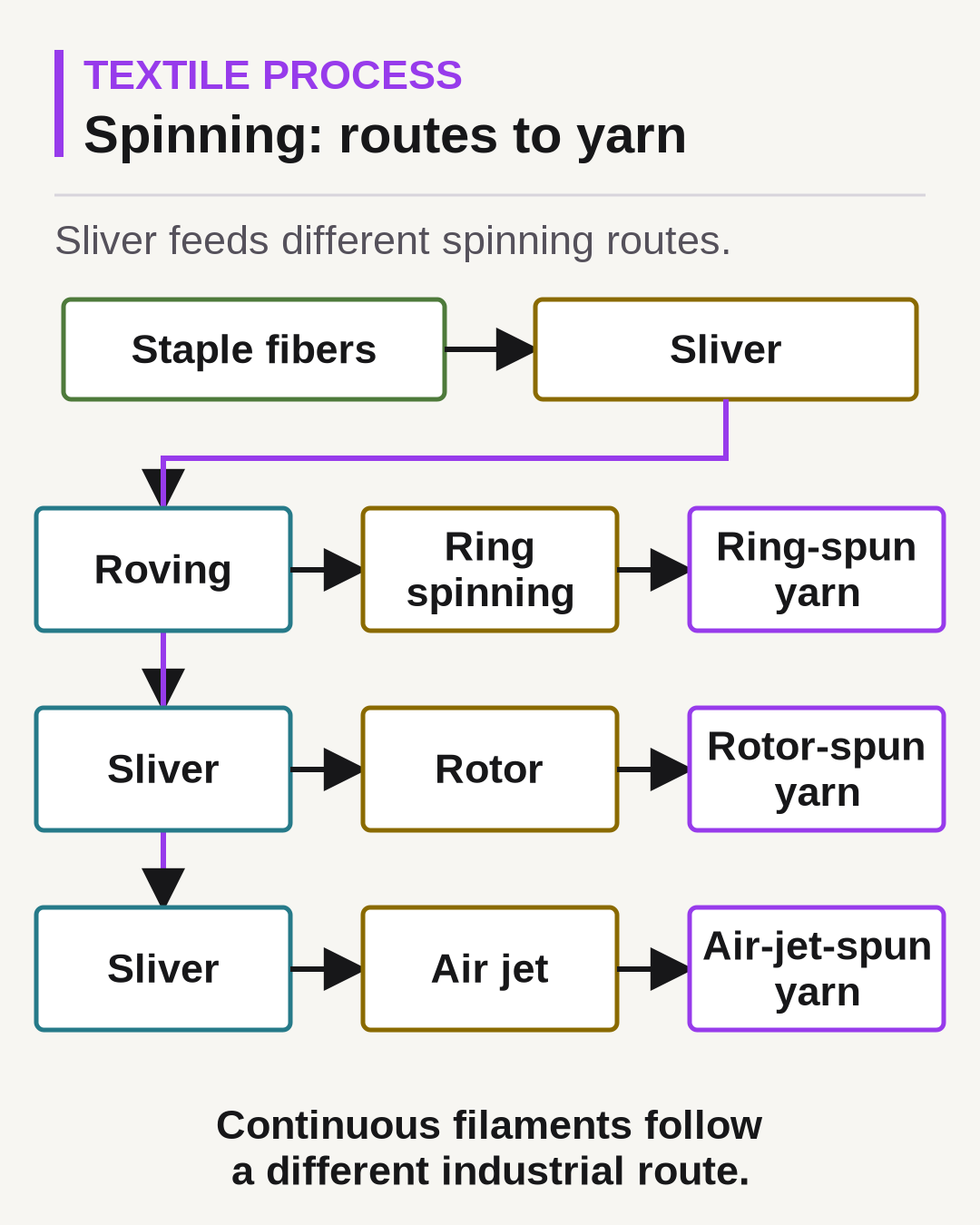
Textile processing (beneficiamento, also called ultimação in Brazil) brings together the preparation, dyeing, printing and finishing treatments applied to the textile material that fashion turns into a garment. In English it is usually called textile wet processing or dyeing and finishing. Imagine the Aurora, an invented shirt: you ask for "blue finishing" and the supplier sends back a question about hand feel that you never defined.
Stages of textile processing:
- Preparation (desizing, scouring, bleaching).
- Color (dyeing and/or printing).
- Finishing.
The order and the presence of each stage depend on the material and its destination: dyeing, for example, can already happen at the fiber or the yarn.
What is part of textile processing?
Preparation, dyeing, printing and finishing are part of it, and preparation comes before dyeing and printing (BREF, the best available techniques reference document for the Textile Industry, JRC, European Commission Joint Research Centre, 2023, p. 42).
In the textile and apparel chain, they define the material that arrives at your cutting. Asking for "blue" answers only one of the questions: how the fabric arrives, what color it carries, what hand feel it delivers.
What is the difference between textile processing and textile finishing?
Textile finishing is the part of processing that gives end-use properties, such as hand feel, visual effect and waterproofing, by physical, mechanical or chemical means (BREF, p. 106).
Processing also includes preparation, dyeing and printing. On the Aurora spec, ask for one sample for the color and another for the hand feel, and approve each in its own field.
What is preparation, or pretreatment, of the fabric for?
Preparation, or pretreatment, removes foreign materials from the fibers and improves uniformity, hydrophilicity and affinity for dyes and finishes, before dyeing and printing.
Imagine the Aurora fabric going straight to the vat still sized: the size gets in the way of the affinity with the dye, and the blue risks coming out uneven. In cotton, desizing applies to woven fabric.
What is desizing?
Desizing is the pretreatment that removes the sizing products applied to the fabric for weaving (Implementing Decision (EU) 2022/2508, OJ L 325, pp. 115 and 116).
The Aurora fabric arrives greige and sized, and this entry condition deserves its own field on the spec.
When does fabric need scouring and bleaching?
Material for dark colors can go straight to dyeing; for pastel colors or prints, bleaching is necessary (BREF, pp. 46 and 47).
Scouring extracts pectins, fats, waxes, proteins, mineral salts and remains of size. "Complete preparation" on the spec leaves the supplier to guess the sequence; writing the destination, pastel blue, already says that bleaching is included.
How does dyeing differ from printing?
Dyeing gives color to the whole material, and printing applies color only to defined areas, to form a design (BREF, p. 92).
Reserve a field for each. A plain shirt calls for the entry "no print", which keeps the supplier from asking whether the design was forgotten. For a printed design, see digital printing.
How do you specify textile processing on the spec?
Write one line per decision, each tied to a sample when there is one: preparation, color, print and finishing. The Aurora spec looks like this:
| Field | Value |
|---|---|
| Destination garment | Aurora shirt |
| Material and quantity | Woven cotton fabric, 120 m |
| Entry condition | Greige and sized |
| Preparation | Desizing, scouring and bleaching, because the color is pastel |
| Color | Pastel blue, color sample A-01 |
| No print | |
| Finishing | Soft hand feel, result to be approved against hand-feel sample T-02 |
| Approval | Lot compared with A-01 and T-02 before release |
The old Spreadsheet carried the cell "finishing: blue", which the supplier read as color and the designer read as hand feel. In the new spec, the cell became two lines, A-01 and T-02, and the lot only ships after being compared with both. How to reach the soft hand feel is up to the supplier.
Can dyeing happen on the finished garment?
It can: dyeing takes place on the fiber, the yarn, the woven fabric, the knit or the finished garment (BREF, p. 61).
Record on the spec at what point the color enters. For the finished garment, see garment laundry.
Quick questions
Can color and hand feel go in the same field of the spec? Better to separate them. In a single field, one approval hides the other, and the supplier discusses the whole spec instead of one stage.
Can the preparation stages be done together? Yes: pretreatment allows several operations to be combined (BREF, p. 42). Combining changes the supplier's process, and the result required on the spec stays the same.
A cell with two decisions approves the worse of the two.
Verified facts
- Textile processing (beneficiamento in Portuguese, also called ultimação) covers dyeing, printing and finishing in the textile chain.
Source: redalyc.org ↗ - Pretreatment removes foreign materials from the fibers, improves uniformity, hydrophilicity and affinity for dyes and finishes and comes before dyeing and printing.
Source: bureau-industrial-transformation.jrc.ec.europa.eu ↗ - In the pretreatment of cotton, desizing applies to woven fabric and several operations can be combined.
Source: bureau-industrial-transformation.jrc.ec.europa.eu ↗ - Desizing is the pretreatment that removes the sizing products applied to the fabric for weaving.
Source: eur-lex.europa.eu ↗ - Scouring extracts impurities such as pectins, fats, waxes, proteins, mineral salts and remains of size.
Source: bureau-industrial-transformation.jrc.ec.europa.eu ↗ - Bleaching is necessary for material destined for pastel colors or printing, while material destined for dark colors can go directly to dyeing.
Source: bureau-industrial-transformation.jrc.ec.europa.eu ↗ - Printing, like dyeing, applies color to the substrate, but in defined areas to form a design.
Source: bureau-industrial-transformation.jrc.ec.europa.eu ↗ - Finishing comprises physical, mechanical or chemical treatments that give the material end-use properties, such as visual effect, hand feel and waterproofing.
Source: bureau-industrial-transformation.jrc.ec.europa.eu ↗ - Dyeing can take place on the fiber, the yarn, the woven fabric, the knit or the finished garment.
Source: bureau-industrial-transformation.jrc.ec.europa.eu ↗
Related entries
Textile and apparel supply chain
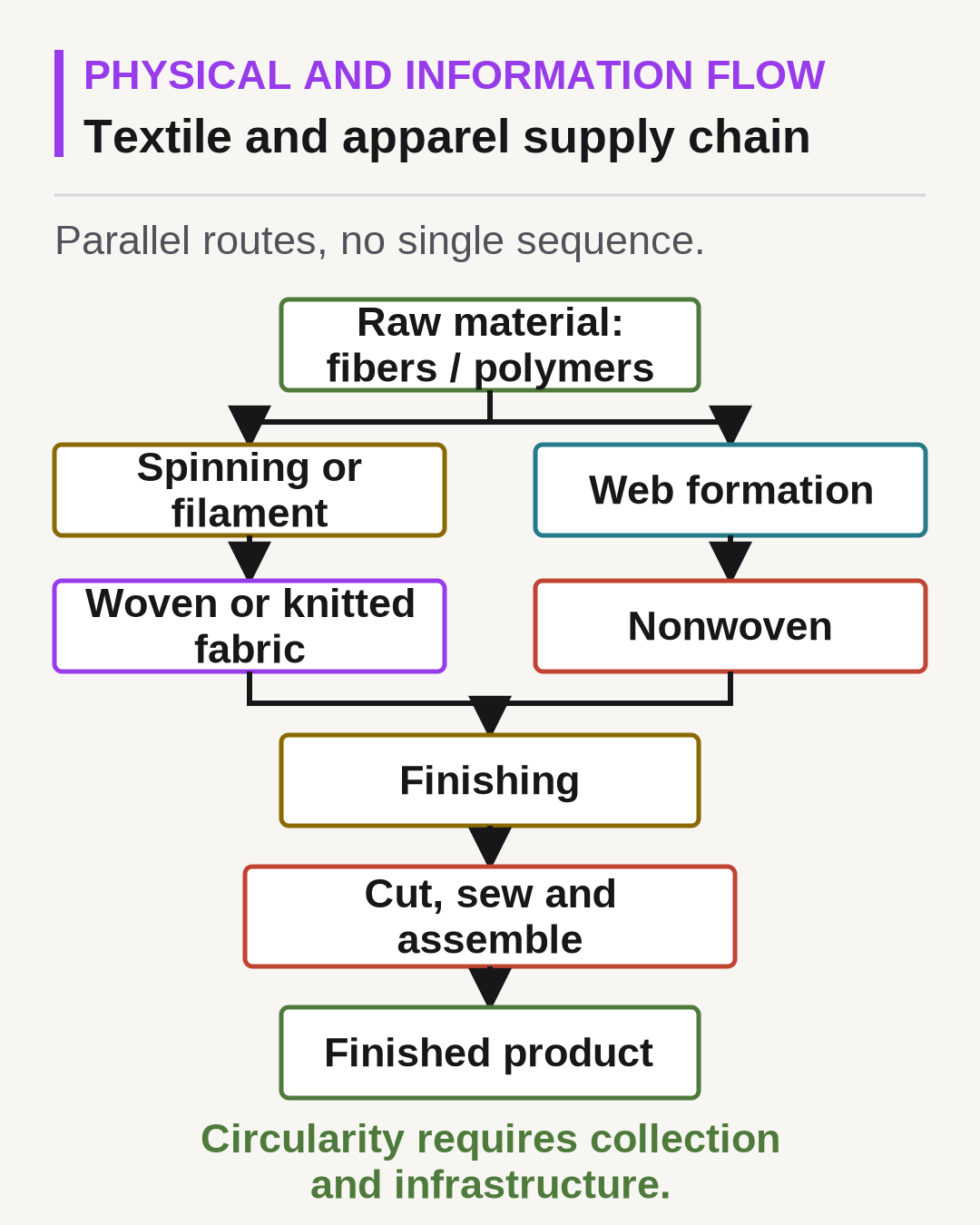
The textile and apparel supply chain transforms natural or manufactured raw materials into yarns, woven or knitted fabrics, and then finished articles. Its reference flow covers fibres, spinning, material formation, wet processing, cutting and assembly, while the real system also includes suppliers, subcontracting, distribution, use and recovery routes.
Industrial garment laundry
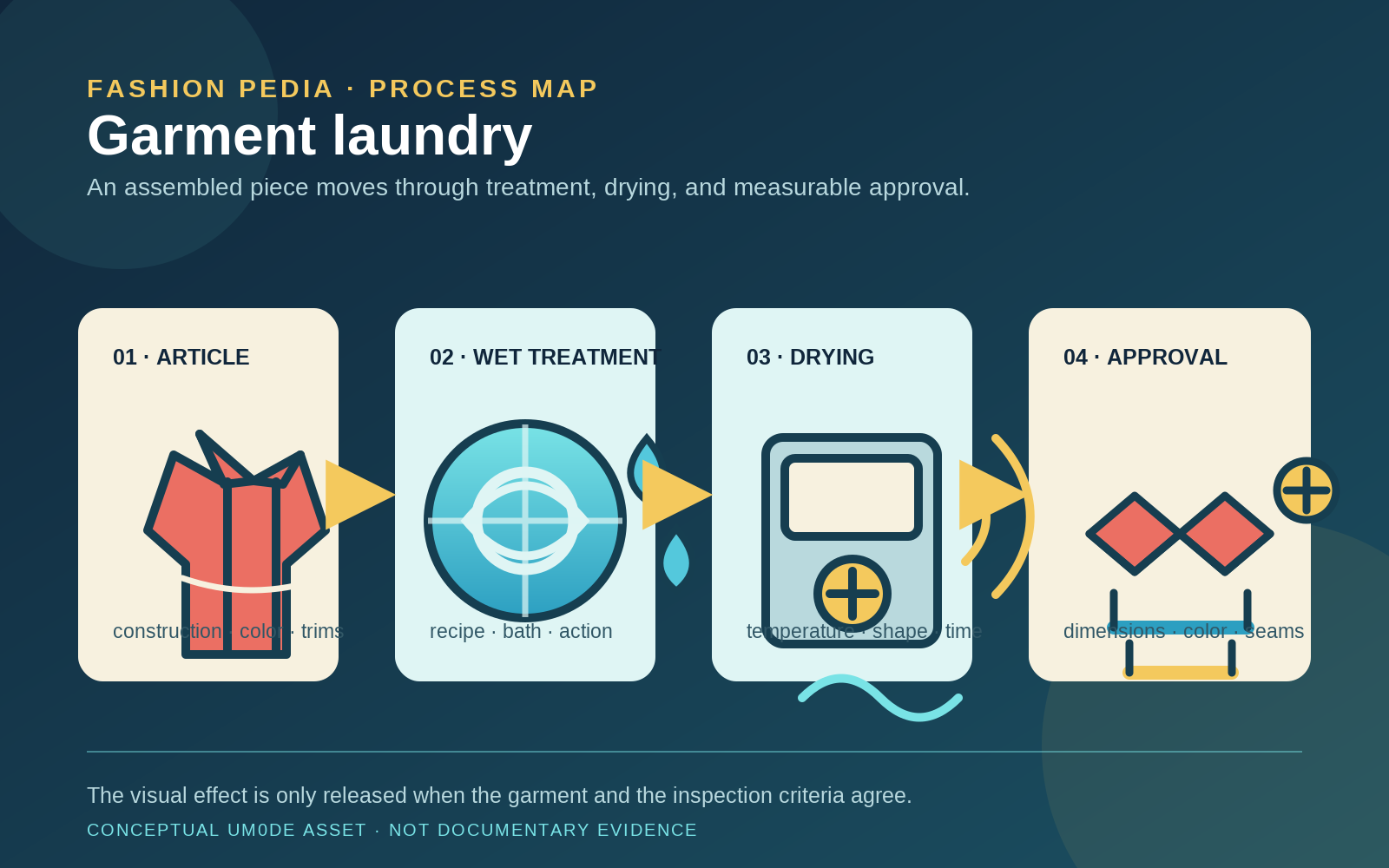
Industrial garment laundry is the controlled wet treatment and drying of an already-sewn garment to obtain cleaning, appearance change, or a finish. Approval must separate the visual effect from measurable results such as dimensional change, color change, appearance, and seam twist.
Digital textile printing
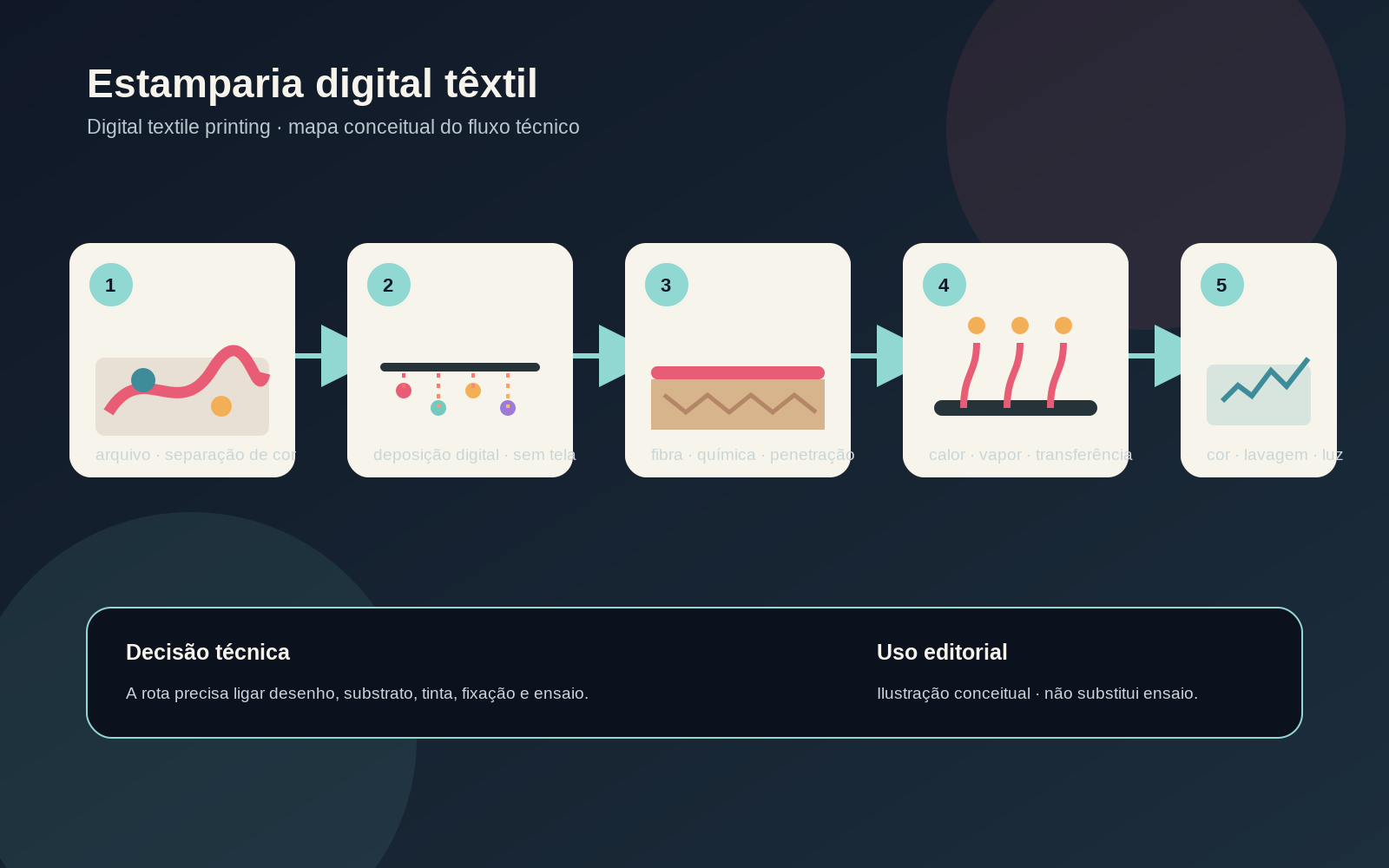
Digital textile printing places an image on a textile substrate through a digitally controlled print system. The route must be selected with the substrate, ink, preparation or transfer, fixation, and relevant fastness tests considered together.
Industrial weaving
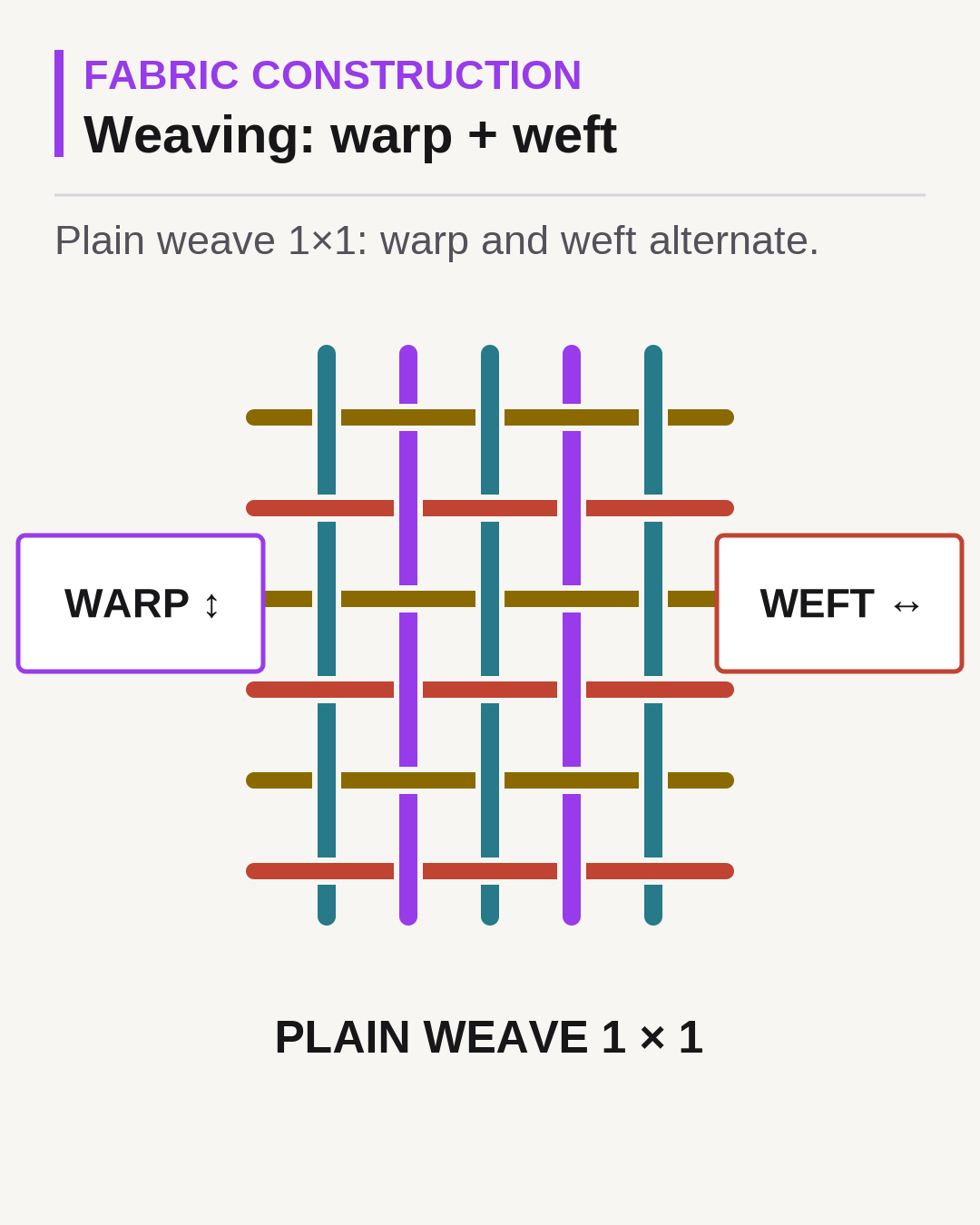
Weaving is the process of forming fabric by regularly interlacing two yarn systems: warp in the lengthwise direction and weft across the width. The construction results from warp preparation, shed formation, weft insertion and beat-up, and control of yarn delivery and fabric take-up.
Sources
Want to apply this to your operation?