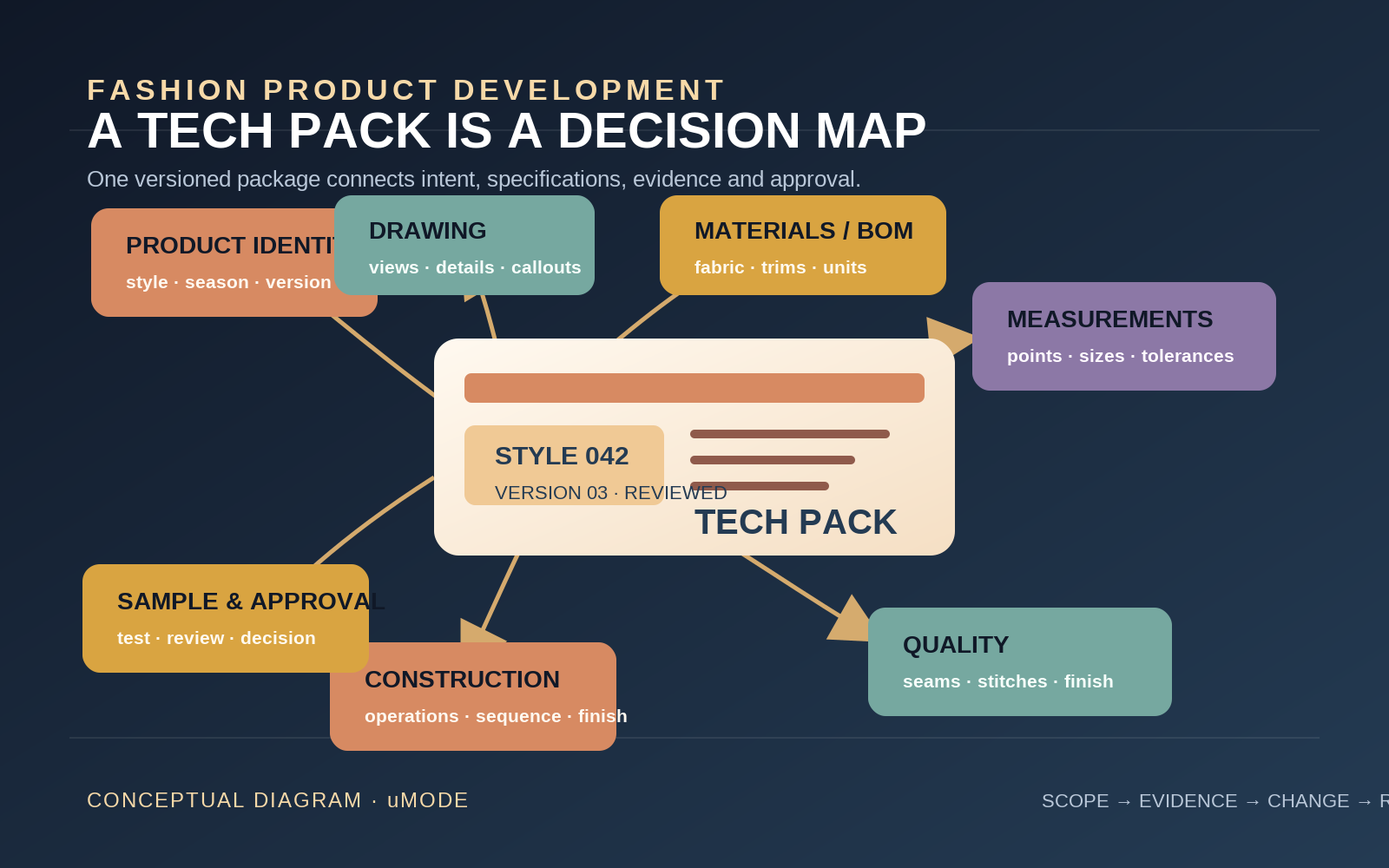
How to start a clothing brand: steps, costs and a first-garment example
See the steps to start a clothing brand, the math of a first garment in a table and the cautions around production, name, company and label, with the Brazilian rules that apply.
On this page
- How do you start a clothing brand, step by step?
- How much does the first garment of a clothing brand cost?
- How much does it cost to open a clothing brand?
- Is it possible to have a clothing brand without a factory?
- What should you do about the brand name?
- How do you open the company for a clothing brand?
- What goes on the label of a garment?
- Is it better to sell direct or through resellers?
Starting a clothing brand is deciding product, production, name and sales channel of a fashion business before the first lot. The rules about registration, label and taxes in this entry are Brazilian; the logic of the steps applies anywhere. Imagine the Aurora blouse, invented: you buy the fabric for the first lot before the pilot sample, the sleeve pulls at the fitting and the calculated consumption no longer works. That is the wrong order; step 4 shows the right one.
How do you start a clothing brand, step by step?
There are six steps, and the approved pilot sample comes before any large purchase.
- Define the customer. Write down who wears the Aurora and where: an office blouse needs to drape well when seated. Link the answer to collection planning.
- Search for and apply to register the name. Do this at INPI (the Brazilian National Institute of Industrial Property) before printing the label, tag and profile with a name that may collide.
- Choose how to produce. Decide between receiving the finished garment with your label or hiring a facção (sewing subcontractor) and supplying fabric and trims.
- Design, test and approve the pilot sample. Make the spec sheet, pattern and prototype; fix the sleeve before grading S, M and L and only release the lot with the pilot sample approved technically and commercially.
- Add up all the spending. Lot and development go into the same calculation, as in the table below.
- Choose the channel. Decide between direct sales and indirect channels before setting the price.
The path from planning to realization, with tests, corrections, the final spec sheet and a pilot sample approved technically and commercially, appears in the Montemezzo framework (Emídio and Sabioni, Projética, 2010, PDF pp. 7 and 8).
How much does the first garment of a clothing brand cost?
Of the cash set aside, only what is left after paying for the lot and the development is free.
Give the Aurora numbers; the values are hypothetical, just to do the math:
| Field | Value |
|---|---|
| Product and audience | Aurora blouse in woven fabric, for women who wear a blouse to the office |
| Lot and size run | 20 pieces: 6 S + 8 M + 6 L |
| Production | Facção; fabric and trims supplied by the brand; sleeve being adjusted; pilot pending |
| Fabric | 30 m × R$ 20/m = R$ 600; the 30 m are 1.5 m per piece × 20 pieces, consumption that is only confirmed at the marker of the pattern approved on the pilot |
| Lot cost | R$ 600 fabric + R$ 500 service + R$ 100 trims and labels = R$ 1,200; R$ 60 per piece |
| Cash set aside | R$ 1,200 production + R$ 300 development + R$ 500 reserve = R$ 2,000 |
| Channel and price | Direct sales; R$ 120 per piece; revenue of R$ 2,400 if all 20 sell, before selling costs |
| Wrong and right calculation | Wrong: R$ 2,000 − R$ 600 = R$ 1,400 treated as free. Right: R$ 2,000 − R$ 1,200 − R$ 300 = R$ 500, which is the reserve. Difference: R$ 900 |
The R$ 60 per piece covers only production: digital marketing, logistics and customer service for direct sales are left out.
The Aurora's Spreadsheet had the fabric budgeted and a blank cell in the sleeve column, but the lot already showed as "ok". Whoever added up only the fabric saw slack where there was reserve. Budgeting only the fabric is measuring the bust and forgetting the sleeve: the calculation pulls too.
How much does it cost to open a clothing brand?
It depends on producing outside or setting up a factory: the first case fits in the table above, the second becomes an investment budget.
The Sebrae guide separates the initial investment into fixed investments, pre-operating expenses and working capital, with values that change with size, team, mix and location (Business Idea: Apparel Manufacturing, Sebrae, PDF p. 14). The Aurora's cash covers the lot and the development; company, name and sales go on separate lines.
Is it possible to have a clothing brand without a factory?
Yes: you receive the finished garment or hire only the labor.
In private label, the supplier delivers the garment with your brand's label. In a facção, you supply raw material and trims and pay for the sewing service. The choice changes what goes into the budget and who answers for the fabric (Emídio and Sabioni, Projética, 2010, PDF p. 7).
What should you do about the brand name?
Search and apply for registration before printing the name on the label, because ownership comes from the registration.
INPI advises searching for similarity, focusing on the core of the name, and warns that the examination also considers phonetic similarity. Ownership of a trademark is acquired by a validly issued registration, which gives exclusive use throughout the national territory (Law 9,279/1996, art. 129). An Aurora identical to another brand's does not pass just because it was your idea. A Brazilian registration covers Brazil; for other countries, check the local trademark office.
How do you open the company for a clothing brand?
Open the company before selling the first garment.
Sebrae lists registration with the Commercial Registry (Junta Comercial), the National Register of Legal Entities (CNPJ), state registration when required and registration with the city hall for the operating permit, with an exemption from permits for low-risk A activities under the conditions of the guide (Business Idea: Apparel Manufacturing, Sebrae, PDF p. 7).
What goes on the label of a garment?
The label carries the party responsible for the garment, the origin, the composition, the care instructions and the size.
According to the National Institute of Metrology, Quality and Technology (Inmetro), the label asks for identification of the responsible party and tax identification, country of origin, fibers with percentages, care instructions and size (Textile Products booklet, 2021, PDF p. 4).
Is it better to sell direct or through resellers?
What changes with direct sales?
You gain control of brand and margin, but pay for digital marketing, logistics and customer service (Business Idea: Apparel Manufacturing, Sebrae, PDF p. 13).
And in indirect channels, what is lost?
You reach a larger audience and share distribution costs, but lose control of the brand and of the customer experience.
The Aurora's Spreadsheet now has the sleeve filled in, the pilot sample approved and the lot released. A brand only begins when the first sleeve sits right.
Verified facts
- The Montemezzo framework reproduced by Emídio and Sabioni in 2010 includes planning, project specification, conceptual delimitation, generation of alternatives, evaluation and elaboration, with tests and corrections, and realization, with the final spec sheet and a pilot sample approved technically and commercially.
Source: ojs.uel.br ↗ - In private label, the supplier delivers the finished garment with the contracting brand's label; in a facção (sewing subcontracting), the client supplies raw material and trims and hires the labor.
Source: ojs.uel.br ↗ - The guide Business Idea: Apparel Manufacturing separates the initial investment into fixed investments, pre-operating expenses and working capital, with amounts that vary by size, number of employees, mix and location.
Source: bibliotecas.sebrae.com.br ↗ - The procedures for opening an apparel manufacturer listed by Sebrae include registration with the Commercial Registry (Junta Comercial), CNPJ (the company tax ID), state registration when required and registration with the city hall for the operating permit, with an exemption from permits and licenses for low-risk A activities under the conditions described in the guide.
Source: bibliotecas.sebrae.com.br ↗ - The Textile Products booklet, from Inmetro, 2021, requires identification of the responsible party and tax identification, country of origin, fibers with percentages, care instructions and size or dimension on the label.
Source: gov.br ↗ - INPI (the Brazilian trademark office) advises searching beforehand for similarity, focusing on the core of the sign, and says that the examination also considers phonetic similarity.
Source: gov.br ↗ - Ownership of a trademark is acquired by a validly issued registration, which ensures exclusive use throughout the national territory.
Source: planalto.gov.br ↗ - Direct-to-consumer sales give greater control of brand and margin, but require investment in digital marketing, logistics and customer service; indirect channels allow reaching a larger audience and sharing distribution costs, with less control of the brand and of the customer experience.
Source: bibliotecas.sebrae.com.br ↗
Related entries
Sources
- https://ojs.uel.br/revistas/uel/index.php/projetica/article/download/7724/6867
- https://bibliotecas.sebrae.com.br/chronus/ARQUIVOS_CHRONUS/IDEIAS_DE_NEGOCIO/PDFS/ideia-de-negocio_confeccao.pdf
- https://www.gov.br/inmetro/pt-br/centrais-de-conteudo/publicacoes/cartilhas/cartilha-produtos-texteis-2021.pdf/@@download/file
- https://www.gov.br/inpi/pt-br/plataforma-integrada-de-atendimento/arquivos/documentos/etapas-para-pedido-de-registro-de-marca.pdf
- https://www.planalto.gov.br/ccivil_03/leis/l9279.htm
Want to apply this to your operation?