Fashion retail: what it is, what it includes and Brazil's CNAE 4781-4/00 code
Fashion retail is the sale of new clothing and accessories to the final consumer. See what falls in and out of Brazil's CNAE code 4781-4/00 and what sell-through, markdown and inventory turnover show.
On this page
Fashion retail is the sale of new clothing and accessories to the final consumer, classified in Brazil's National Classification of Economic Activities (CNAE) under code 4781-4/00. The classification in this entry is the Brazilian one; the indicators work in any market.
In the hierarchy of the Brazilian Institute of Geography and Statistics (IBGE), this code is the subclass of retail trade of clothing and accessories, within division 47, retail trade (IBGE, Hierarchy).
What does fashion retail include?
This activity covers clothing and clothing accessories and complements, as long as they are new.
On the clothing side, there are dresses, blouses, pants, underwear and school uniforms. On the accessories and complements side, there are ties, belts, scarves, socks, umbrellas, hats and gloves (IBGE, Explanatory notes).
The criterion applies to any material: what counts is that the item is new.
What is left out of fashion retail?
Used clothing, footwear, travel goods and sporting goods are left out of this subclass.
Used clothing retail belongs to 4785-7/99, footwear to 4782-2/01, travel goods to 4782-2/02 and sporting goods to 4763-6/02 (IBGE, Explanatory notes).
Which indicators does fashion retail track?
In the store, the rack shows what is left over and the clearance tag shows what price tried to solve; the indicators put numbers on those two scenes.
Sell-through and turnover appear in the UDESC guide to apparel retail indicators; the CNAE classifies the activity and determines no indicator at all. Each one answers a question:
- Sell-through: how much of the inventory was sold?
- Markdown: which pricing action clears seasonal merchandise?
- Inventory turnover: how many times was the average inventory sold in the period?
The two calculations that need the most care fit on one line each:
- sell-through = pieces sold in the period ÷ initial stock in pieces
- turnover = sales in the period ÷ average inventory for the period
Every calculation needs three definitions: the period, the numerator and the inventory base.
How do you measure sell-through?
Sell-through is the percentage of inventory sold in a given period.
The formula in the apparel retail guide divides the product's sales in pieces in the period by the initial stock in pieces. Initial stock in units is the sum of the products in stock before the sale (UDESC, pp. 5, 6 and 8).
A piece sold goes in the numerator; a piece that sits still stays on the rack.
What is markdown in fashion retail?
Markdown is a pricing action to clear seasonal merchandise.
A pricing engine can handle regular, promotional and clearance prices across all touchpoints. Price analysis can combine cost, current price, margin, upcoming events and inventory data (Oracle).
How do you calculate inventory turnover?
In apparel retail, turnover is the number of times the average inventory is sold in the period, and the formula is sales divided by average inventory (UDESC, p. 24).
There is an accounting variant. For a commercial company, another material presents the calculation of cost of goods sold (COGS) divided by inventories or by average inventory, and the external analyst usually estimates the average inventory by adding the initial and final inventories and dividing by 2 (Cecierj Foundation, 2006, pp. 13, 21 and 22).
Here lies a reading trap: turnover uses average inventory as its base, and sell-through uses initial stock. When recording either one, make explicit the period, the numerator and the inventory base adopted.
A number without a period and without an inventory base is just a counter-top guess. For neighboring readings, see markup and margin and ABC curve.
Frequently asked questions about fashion retail
What is fashion retail?
It is the activity of selling new clothing and accessories to the final consumer. At IBGE, the National Classification of Economic Activities (CNAE) registers it under code 4781-4/00, within retail trade.
What does fashion retail include?
It runs from the dress to the school uniform and from the tie to the glove. Used clothing, footwear, travel goods and sporting goods have their own codes and are left out.
Which indicators does fashion retail track?
Sell-through, markdown and turnover. Before comparing numbers, note the period, the numerator and the inventory base of each calculation.
See other uMode tools at https://www.umode.com.br/ferramentas (page in Portuguese).
Whoever measures only what sold forgets what is left on the rack.
Verified facts
- In IBGE's CNAE 2.3 (Brazil's national classification of economic activities), subclass 4781-4/00 is the retail trade of clothing and accessories, within division 47, retail trade.
Source: concla.ibge.gov.br ↗ - The subclass covers the retail trade of new clothing items of any material, such as dresses, blouses, pants, underwear and school uniforms, and of clothing accessories and complements, such as ties, belts, scarves, socks, umbrellas, hats and gloves.
Source: concla.ibge.gov.br ↗ - The subclass does not cover the retail of used clothing (4785-7/99), footwear (4782-2/01), travel goods (4782-2/02) or sporting goods (4763-6/02).
Source: concla.ibge.gov.br ↗ - Sell-through, written "sellthrough" in the UDESC guide, is the percentage of inventory sold in a given period.
Source: udesc.br ↗ - The formula presented in the guide divides the product's sales in pieces in the period by the initial stock in pieces.
Source: udesc.br ↗ - Initial stock in units corresponds to the sum of the products in stock before the sale.
Source: udesc.br ↗ - Markdown is used in retail as a pricing action to clear seasonal merchandise.
Source: oracle.com ↗ - A pricing engine can handle regular, promotional and clearance prices across all touchpoints.
Source: oracle.com ↗ - Price analysis can combine cost, current price, margin, upcoming events and inventory data.
Source: oracle.com ↗ - The UDESC guide, with no year given, defines turnover in apparel retail as the number of times the average inventory is sold in the period and presents the formula sales divided by average inventory.
Source: udesc.br ↗ - Inventory turnover is the number of times inventories are renewed, on average, over the period; for a commercial company, the Cecierj Foundation, in 2006, presents the calculation COGS (CMV in Portuguese) divided by inventories or average inventories.
Source: canal.cecierj.edu.br ↗ - The Cecierj Foundation material, from 2006, says the external analyst usually estimates the average inventory by adding the initial and final inventories and dividing by 2.
Source: canal.cecierj.edu.br ↗
Related entries
Sell-through in fashion retail
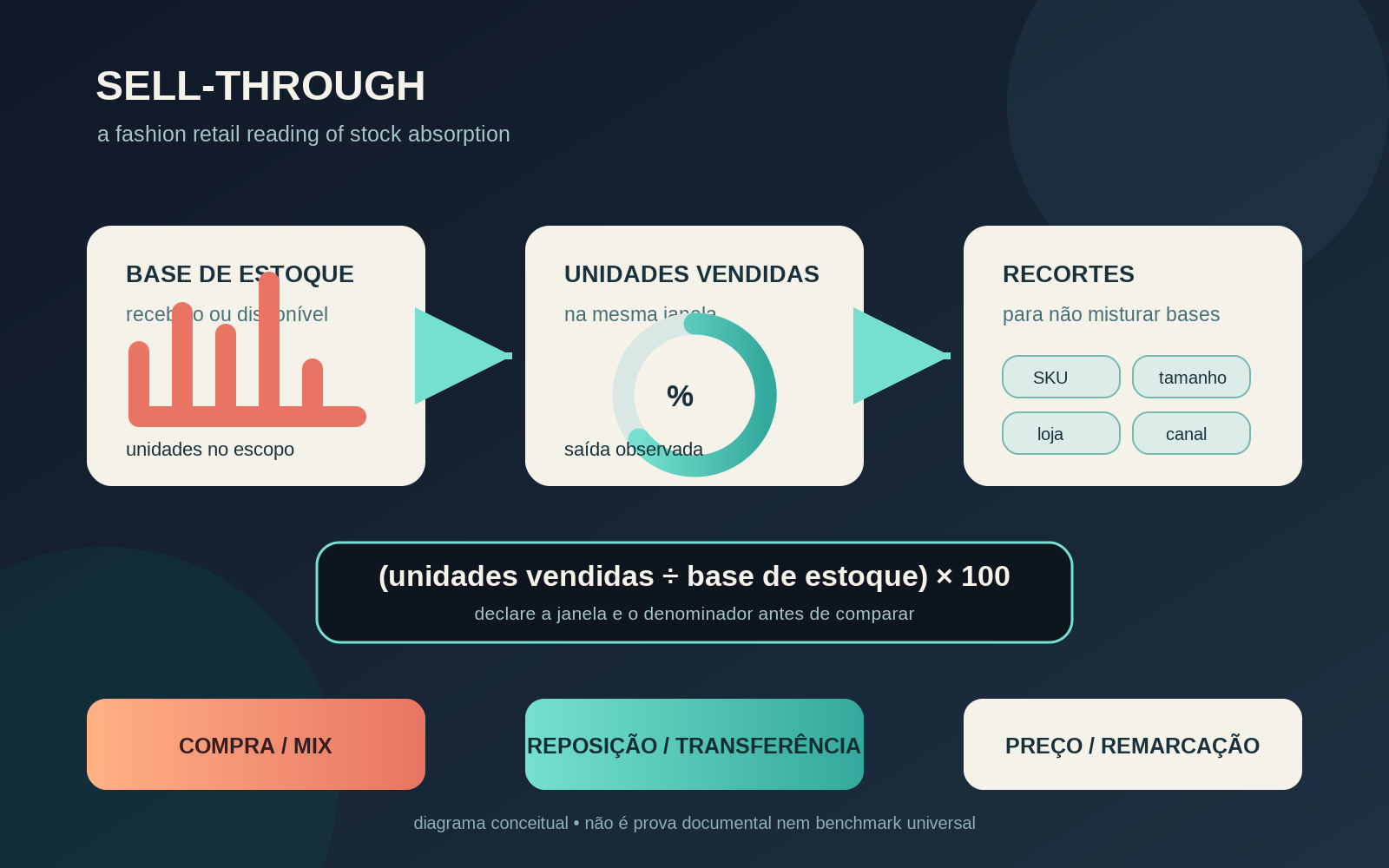
Sell-through in fashion retail. Sell-through is the percentage of units sold from inventory received or made available within a defined window. In fashion retail, the metric becomes useful when it is cut by style, color, size, store, channel, and product life cycle, with the denominator stated before it informs buying, replenishment, or markdown decisions.
Fashion retail markdown
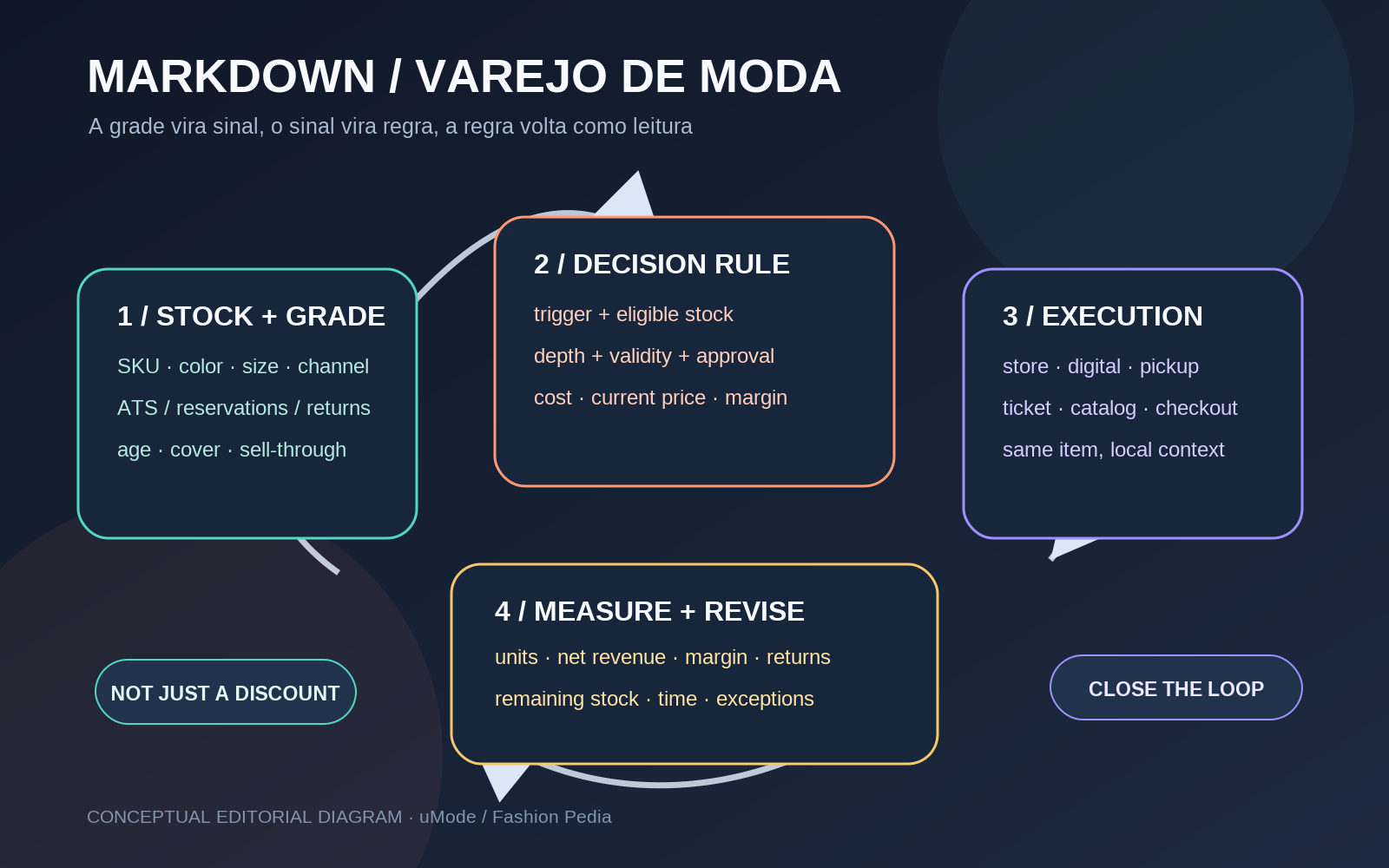
Fashion retail markdown is a controlled price reduction applied to a defined product, location, and channel to move stock while preserving visibility into size availability and margin. The process starts with sellable inventory and sales signals, applies a documented rule, and measures the result rather than treating a new ticket price as the result itself.
Inventory turnover
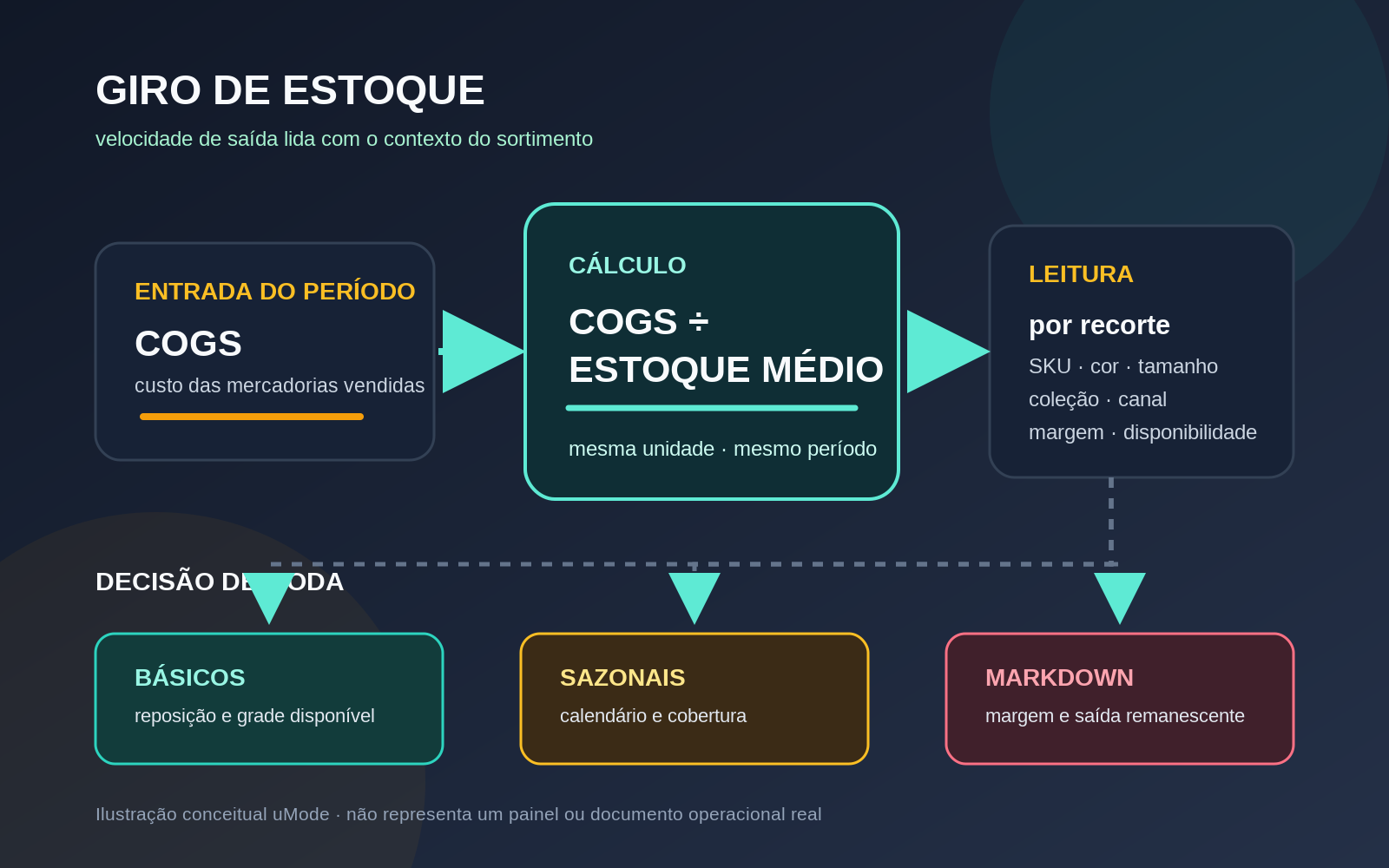
Inventory turnover is the ratio of cost of goods sold to average inventory over a defined period. In fashion retail, it must be read by product, collection, and channel alongside availability, margin, coverage, and markdowns, because speed of movement does not explain assortment quality on its own.
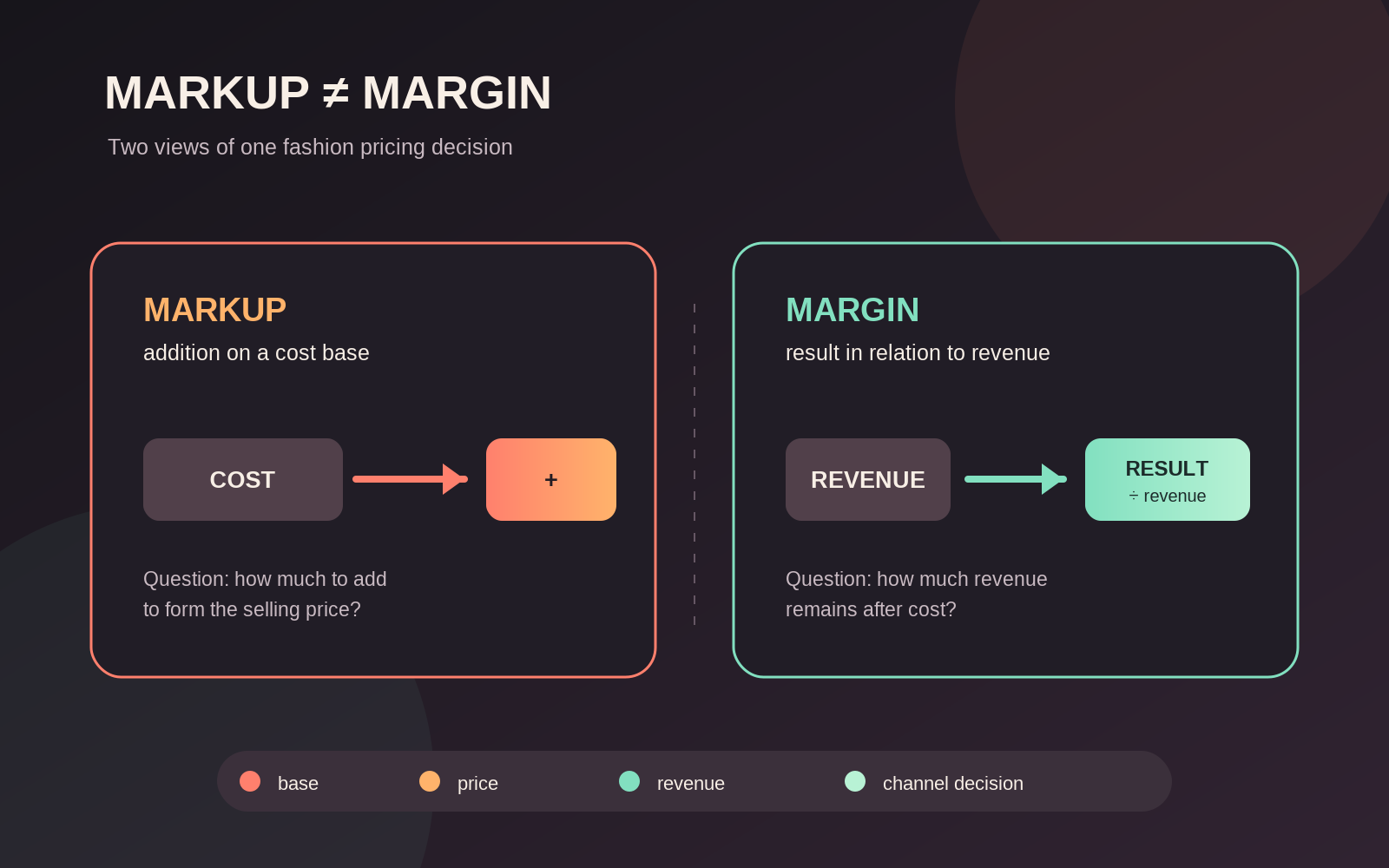
Markup and margin in fashion
Markup and margin in fashion. Markup is the amount added to cost to form a selling price; margin is the share of revenue left after cost. In fashion, keeping the two bases separate makes price, cost, discount, and result comparisons more reliable.
ABC analysis in fashion: what it is and how to do it for inventory
Sort the items, calculate the cumulative values and separate classes A, B and C to decide where fashion inventory control needs to be firmer.
Sources
- https://concla.ibge.gov.br/busca-online-cnae.html?subclasse=4781400&tipo=cnae&versao=10.1.0&view=subclasse
- https://www.udesc.br/arquivos/ceart/id_cpmenu/10685/E_book_Indicadores_de_varejo_de_vestu_rio_16130812325317_10685.pdf
- https://www.oracle.com/retail/merchandising/
- https://canal.cecierj.edu.br/012016/08fa8c9ed5c81c6739a277e3b40a386b.pdf
Want to apply this to your operation?