The rise of Uniqlo: why the Japanese brand could overtake Zara in 5 years
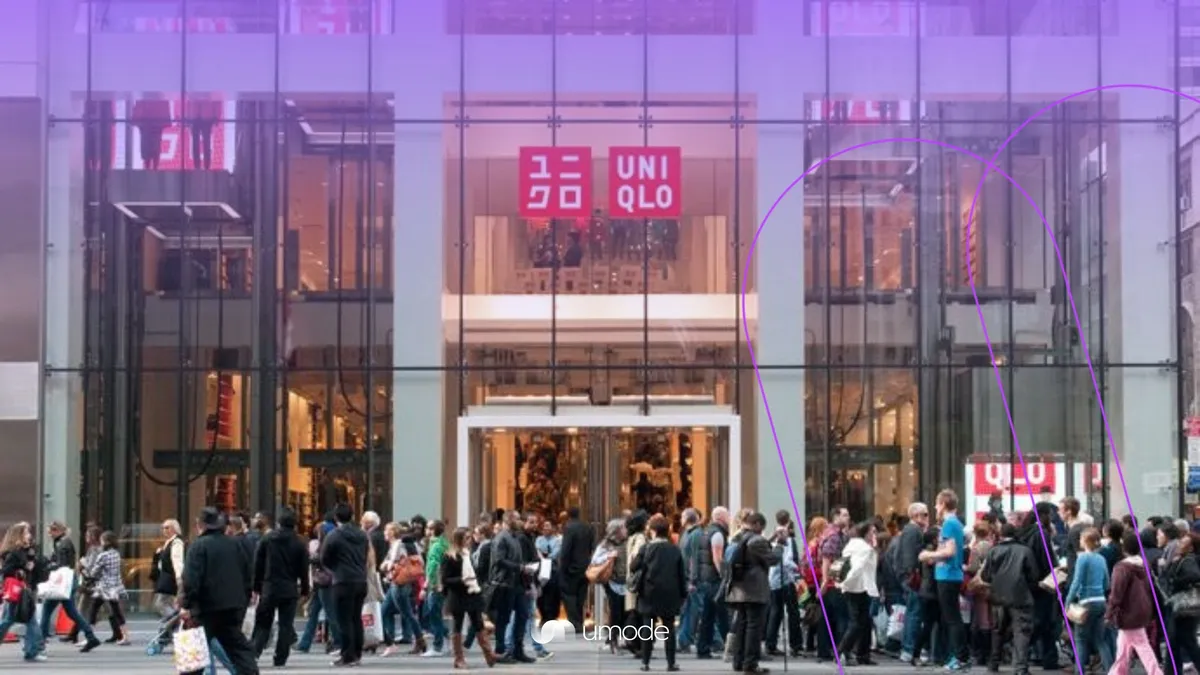
The forecast changing the global retail landscape
The fashion world is about to witness a seismic shift. A detailed analysis of the latest financial and strategic data indicates that Uniqlo is positioned to overtake Zara as the global fast fashion leader within five years. This bold forecast rests on four strategic pillars that are redefining the future of fashion retail.
The power of math: Uniqlo's exponential growth
A different speed of growth
The numbers do not lie. While Zara grows at a rate of 7.46% a year, Uniqlo posted impressive growth of 12.2% in fiscal year 2024, effectively growing almost twice as fast as its Spanish rival. This seemingly small mathematical difference turns into an exponential competitive advantage over time.
Fast Retailing, the group that owns Uniqlo, reported record revenue of US$20.7 billion in 2024, with prospects of reaching US$22.73 billion in 2025. In contrast, Inditex, the owner of Zara, shows signs of slowing down, with growth falling to just 4% in the first quarter of 2025.
Market share momentum
Uniqlo experienced a notable jump in market share, growing from 4.8% to 7.3% in the overall market, while Zara lost 3% of its share in the same period. Even more impressive is the performance among Generation Z consumers, where Uniqlo jumped from 8.9% to 12.8%, while Zara practically stagnated in this segment that is key for the future.
The geographic advantage: unexplored territories
Expansion potential versus saturation
Although Zara is present in 96 countries, operating about 1,811 stores worldwide, Uniqlo has only 2,546 stores in 23 to 25 countries. This apparent disadvantage is actually the Japanese brand's biggest strategic opportunity.
Uniqlo's complete absence from South America represents an entirely untouched market with more than 430 million potential consumers. Academic studies have already identified Brazil as a priority market for Uniqlo's expansion, highlighting the tropical climate, young population and growing middle class as favorable factors.
Accelerated expansion in key markets
Uniqlo is accelerating its expansion in North America, with plans for 200 stores by 2027, up from the current 103 stores. In Europe, the brand opened stores in new markets such as Poland and expanded its presence in cities such as Amsterdam and Rome.
Demographics and inclusion: the LifeWear strategy versus fast fashion
Democratic versus elitist philosophy
The fundamental difference between the brands lies in their target audience philosophies. Zara traditionally focuses on fashionistas aged 18 to 40 with a more adult, higher social class profile, while Uniqlo defines itself as a LifeWear company, seeking to serve anyone, of any ethnicity and social class.
Tadashi Yanai, chairman of Uniqlo, stresses: "We do not follow trends. People mistakenly say Uniqlo is a fast fashion brand. We are not. We are about clothes made for everyone." This inclusive philosophy opens exponentially larger markets than Zara's segmented approach.
Timeless products versus ephemeral trends
While Zara races to deliver the news of fashion week as fast as possible through its ultra-fast supply chain, Uniqlo invests in being as technological as possible, developing timeless products with very high technology.
Technology revolution: the decisive difference
RFID innovation and automatic checkout
Uniqlo has globally implemented the most advanced automatic checkout system in the world, using RFID technology that lets customers finish purchases in just 3 seconds. Consumers simply place their items in a basket, and the system automatically reads all the RFID tags, shows the total and processes the payment.
This revolutionary technology not only cut checkout time by 50%, but also delivered 97% inventory accuracy and tripled storage efficiency. As one consumer commented on social media: "It was magic, I expected checkout to be hell and it was magic."
Uniqlo as a technology company
Tadashi Yanai states categorically that "Uniqlo is not a fashion company, it is a technology company." This technology identity shows in innovative products such as HeatTech and AIRism, which combine technology with fashion to meet consumers' diverse needs.
Zara's challenges and opportunities
Signs of slowdown
Zara faces slowing growth, with revenue rising only 4% in Q1 2025 compared with 11% the year before. CEO Óscar García Maceiras expressed caution about the uncertain environment, citing US tariffs as the main concern.
Saturation of mature markets
With an established presence in 96 countries, Zara faces saturation in key markets, while Uniqlo has vast territories left to expand into. Zara's fast fashion strategy, although historically successful, is losing appeal among more conscious consumers who value quality and durability.
The future: five years to change
Growth projections
With Uniqlo growing at twice Zara's speed and expanding aggressively into new markets, the mathematical projections point to a convergence of revenues between 2028 and 2030. Uniqlo's entry into South America alone could add billions in annual revenue.
Generational shift
Uniqlo's growing dominance among Generation Z, the future of consumption, points to a fundamental change in consumer preferences. This generation values functionality, technology and inclusion over passing trends.
Conclusion: the quiet revolution
The rise of Uniqlo is more than a simple change of leadership in the fashion market. It is a philosophical revolution that puts technology over trends, inclusion over exclusivity, and functionality over ephemeral fashion.
The four reasons presented, superior mathematical growth, unexplored geographic potential, an inclusive demographic strategy and a decisive technological advantage, converge on a scenario where Uniqlo not only can, but probably will, overtake Zara in the next five years.
This transformation marks the end of the traditional fast fashion era and the start of the LifeWear era, where technology, sustainability and inclusion define the future of global retail. Uniqlo is not just growing: it is completely redefining what it means to be a fashion company in the 21st century.
Want to apply this to your operation?