PLM and ERP integration without retyping: the dashboard that shows what got blocked
PLM and ERP integration is the automatic passing of product data from one system to the other, so that the registration made in development arrives ready in operations. When it does not exist, someone retypes: the product approved on Thursday becomes a spreadsheet on Friday, and on Monday the ERP receives a code with a swapped measurement.
The person in charge of registration copies field by field, checks from memory and hopes none was skipped. When the error shows up, nobody knows where it was born: in development, in the spreadsheet or in the typing.
On the uMode platform, writing to the ERP is a configured flow, with a dashboard that shows the state of each submission.
How does the submission reach the ERP?
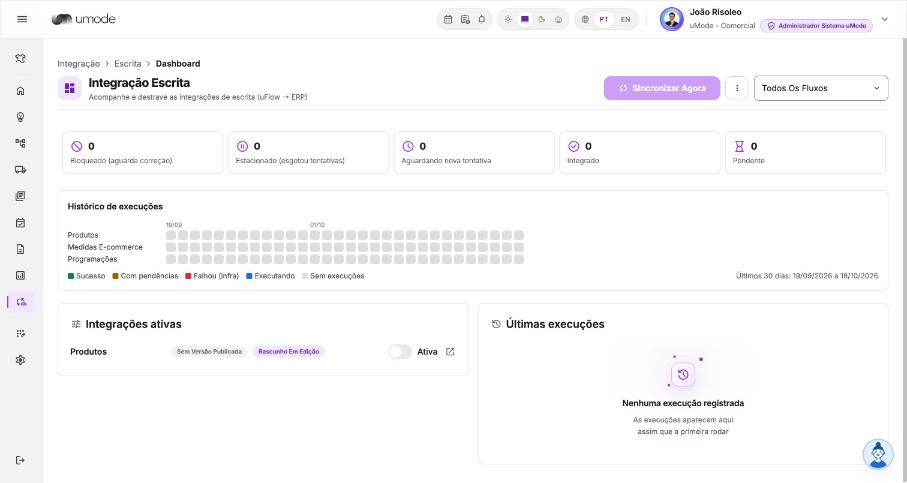
In the Integração (Integration) module, the Escrita (Write) area takes data from the platform to the ERP. The write Dashboard opens with a direct sentence: track the write integrations. A button, Sincronizar Agora (Sync Now), triggers the submission immediately, and a filter lets you look at all flows or one at a time.
At the very top there are five counters, and each one answers a question the team asks every day:
| Counter | Question it answers |
|---|---|
| Blocked | What is waiting for a fix before moving on |
| Parked | What has used up its attempts |
| Awaiting retry | What the platform will send again |
| Integrated | What has already reached the ERP |
| Pending | What is still waiting its turn |
How do you follow the history?
Below the counters, the Execution history organizes the last 30 days in a grid, with one row for each flow, such as Products, E-commerce Measurements and Schedules. Each small square is a day, and the color tells the result: success, with pending items, failed due to infrastructure, running or no runs. A red day stands out in the grid and leads straight to the right question.
Further down, the Active integrations block lists each flow with a switch to turn it on or off and indicates whether it has a published version or a draft being edited. Next to it, Latest executions shows the record of each run as soon as it happens.
What changes for those who register and those who operate?
For those who register, the origin of the data changes: it is written once, on the platform, and goes to the ERP without passing through a spreadsheet. Retyping disappears, and with it the most common source of divergence between the two systems.
For those who operate, visibility changes. A blocked item appears in the counter as awaiting correction, instead of vanishing silently, and the team fixes it at the source. What has used up its attempts is kept separate from what will still be resent, and the support conversation starts from a number, not a guess.
For those who coordinate, confidence changes. The history shows whether the integration ran every day and in which flows, which makes the conversation with the technology area shorter.
Integration also has its conceptual side, because each system has a role. The Fashionpedia entry on ERP, PLM and PIM explains what each one stores and where each one's responsibility ends.
Data typed twice is wrong data waiting to show up.
Want to apply this to your operation?